Showing posts with label Tom Corbett. Show all posts

Wednesday, November 5, 2014

Democracy's Death of a Thousand Cuts

It was Election Day yesterday, so naturally, I was sitting on my couch binge-watching my favorite program on Netflix.

It had not been a conscious decision -- to avoid election-related information on Election Day.

Rather, it was just that I knew I didn't have to be at work until 4 p.m., and so why not take advantage of having the house to myself?

But then I made the mistake of turning on the radio while I did the dishes, and something the host of program I was listening to said, made me pause.

He said something about hating elections and I realized, to my dismay, he was absolutely right.

I hate what elections are now in America, and, I'm not alone in suspecting, most Americans do as well.

Its not hard to find someone reminding us on Election Day about the sacrifices made by our troops over the years to secure and maintain the right to vote.

And they're right, they have.

And yet, we're more willing to put a yellow ribbon on our truck to honor that sacrifice than we are to exercise the vote they died to protect.

Not to worry, this is not a sanctimonious lecture about how we're all failing American democracy -- we are, that's a given at this point -- but more a rumination on why.

I have this James Madison quote taped to my computer screen at work, and I look at it every day: 
I believe there are more instances of the abridgement of freedom of the people by gradual and silent encroachments by those in power than by violent and sudden usurpations.
It's not quite on point, but it does catch the flavor of what I think is happening to us.

In fact, sometimes I think the single best way to increase voter participation would be to introduce a bill to eliminate it completely (I mean it's not as if they're using it), to force people to fight for it.

But it's not worth the risk, given the tepid response America has had to the "Voter ID" craze, an attempt in the name of democracy, to make it harder to vote, rather than easier.

Many blame the obvious villain. 

But it's not the media, or at least not the media in the traditional sense that most of us mean. 

As I pointed out in a Facebook rant several weeks back, the real tradition is American journalism is one of rank partisanship. It was there in the beginning even as it experiences a renaissance today.

The tradition of impartiality in journalism is relatively recent in the long view and those who bemoan our current state of news coverage and harken back for a simpler time would be amazed and disgusted at what passed for journalism in the time of the founding fathers. 

Nevertheless, quotes from Jefferson about preferring newspapers to government notwithstanding, the founders did see them as necessary, not because they were beacons of impartial truth; but because it was at least some way to get out a message about policy and information to a larger nation than democracy had ever been tried in before.

That's why they allowed newspapers to pass through the mails free of charge.

It was an imperfect system, but it was all they had.

Still, despite partisan and outright false newspaper reporting similar to what we have today, Americans still turned out for elections in droves in generations past.

Election Days of the past were marked by parades, riots, free beer, all for the purposes of gathering support at the polls. No, not the best environment for considered decision making, but let's remember the state of public education until the last century.

So if it isn't a partisan media, why don't we vote in large numbers anymore, particularly in the lower level elections which have such a disproportionately larger impact on our lives?

(Perhaps the exception in Pennsylvania proves the point. It's no accident that the governor's race will pivot almost entirely on the issue of public school funding, because voters have experienced it first-hand. When was the last time THAT was the major issue?)

Well, allow me to contradict myself now and say the media is certainly to blame, at least in part, for this voter malaise, to channel the spirit of President Carter

And by that I mean the media in the sense of advertisements, mailers, relentless e-mails and robo-calls and, yes, partisan television and web sites.

Remember, for the most part, this media is not reporting so much as passing along paid messages, messages paid for by the candidates or supporters. The media is merely the medium by which they are brought to your doorstep.

And, I think that's because those media vehicles work best in conveying symbols and simple messages. 

It's no accident that the term "optics" was born in Washington, and no one speaks to a camera in front of a lecturn anymore without the message of the day prominently and repeatedly splashed across the backdrop.

So in one sense, my journalism professors were right. "The medium IS the message."

But, like everything, it's not that simple.

My father often boasts that his single biggest responsibility in raising children was to teach them irony. He did that well.

I, on the other hand, spend a lot of time reinforcing in my son the idea of nuance, of complexity, of an outright rejection of the view that, with several obvious exceptions, everything can be seen as black and white, right and wrong, us and them.

We have complex problems. I doubt simple solutions will solve them.

So, in arguing for nuance, let's take this governor's race. 

I'll reveal a secret that's not hard to guess and say I voted for Tom Wolf, but even that's not entirely correct. 

I voted mostly against Tom Corbett, in much the same what that I did not vote FOR John Kerry, so much as AGAINST George W. Bush.

To further the cause of complexity, I will also tell you that I cast my vote yesterday despite the fact that I agree with Gov. Corbett on at least one major issue, the issue of public pensions. 

I agree, more pointedly, with the idea that reform is needed and that without reform, our public school budgets will continue to explode to pay for things that have nothing to do with educating the current crop of children.

But, having had the luxury denied most voters and having interviewed Gov. Corbett several times, I was pretty convinced he was not a skilled enough negotiator to successfully carry out meaningful reform. And despite his attempts to convince the public to the contrary, his undermining of public education was too extreme and too brazen to earn my vote.

And so I voted for Tom Wolf, even though I don't know very much about Tom Wolf, and that makes me nervous. 

I tried to be an informed voter. I went on his web site looking for his positions on pensions and how he would improve funding and results for public education, and what I found mostly was a list of things he would NOT do, and some vague assertions.

And so I pushed the voting button yesterday with very little hope that public pensions will be dealt with in any kind of comprehensive and fair way in the next four years, and that I will continue to write news articles quoting school district business managers talking about how much local tax money will be diverted to PSERS instead of classrooms.

And so I don't wonder if my experience wasn't duplicated, will thousands of local variations, a million times all over the country yesterday.

Those who did vote, whether in national or state elections, doing so listlessly, more as a civic duty than with any enthusiasm for a particular candidate or, even more pointedly, their program of solutions.

Voting, it seems to me, has become like going to the dentist. We do it because we should, not because we're excited about what's involved.

And, like the dentist, voting has become expensive.

Money, for the most part, decides elections but I am heartbroken at what that money buys, at the messages on which that money is spent

But the politicians and operatives don't do it to be undermine democracy. They do it because it works.

The simple truth is Americans don't have the attention span for the kind of detailed, comprehensive and issue-oriented campaign we all pretend we want.

And that brings is right back to us.

Again.

We could choose to ignore political ads and educate ourselves about candidates.

But we don't.

We could choose to go to the polls despite the fact that none of the candidates seem to possess many redeeming qualities.

But, increasingly, we don't.

We could even vote for third-party candidates in great numbers, just to shake things up and maybe put a scare into the two big parties and bring about the change we say we all crave.

But we don't.

Instead, we choose to do exactly what the pollsters say we will do and that which we say we abhor.

If we vote at all, we make decisions based on "gut feelings," on "optics," on, like I did, which of the candidates is the lesser of two evils.

And we blame the politicians, and the political operatives, and the Supreme Court Justices who have unleashed this idiocy even more fervently further into our living rooms.

And we should blame them.

And we hate them for it.

But I think we also hate ourselves for it as well; for accepting that this is just how things are, that there's nothing we can do about it, that one of us, or some of us or (dare I say it?) all of us, standing up and demanding something better, supporting something better, encouraging something or someone better would not make a difference.

And because we hate ourselves for our collective failure, we avoid the thing that reminds of us of that failure within ourselves -- the voting booth -- and so that failure is compounded.

It is a failure driven not, as it turns out, by violent usurpations, as Madison put it and partisan e-mails would try to convince us, but by slow, creeping "gradual and silent encroachments," each too small to cause a rise in us, to warrant a call to arms (or the ballot box) but collectively burying us over time in cynicism, indifference and inaction.

Happy Election Day.

Saturday, September 14, 2013

This Saturday in Underwater Science

Photo stolen from NPR
The Blob Fish.
Yuck.
Well we had a choice as we prepared this week's science entry and Mercury Police Reporter Caroline Sweeney made the decision.

Caroline Sweeney

(She hates this photo)
Offered science news about space or about water, she chose water and so don't blame us if you find this post to be all wet, or you're grossed out by the picture posted above.

It's there to grab your attention.

And so we begin with something truly ugly -- so ugly in fact that it has actually been voted most ugly by the Ugly Animal Preservation Society.

There really is such a thing.

Who knew?

Anyway, for reasons clear only to them, the society decided to hold an on-line contest to determine the world's ugliest animal and the blob fish, a native of very deep waters off Australia, won for obvious reasons.

Our thanks(?) to National Public Radio's web site for bringing it to our attention.

Seriously, yuck.
Graphic stolen from the Washington Post


While we're spending time on things you may find in deep water, we bring you now to the world's largest volcano which is, you guessed it, deep underwater.

Called "Tamu Massif," it too lives in the deep waters of the Pacific Ocean and was only recently discovered, according to this article in The Washington Post.

And, in case you were wondering why the word "massif" is in its name, it's because its friggin MASSIVE.

Up until now, Mauna Loa, one of the five volcanoes that comprises the big island of Hawaii, was the world's largest.

But Tamu Massif has a footprint the size of New Mexico!

Tamu, by the way, is an abbreviation for Texas A. & M. University, the home school of the scientists who discovered it. Figures, its discovered by Texans, who are always bragging about how everything in Texas is big.

"The area covered by the newly discovered volcano rivals the biggest volcano in the solar system, Olympus Mons on Mars," the Post reported. (See how I snuck a little space reference in there anyway?)

"Olympus Mons is the 800-pound gorilla of the solar system," said geophysicist William W. Sager of the University of Houston, the study’s lead author. "We didn’t know these massive volcanoes were here on Earth."

However, before we get all braggy about it, turns out Tamu is broad, but short.

Although Tamu Massif has a gigantic footprint, it is relatively short compared with Olympus Mons. The newly discovered volcano rises only a few miles above the seafloor, while the Martian mountain rises 16 miles at its peak.

Most importantly, scientists say there is little chance it will erupt.

Having visited ugly fish, let's visit some dead fish, thousands of them.

A resident of Wuhan, China, cleared dead fish from the Fu River

They were killed in a river in China because they had the misfortune of being downstream of a chemical plant there.

"Environmental protection officials said tests on water taken from the Fu River upstream from the metropolis of Wuhan revealed that extremely high levels of ammonia in the water were caused by pollution from a plant owned by the Hubei Shuanghuan Science and Technology Company," The New York Times reported in this Sept. 4 article.

The plant produces sodium carbonate, used in making glass, and ammonium chloride for fertilizer, according to local news media reports. It has been cited for environmental violations four times since 2008, said Ma Jun, director of the Institute of Public and Environmental Affairs, a Chinese nongovernmental organization that tracks air and water pollution.

The Fu River flows into the Yangtze, China’s longest river and the source of drinking water for millions. Spills into the Yangtze and its tributaries remain a continuing problem despite huge investments in reducing pollution, Mr. Ma said.

China’s Ministry of Environmental Protection said water pollution was a serious concern, with industrial spills, farm runoff and untreated sewage all factors in degrading water quality. As of last year, nearly a third of the sections of major rivers it monitored were so degraded that the water was unfit for human contact, the ministry said in its annual State of Environmental Quality report, released in June.

Now, just in case you're shaking your head thinking that China needs to get its act together  before it pollutes all its drinking water, we would warn you to look in the mirror first.

A drilling rig used to extract natural gas from the Marcellus Shale in Washington County, Pa. (The Associated Press)


Two years ago, The New York Times revealed that conventional wastewater treatment plants are poorly equipped to deal with the often toxic outflow from Marcellus shale drilling operations.

But in June, as reported by NPR's State Impact team, the state’s Independent Regulatory Review Commission, approved new water quality standards for pollutants like strontium. But chloride and sulfates were not included in the more than 100-page revision.

Prepare to be shocked, but apparently the industries that would have been affected by the regulation didn't want it. And so, it didn't happen.
Pennsylvania’s Department of Environmental Protection had originally proposed adding
chloride, sulfates, and a chemical known as molybdenum, to the state’s water quality standards.
But opposition came from miners of molybdenum, the coal industry, and the natural gas industry. Coal mining, along with other industries, generates sulfate discharges. Molybdenum is a heavy metal mined for use in steel and cast iron.
Despite efforts by environmental groups concerned about increased natural gas drilling activity, and resulting discharges of chloride, the DEP withdrew the chloride from the original proposal.
In 2011, the gas drilling industry agreed to stop sending its wastewater to the plants, but apparently (who knows how....) some of the pollutants are ending up in rivers and streams in Pennsylvania anyway.

Most conventional sewage treatment plants, like this one in
McKeesport, 
cannot handle wastewater from
natural gas 'fracking.'
And even though the gas industry in Pennsylvania says it operates in "zero discharge mode," it nonetheless opposed the regulations that should have had no effect on its operations. Hmmmmm.

As State Impact's Susan Phillips reported, "that wastewater has a high salt content. In it’s original proposal, DEP pointed to increased oil and gas production as a reason to establish standards for chloride, describing its potential impacts on aquatic life."

The Pennsylvania Department of Environmental Protection wrote "freshwater fish and aquatic communities cannot survive in elevated concentrations of chlorides. Maintaining a proper salt-to-water balance in a fresh water environment challenges most aquatic life and, in particular, aquatic insects."

But maybe there's hope still in Pennsylvania.

The on-line version of the Harrisburg Patriot-News reported Thursday that: "Attorney General Kathleen Kane on Tuesday afternoon filed criminal charges against a Pennsylvania subsidiary of ExxonMobil for illegally discharging more than 50,000 gallons of toxic wastewater from a Marcellus Shale gas well site in Penn Township, Lycoming County.
"

One can't help but wonder if former attorney general Tom Corbett, who has received thousands in campaign contributions from this industry, would have made that case.... 


But before we get all conspiracy theory on you, let's not forget that sometimes we are a danger to aquatic life just because we're stupid.

Hawaii News Now - KGMB and KHNL
Case in point, NPR reported Thursday that 233,000 gallons of molasses that were spilled into Honolulu harbor on Monday, literally killing everything.

KGMB TV sent diver Roger White into the water to see what's happened to sea creatures there. He shot video and came back to say that:
"It was shocking because the entire bottom is covered with dead fish. Small fish, crabs, mole crabs, eels. Every type of fish that you don't usually see, but now they're dead. Now they're just laying there. Every single thing is dead. We're talking in the hundreds, thousands. I didn't see one single living thing underwater."

Why is the molasses causing so much damage? In an earlier report, Hawaii News Now:
A crab suffocated from a massive molasses spill in
Honolulu harbor.
"... did an experiment to see why molasses is so hazardous to fish. When we poured store bought Molasses into a vase of water we collected from Keehi Lagoon, the concentrated sugary substance went straight to the bottom.
"Unlike an oil spill, which can be cleaned by skimming the surface, the molasses quickly disperses to the deepest points. 'It's sucking up all the oxygen,' explained [state reef biologist Dave] Gulko. 'There's no oxygen at depth so the animals that need it can't get it and are suffocating.' "
You can see why its called a "Snakehead."


And, because no scientific post involving water on this blog is complete without news of our favorite "Frankenfish," we bring you now the latest news of the Snakehead, an invasive fish from China that, according to some stories, can do everything but advanced algebra.

In addition to being a voracious predator that can crowd out indigenous species, now, it turns out, it can also carry diseases that will kill its competitors but leave the Snakehead feeling dandy.

Last month, the Washington Post reported on an announcement from "the U.S. Geological Survey that Northern snakeheads in the Potomac River have apparently contracted a virus that is known to cause massive kills among largemouth bass."
It is possible that snakeheads could be reservoirs of the virus and pass it to bass throughout the Chesapeake Bay watershed.
So far, the virus has been detected in bass, sunfish and other species, the USGS said, but only largemouth bass have developed a disease as a result. Most bass who contract it are otherwise fine, but some have trouble submerging and are forced to float on the surface.

Sunday, January 27, 2013

Pennsylvania Embracing Failure

Albert Einstein is perhaps our most famous
theorist. Turns 
out, the evidence has proven
him right. Win.
Lately, I have begun to espouse a new philosophy which is distinctly non-philosophical -- "show me that it works."

Both liberalism and conservatism are replete with theories about the way we should live and run our governments and our societies.

Some theories -- trickle-down economics for example -- have lived long beyond the time they should have been abandoned for the simple reason that have failed to produce the results they promised.

(For my entire adult life, I've been waiting for tax cuts for millionaires to ensure me a comfortable middle class lifestyle. Next.)

Failure of this theory is no joke.
Perhaps nowhere is theory more prevalent these days than in the field of education.

And so, although dubious, I was willing to give school choice a chance under the rubric that if it works, let's go with it.

After all, as someone who is the product of public schools, has a child in public schools and reports on traditional public schools on a daily basis, it was hard to argue that public schools don't have their problems.

The answer to those problems, we were told, was a new beginning; charter schools; cyber-charter schools; vouchers; starting from scratch.

Although I've always believed its better to fix the car than to buy a whole new car, I acknowledge that sometimes the car can't be fixed, or that fixing it would cost more than the value of the car itself.

So OK school choice, show me this works.

Fail.

As traditional public education advocates have been shouting from the roof tops for the past week or so, newly re-calculated test results that actually compare apples to apples between charter, cyber-charter and traditional public schools show that fewer than 30 percent of charter schools meet national benchmarks.

By way of comparison, at least 50 percent of traditional public schools run by districts met the benchmarks.

Don't get me wrong, I'm no advocate for standardized tests being the only barometer of school effectiveness. They should be a part of a larger assessment.

But its the school choice people who have shoved those test scores in our face as evidence that traditional schools are failing and who used the skewed results as evidence of their success.

Ooops.

So what's good for the goose is good for the charter school I say.

Remember, the state slapped Pottstown High School with the dubious honor of being a "failing school" for missing one math benchmark and otherwise having grades much better than most charters and ALL cyber-charters.

The 'level playing field' Pennsylvania envisioned for

comparing traditional public schools and charter schools.
Surely, in the interest of "the level playing field" we all claim to want, that label will now be carefully applied to all 12 of Pennsylvania's cyber-charter schools, none of which made the "Adequate Yearly Progress" required under the federal No Child Left Behind Law.

Surely, in the interest of providing parents with as much information as possible to make informed choices, that label will now be slapped on the 61 percent of the 80 brick-and-mortar charter schools that did not make AYP.

Surely you're joking.

This is Pennsylvania people.

Consider that the reason those scores are new, is that until the feds stepped in and said no, Pennsylvania had one way of calculating scores for charter schools and a whole different (much harsher) way of calculating them for traditional public schools.

In other words, as I wrote about in August, there was a double standard.

Shocking I know.

"How could this happen?" You ask.

It's Pennsylvania people.

The better question to ask is how could it not happen?

Charles Zogby talks about Pennsylvania's pension crisis
during a meeting with Digital First Media journalists on Jan. 10.
Well, however it happened in the Byzantine halls of Harrisburg, I feel confident in the belief that just because former Secretary of Education Charles Zogby was subsequently a highly paid executive with a for-profit company with ties to the largest of Pennsylvania's cyber charter schools in no way ensured that a way would be found to make those companies look good and attract more investment.

Because that would be wrong.

By way of a little history, Zobgy served as education secretary under Republican governors Ridge and Schweiker from 2001 to 2003, and as the Director of Governor Ridge's Policy Office from 1995 to 2001.

Before returning to government service as Tom Corbett's budget secretary, a happy coincidence if ever there was one, Zogby, served as the Senior Vice President of Education and Policy for K12 Inc.

That for-profit company is an online school curriculum developer and provider with ties to Pennsylvania Virtual Academy and Agora, two of Pennsylvania's largest cyber charters.

This makes K12 seem like a perfectly nice company.
In July, K12 Inc. offices were raided by federal agents and the firm is also under investigation on Wall Street for lying to investors and in Florida for using non-certified teachers.

Surely, given the lobbying, the money, the poor performance, one would think it's time for some detailed examination of this school choice experiment.

Surely, given that not a single cyber-charter school demonstrated adequate effectiveness in educating our students to a state-wide standard, we would have a halt on any new cyber-charter school applications until we could figure out how to do better.

Surely, I've mentioned this is Pennsylvania right?
More money, worse results?

Let's have more of that.

Well in Pennsylvania, when there's doubt about the effectiveness of an entity using public money to do a sub-standard job, we respond by saying: "let's have us some more of that."

Yup, in a move that strains credulity, Pennsylvania is now considering approval of eight new cyber charter schools.

That's a 50 percent increase in the investment of public money in a model now shown to be failing.

Not satisfied with that depressing statistic, see if you can guess who would be contracted to run one of these eight new cyber charter schools -- you guessed it, K12 Inc.

That's how we roll in the Keystone state.

This year, Pennsylvania taxpayers will spend about $400 million so that roughly 35,000 students can be taught through cyber charters instead of traditional public schools.

By 2017, we the taxpayers would be spending an additional $108.3 million to educate another 9,800 students in cyber schools if these new proposed cyber-charters are approved.

Talk about throwing good money after bad. 

Rhonda Brownstein
In their review of the Philadelphia School District's operations, the Boston Consulting Group described the quality of Pennsylvania's cybers as "notoriously low."
The consultants recommended that the district start its own online program to draw students back.
And Rhonda Brownstein of the Education Law Center wants a freeze on all new cyber charters.
"With all of the dismal academic performance, we think that the Pennsylvania Department of Education should slow down, take a look at what the problem is, and not go on to approve additional [cybers]," she said.
But, according to Newsworks, the Pennsylvania Department of Education is doing the exact opposite.

Carolyn Dumaresq, PA's deputy secretary of
education sees "value" in a schools model that
fails to meet standards 100% of the time.
After all, it is the Pennsylvania Department of Education.

It's not like its some non-partisan public entity dedicated to giving the Commonwealth's children the very best education for the lowest price.

So, Carolyn Dumaresq, Pennsylvania's deputy secretary of education, showed up at the hearings "touting the value of online options," according to the Newsworks report. 

Perhaps she went to a cyber-charter school herself. I'm having trouble understanding how more money and poorer results defines the word "value."

"The beauty of the cyber charter is that any child, anywhere in Pennsylvania can participate," said Dumaresq. "I think they serve a unique role in providing additional opportunities for students."

Which of course, brings us back to theories versus actual evidence in the real world; where the "opportunity" to participate in a failing enterprise from anywhere in the state, is a value greater than a public school where your chances of academic success are greater.

A decision on the new charters is expected tomorrow. Anyone want to bet they all get approved?


Corbett listens to a question from Phil Heron, right, the

editor of the Delaware County Daily Times during a Jan. 10

meeting with editorial staff from Digital First Media.
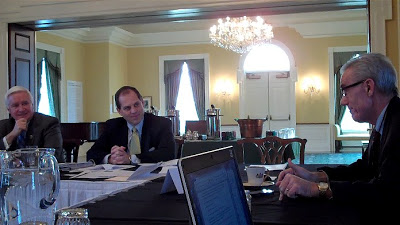
When I joined a group of Digital First Media editors and reporters to meet with Gov. Corbett so he could highlight the crisis of pensions in Pennsylvania (see today's Mercury for an in depth-analysis of that problem) I asked him about the results for school choice.

As I wrote in a Jan. 13 post, Corbett's affection for the theory allows him to by-pass the facts.

I started by asking him about the "voucher lite" program, that uses a business tax break to divert what would have been tax receipts that could have funded public schools (you'll remember them as the ones that are doing better than charter schools). Instead, the money goes to foundations that offer scholarships to private schools.

According to an analysis I did in August, by an overwhelming margin, the program favors schools with a religious affiliation.

So I asked Gov. Corbett if using the state to facilitate religious education bothered him.

"Are you asking me if I'm against school choice? No, I'm not against school choice. Competition is always good," Corbett replied, completely ignoring the question I had actually asked him.

When I pointed out, as we've shown here, that test scores at charter schools, cyber and otherwise, are in general worse than those in traditional public schools, he was untroubled.

Smiling, he said these experiments in choice are "just getting started" and will have to "do better."

Faith in the theory that "competition is always good" trumped evidence that this is not always the case.

I would have hoped that a former prosecutor would be more moved by evidence.

But that's just a theory.

After all, this is Pennsylvania.

Sunday, January 13, 2013

'Ello Guvnah

The governor's Mansion in Harrisburg.
I have now had the privilege of interviewing (or participating in an interview with) a Pennsylvania governor five times -- three times with Gov. Ed Rendell and twice with his successor and our current Gov. Tom Corbett -- in my 15 years with The Mercury.

Thursday, however, was the first time it took place in the Governor's official residence, OK, the Governor's Mansion, in Harrisburg.

It's an impressive building, built with native Pennsylvania brick, with a lovely view of the Susquehanna River, on whose eastern shore it sits.

An enthusiastic and surprisingly knowledgeable tour guide, Corbett took a group of Digital First Media journalists through much of the elegant downstairs, showing us various formal rooms as well as his office, paneled with dark wood and graced with a fireplace every-ready to be lit.

(While we appreciated his time and interest, I don't think I was alone in thinking that certainly he had better things to do than show us around, but he was very gracious, so we let the thought pass unconsidered.)

We were there not as tourists but as journalists from our Digital First Media group because Gov. Corbett wanted to talk about pension reform -- a subject of vital importance to Pennsylvania's economic and budgetary health.

PA Treasury Secretary Charles Zogby gave us an hour-long

briefing on the pension crisis.
The hour-long briefing from Treasury Secretary Charles Zogby on how we got to this point of crisis, which preceded the meeting with the governor, was welcome, well-organized and informative. What the crisis essentially boils down to is a series of short-sighted and selfish decisions made with a hefty pinch of extraordinarily bad timing.

I don't envy Corbett the job of being the person who has to clean up this mess, left largely by his predecessor and the collection of rocket scientists known as the Pennsylvania General Assembly.

(I'll be working on a story looking at that issue in greater detail in next Sunday's Mercury. In the meantime, if you can't wait, I recommend Saturday's article by Jennifer Lawson at The Reporter, who was among those there.)

But what I am musing about today is not that crisis, but how the interviews in which I have participated illustrate for me how both men, Ed Rendell and Tom Corbett, approach the job of being governor.

Delaware County Daily Time Editor Phil Heron, right, did a 

pretty good job of keeping Corbett, left, on topic.
No matter what you tell yourself when you lie awake the night before, thinking of all the ways you will grill the governor, you will always find that politicians, especially those good enough to get to the governor's post, have an agenda of their own in agreeing to an interview.

And how they pursue that agenda in an interview, their style, says a lot, to me at least, about how they do their job and why they like their job.

In Rendell's case, it was a mastery of numbers and facts.

Unless you cover state government as part of your every day beat, it was easy for Rendell to overwhelm you with details about a question asked which left you feeling unqualified to ask a follow-up -- a kind of obfuscating fog of facts which, paradoxically, can be used to conceal the truth if need be.

He rarely had to refer to a briefing paper, taking the numbers off the top of his head and then spinning out a scenario about what would happen to those numbers if....

He had equal mastery, necessary for any successful politician, for names.

A champion name-dropper, Rendell would go for the upper hand in an interview by saying something like "oh the real expert in that is Joe Jones, do you know him? No? Oh well you really should talk to him about this..."

Corbett, on the other hand, uses a skill set born, no doubt, of his years as a prosecutor, a profession built on asking questions, not answering them.

Also a former school teacher, albeit 40 years ago, Corbett often responds to a question by asking you one.

Nancy and I outside the governor's mansion Thursday.
For example, when my boss, Nancy March, asked a question about educational reforms, he responded with "have you read the report?"

She wisely, and truthfully, answered that she had, but one is left with the impression that if she had said no, Corbett would have suggested she do so before wasting his time by answering the question; or spent time explaining the report's contents rather than answering the direct question those contents inspired.

He also uses a classic tool of politicians by answering the question he wants to answer, not the one you asked.

In August, some of you may recall that I wrote an analysis of the new Opportunity Scholarship Program.

This program begins with the state labeling schools with low-test scores as "under-performing," Pottstown High School being one of them, and then funnels business tax money to non-profit foundations which, in turn, grant scholarships of a maximum of $5,000 to low-income students of those schools.

The businesses pay roughly the same they would in taxes, but into a foundation of their choice instead of the state coffers, which would then be tapped to fund public education.

My analysis of the schools accepting the scholarships, called "vouchers lite" by many, showed that nearly 90 percent of the participating schools had a religious affiliation.

So when I asked the governor if he felt having the state facilitate the movement of money that otherwise would have been tax receipts into religious institutions, he didn't bat an eye and instead answered a question he preferred.

"Are you asking me if I'm against school choice? No, I'm not against school choice. Competition is always good," he said.

This is, of course; not what I had asked him at all.

To my regret, I took that bait and asked him how school choice is benefiting children when those same test scores used to identify Pottstown High School as "under-performing," show that the "choices" at many charter schools, and cyber schools in particular, are no better than the public schools they are leaving.

He responded, no doubt with the troubled Chester-Upland schools in mind, that many of the new schools are safer and that the other schools are "just getting started" and will have to "do better."

And so we moved on.

With six journalists sitting at a table around a sitting governor, there is always another question on another topic.

But I have also come to the conclusion that unlike his predecessor, Corbett does not like doing too many things at the same time.

Rendell always had five or six irons in the fire. Some might say that's why everything he did was only half-done, and there is probably some truth in that.

But the opposite seems to be true of the current governor, who, as Phil Heron asked him, you would expect to be getting more done with his party controlling the governor's mansion, and both houses of the General Assembly.

As he said in response to questions about his latest Penn State bombshell, however, "I’m very cautious. When I know what I’m going to do, that’s when I announce it."

And he seems to approach other aspects of his job that way as well.

Only time will tell if its more effective.

Sunday, August 19, 2012

Double-Dips and Double Standards, the Farce that is School 'Competition' in Pennsylvania


I have to hand it to the newspapers in Pittsburgh.

They are really doing some excellent reporting on the difference between the two kinds of public schools in Pennsylvania -- the kind you and I attended and charter schools.

This first came to my intention through daily e-mails I must have signed up for somewhere along the way. They come from Lawrence Feinberg on behalf of the Keystone State Education Coalition and are a round-up of the day's coverage of education issues in Pennsylvania.

Their links are archived here.

The first article that caught my eye was in the July 13 edition of the Pittsburgh Tribune-Review and was coverage of a really dry subject that adds up to big public dollars.

Here are the first two paragraphs:
"Pennsylvania charter schools are reaping a multimillion-dollar, taxpayer-funded bonus on pension reimbursements at the expense of public school districts, a coalition of school groups contends.

The associations, representing urban and rural schools, school boards, business managers and administrators, say the state’s calculation for the tuition that districts must pay for charter school students requires them to pay double the amount they should for employee pensions."
Public schools and charter schools alike both pay 50 percent of their state-sponsored pension costs, and the state pays the other 50 percent.

"But in addition, school districts must include the state and the local pension payments in their calculations for charter school tuition, a formula that theoretically provides charter schools with 150 percent of pension costs," reporter Debra Erdley wrote.

This is just one way that obscure funding formulas and non-existent oversight make for a skewed playing field in the "competition" between traditional public schools and charters -- particularly cyber-charter schools which receive the same "per student" tuition from school districts as regular charters which, like public schools, have buildings, heat, electricity, water and sewer and, usually, higher personnel costs to cover.


Not to be outdone by its cross-town rival, the Pittsburgh Post-Gazette has been doing some digging as well.

In addition to detailed coverage of the FBI investigation into entities with ties to Pennsylvania Cyber Charter School, the state's largest cyber charter operation, reporter Eleanor Chute filed this Aug. 12 objective report about the different rules that govern the two types of public schools.

The most recent and most blatant of these is the latest state requirement that student performance make up at least one-half the measurement for evaluating teacher performance.

That requirement, however, does not apply to charter schools where, by what I'm sure is pure coincidence, most teachers are not unionized.

Ira Weiss
Ira Weiss, solicitor for Pittsburgh Public Schools, told Chute he believes the current exemptions are so significant that it's like having two basketball teams, one with eight players and the other with 11.

"Everybody likes to talk about competition. Competition really means playing by the same rules," Mr. Weiss said.

"Various charter school proposals -- such as exclusion of charter school vendors from the state Right to Know Law, a commission to study funding and financial report requirements -- were debated up until the last minute when the state budget was passed in June and may surface again for debate next month," according to the Post-Gazette.

Exclusion from the state's Right to Know law is particularly worrisome and counter-intuitive to the cry for "accountability" from Harrisburg. Already given minimal oversight by the school districts which authorize them, charter schools of either type are spending public money to educate our students. Don't we have a right to know how that money is being spent?

Certainly the FBI investigation of Pennsylvania Charter's links suggests a close eye is needed, despite the efforts of some of the major players in the field.

Gov. Corbett with one of his most effective fund-raisers,
Vahan Gureghian, who also just happens to operate the state's
largest charter school and may try to open one in Pottstown.
One of Corbett's largest fundraisers, Vahan Gureghian, runs the state's largest brick and mortar charter school and has made overtures to open an operation in Pottstown.

Gureghian's Chester Community Charter School recently lost a years' long court battle with The Philadelphia Inquirer in which it fought a Right-To-Know request for salaries in the operation.

It should come as no surprise to Pennsylvanians that Tom Corbett's administration is friendly to charters. He has made no secret of it.


Pennsylvania's Budget Secretary, Charles Zogby served the commonwealth as the Secretary of Education under Governors Ridge and Schweiker from 2001 to 2003, and as the Director of Governor Ridge's Policy Office from 1995 to 2001.

Budget Secretary Charles Zogby was previously
a K12 Inc. executive.
But most recently, prior to his nomination, Zogby, served as the Senior Vice President of Education and Policy for K12 Inc, an online school curriculum developer and provider with ties to Pennsylvania Cyber Charter.

For those of a cynical nature, it's worth noting that the finances at K12 Inc. have raised a few eyebrows at the Post-Gazette as well.

The foxes truly are watching the hen house.

And, as an added bonus, researchers at National Education Policy Center at the University of Colorado recently reported that only 27.7 percent of K12 schools in the study met standards for adequate yearly progress, known as AYP, under the federal No Child Left Behind Act in 2010-11.

Again, this thanks to the Post-Gazette, the researchers said K12's scores were nearly identical to other full-time virtual schools operated by private education management organizations but below the estimated 52 percent of public schools as a whole making AYP that year.

So some virtual charter schools are falling away behind in AYP.

Surely, they too are on an "under-achieveing schools" list like the one to which Pottstown High School was just named.

Yes?

Anyone?

Nope.

In fact, as I understand the "voucher lite" program we've been writing about this month in The Mercury, a parent wanting to "save" their children from the failures at Pottstown High School could get a scholarship to send them to one of K12's schools, which are failing as badly or worse than Pottstown High School.

But given the absence of a similar state list for charter schools which are, you know, public schools too, how would a parent know this?

Why is this important? 

Statewide, charter school enrollment increased from 67,100 in 2007-08 to 105,000 in 2011-12. That enrollment jump is coupled with the elimination of $130 million in state reimbursements to districts for charter school costs, and pension costs that are expected to triple to $3.67 billion by 2015, the Trib reported.

 As as the state slices more and more out of public school funding, more and more of those schools are being declared "failed." Then state rules require local taxpayers to send more and more of their money to charter schools to handle more and more enrollment as the result of parents who understandably don't want their children going to "failing" schools.

Problem is, the rules that declare traditional public schools  as "failing" don't apply to the charters parents are sending their children to, which may be just as bad. You just don't know it because the people writing the rules, are people who have gained or stand to gain financially from increased charter school enrollment.

That's the American we live in today.

As more and more of our tax money gets funneled to charter schools, we need to know more about them, not less. And if they are to be held up as alternatives to traditional public schools, let's hold them to the same standards and rules as those public schools so apples can be compared to apples.

But cynics might argue this will never happen because too many important people are champions of this unfair contest not just for philosophical reasons, but for financial reasons.

Here are a few of the statistics the state likely will not go out of its way to tell you about those school alternatives to which we're supposed to be sending our children to save them from the "failures" like those at Pottstown High School They are courtesy of the Keystone State Education Coalition:
    • 2 of 12 -- Of 12 PA cyber charters only two made AYP for 2011, while eight were in corrective action status under No Child Left Behind and seven have never made AYP.
    • 18 -- Philadelphia charter schools are reportedly under federal investigation. Several charters have involvement of legislators, family members and staffers.
    • 100%.-- The 2011 Stanford/CREDO study found that in 100 percent of Pennsylvania cyber charters, students performed “significantly worse” in math and reading than students at traditional public schools.
    • $1,000 -- What it reportedly costs a home schooled student’s parents for online curriculum through a cyber charter school.
    • $9,000 -- What a representative school district is required to pay in tuition to a cyber charter for each regular education student. 
    • $0 -- What it would cost Pottstown taxpayers in borrowing to refurbish its elementary schools if not for the $1 million annual tuition paid to cyber charter schools. (That one courtesy of Superintendent Reed Lindley.)
    • $86 million -- taxpayer dollars. The PA Auditor General’s Office reported that taxpayers and school districts could have saved approximately $86 million in 2009-2010 if cybers received funding based on what they spent per student. Despite this and the fact that most cybers have never made AYP, the State’s response was to authorize seven more new cyber schools for 2012-2013. 
    • $384,000 -- in campaign contributions to Governor Corbett reported by Vahan Gureghian, whose management company runs the state’s largest brick and mortar charter school and has eyed Pottstown as possible location for another.
    • $1,320,653.69 -- Pennsylvania political contributions reported by Vahan Gureghian from 1/1/2007 through 5/31/11. Mr. Gureghian has been a strong proponent of legislation making it easier for new charter schools to be authorized by the state without the involvement of local school districts, who would still have to pay the bills. He has also filed and lost a lawsuit to keep his operation from being subject to the Right to Know Law. Public money for his schools, but no public oversight please.
    • "Follow the money" -- Deep Throat
    • $5 million -- taxpayer dollars: last year’s bonus to K-12 Inc.’s CEO Ron Packard. K-12’s Agora cyber charter has never made AYP. Prior to his appointment as PA Budget Secretary, Charles Zogby was a K-12 executive.
      So it turns out, that excellent advice "Deep Thorat" gave all those years ago in a dark Washington, D.C. parking garage to Bob Woodward still holds true -- Follow the money.

      That's what the Pittsburgh Post-Gazette did.

      Have look below and you'll see what they did -- if you can follow it.

      Sunday, July 15, 2012

      Voter ID Law is a Solution in Search of a Problem


      So for the moment, and only for the moment, let's set aside the politics.

      Let's say the real reason for the Republican Pennsylvania State Legislature and Gov. Corbett to enact a voter ID law is to prevent fraud.

      At least that was the reason they gave.

      It must be pretty bad.

      I'd like to have a look. Can anyone show me where it is? Where did it happen in large numbers? Where is this problem we're solving?

      The most recent answer to that question came under President George W. Bush, when the U.S. Justice Department conducted a five-year probe of voter fraud, ending in 2007.
      "These laws are the new Jim Crow laws of our times.”
      —Maryland Sen. Ben Cardin (D)

      Their net?  Eighty six convictions.

      Meanwhile, a recent Associated Press reports that 758,939 registered Pennsylvania voters do not have the most easily obtained and widely used photo ID, a state driver's license and so, may be unable to vote.

      In Montgomery County, it is estimated that almost 45,000 voters do not have identification that meets the law’s requirement.

      When debating the measure, Republicans in Harrisburg assured worried voters that the law would hardly affect anybody who is already registered.

      Truly, voter fraud is a mouse of a problem which the GOP is
      solving with the legislative equivalent of an atomic bomb.
      But the Associated Press report indicates the law could disenfranchise 9.2 percent of the electorate.

      Even if you assume all 86 convictions came from Pennsylvania (they didn't) that's a new-problem-created-to-old-non-problem-resolved ratio of 8,824.872093023256 to 1.

      Even by Harrisburg math standards, that seems a bit inefficient; unless of course you don't see disenfranchising more than three-quarters of a million registered voters from exercising their civil rights as a problem.

      Oddly, real problems in Pennsylvania can't seem to get the time of day in the Legislature.

      Consider our lopsided property tax system, or our crumbing infrastructure -- problems which the Pennsylvania Legislature's constituents actually want them to solve. They remain, as they have for decades, languishing in legislative lala land while the GOP rushes to solve a problem whose existence cannot be demonstrated.
      A protestor makes his case.

      Hmm, so if there really isn't a problem, what other reason could there be to pass such a law?

      Prepare yourselves, gentle reader, but the answer might just be ... Dare I say it? Dare we think it? ... yup, politics. More specifically, presidential politics.

      Despite the fact that Pennsylvania has not voted for a Republican presidential candidate since 1992, passing a law that makes it harder for people without cars (poor), who live in cities (blacks) to cast their vote might finally accomplish by fiat what they could not accomplish fair and square.
      Gov. Tom Corbett signs one of the nation's the
      strictest Voter ID bills into law.

      Can't convince enough people your man is the man? Just eliminate the people you can't convince from casting a vote in the first place. Simple right?

      Pardon my cynicism, but it found great foundation when Mike Turzai, the majority leader of the House of Representatives in Harrisburg opened his mouth and removed all doubt.

      Mike Turzai let the cat
      out of  the bag. Ooops.
      Speaking to a friendly crowd recently, Turzai began ticking off a list of the year's accomplishments by the GOP-controlled Legislature and Governor's mansion.

      When he got around to the afore-mentioned law, Turzai said: "Voter ID, which is going to allow Governor Romney to win the state of Pennsylvania – done."

      (For those of you who don't have television, Gov. Romney is the de-facto Republican nominee for president.)

      If it were just Pennsylvania, it would be pretty bad. But it's worse than pretty bad.

      This is part of a nation-wide effort by Republicans to restrict access to the ballot box.


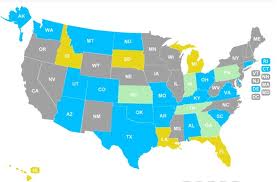
      "This year, legislation is pending in 32 states so far," according to the National Conference of State Legislatures.

      "That includes new voter ID proposals in 14 states, proposals to strengthen existing voter ID laws in ten states, and bills in nine states to amend the new voter ID laws passed in 2011. The governor signed a new voter ID bill on March 14 in Pennsylvania, and the Virginia General Assembly has sent a new voter ID bill to the governor."

      The NCSL has rated Pennsylvania's new law as one of the strictest.

      According to National Public Radio, 11 state legislatures over the past two years have enacted some kind of voter ID law. Thirty-one states now require voters to show identification at the polls.

      Although this kid may have a student ID, it would not allow
      access to the voting booth if the Texas Legislature has its way.
      Luckily, it's a gun license, so vote away junior.
      And in Texas, where right-wing extremism goes when it needs a hug, the new law now being challenged would not allow Social Security, Medicaid, or student ID cards as adequate identification to exercise your rights.

      However, as might be expected from the state that calls the Constitution "the law that lets us carry guns and all that other stuff," gun licenses are enough identification to identify you as someone the Texas Legislature wants in the voting booth.

      Now I would be remiss if I did not make mention of an Associated Press story in yesterday's Mercury which highlighted voter registration forms sent by a non-profit, non-partisan organization to people who had died, or for pets, some of whom had also died.

      The group, once called Women's Voices: Women Vote and now going by the inexcusable name of Voter Participation Center, says it is trying to increase participation among minorities, unmarried women and people under the age of 30 -- all people who should obviously be denied the right to vote.

      In this photo taken Wednesday, July 11, 2012, Brenda Charlston
      holds a photo of her long-deceased dog, Rosie, and a voter registration
      form for 'Rosie Charlston' that arrived in the mail for the canine
      last month,
      in Seattle. Rosie was a black lab who died in 1998.
      I'm not sure of how Rosie
      would have voted, but I'll bet you she
      would never have left any
      hanging chads.
      This undeniably hilarious incident, no doubt, serves as fodder for those who say such "fraud" is rampant and tout photo ID laws as a way to keep those improperly registered, from voting fraudulently.

      But again, while the anecdote is alluring and a great newspaper story, the numbers behind it are small.

      Katie Blinn, a co-director of elections in Washington state, told AP they have heard about a “handful” of pet-related forms in the state of the past few weeks. Once again, it proposes solving an ant-sized issue with a bazooka.

      Personally, I have enough faith in the judgment of the nation's poll workers -- true patriots who work for pennies to ensure the functioning of our democracy's single most critical function --  to believe they would deny poll access to a corpse or "Scampers" the dog, who was apparently offered the chance to register in Virginia.

      Just like you can avoid ID requirements to buy cigarettes,
      most voter fraud happens with absentee ballots, which
      ID laws do not address.
      A conservative friend of mine (yes, I have them) who likes to debate these things with me on Facebook raised what I thought was a pretty valid point.

      He said something like, you have to show ID to get Welfare payments, and Medicaid, cash a check or buy cigarettes or liquor. Why not voting?"

      My response is that those things are benefits that involve public money, or privileges not enshrined in the Constitution. You should have to prove you are the person who is supposed to get that benefit and buying booze is not a right, just a pleasant privilege.

      Voting is a civil right right folks, not a political strategy.

      Do you need to show an ID to be speak in a public place, or publish a newspaper?

      Do you need to show an ID before you can exercise your right not to be discriminated against? (Hmm, OK bad example because, ironically, with these laws in place the answer to that is "yes.")

      Eugene Robinson
      And yes, you do mostly need to show an ID to buy a gun, but, to my knowledge, no one has ever used a ballot to kill someone, so we'll chalk that one up to common sense.

      I couldn't improve on columnist Eugene Robinson's comment on the situation, so I'll just reproduce it here: "Not one case (in the Bush-era investigation) involved the only kind of fraud that voter ID could theoretically prevent: impersonation of a registered voter by someone else. Pennsylvania and other voter ID states have, in a sense, passed laws that will be highly effective in eradicating unicorns.

      So let's call a political hack job a political hack job and move on.

      The law will, in all likelihood, be in place in November so the best thing to do is learn how to deal with it.

      And that is what a non-partisan meeting July 26 is designed to do.

      Ellen Kaplan of the Committe
      It will be held at the Science Center auditorium at the Montgomery County Community College in Blue Bell at 7 p.m.

      The meeting will be facilitated by Ellen Kaplan, vice president and policy director of the Committee of Seventy, a non-partisan voter watchdog group.

      “There is a great deal of confusion and concern about the new Voter I.D. law,” said Montgomery County Commissioners vice-Chairman Leslie Richards, who is also chairman of the Montgomery County Election Board.

      “And this meeting is one of several steps we are taking to help ensure that the law, if upheld in court, does not prevent anyone who wants to vote from doing so.”

      Richards said that while there are strong feelings in favor of and against the new law, the purpose of this meeting is not to provide a venue for people to “trumpet its benefits or vent their displeasure,” but rather to hold a “constructive, informative and helpful meeting where voters can objectively learn about the provisions of the law, and how to obtain the forms of identification the law requires. Of course, if issues or problems with the law’s implementation are overlooked, we would certainly encourage members of the audience to bring that to our attention.”

      Richards said that the county has created a “working group” of individuals from various constituencies with a wide range of talents, who are working diligently to identify issues with the new law and to “seek ways to make sure that everyone who wants to vote can.”

      It should not take a college course to figure out how to vote. That's the kind of barrier erected by Jim Crow laws.