Showing posts with label Delaware Valley Regional Planning Commission. Show all posts

Thursday, January 24, 2019

Regional Planners Review More Rotten Intersections

Photos by Evan Brandt
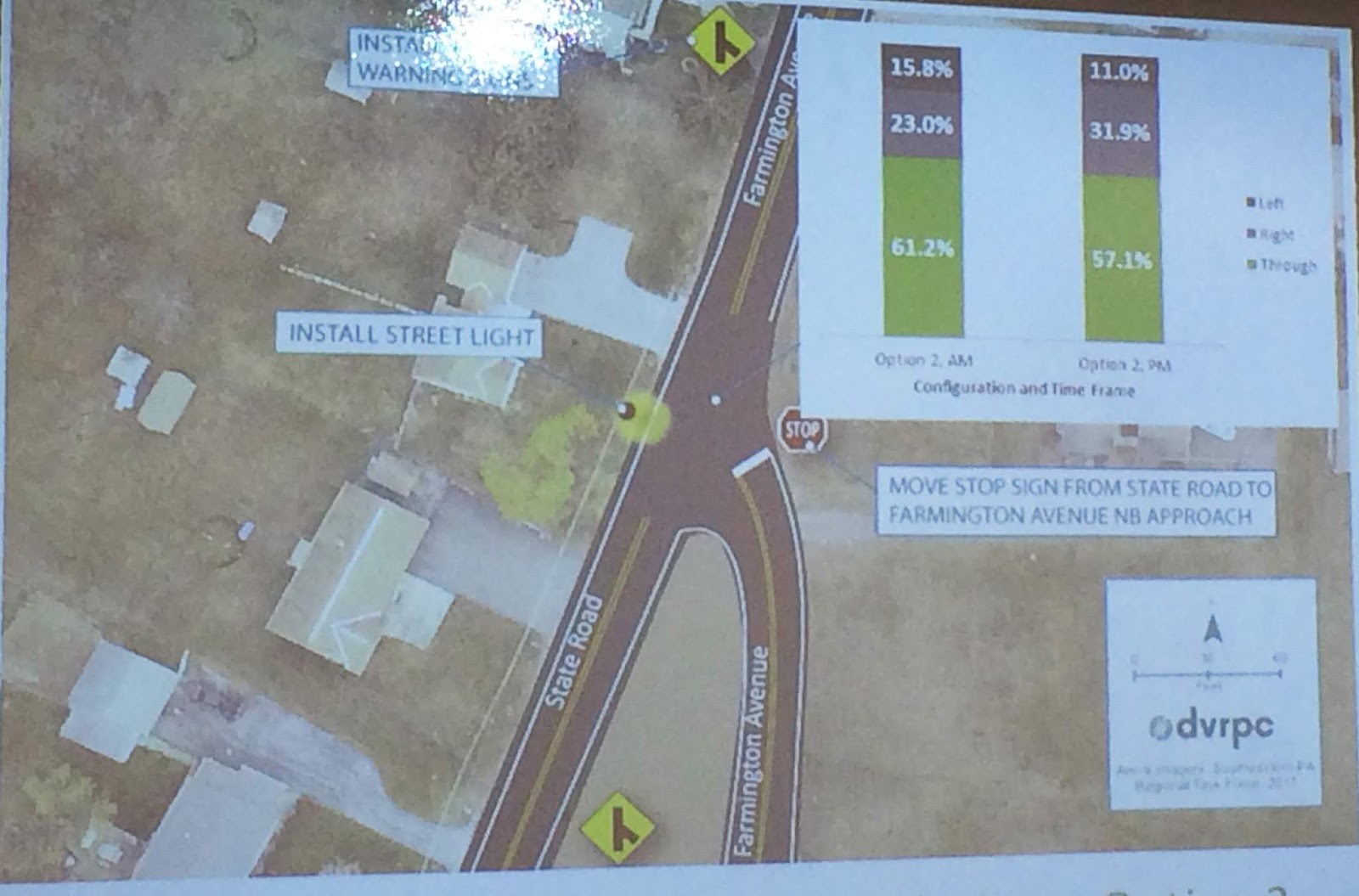
Above is one option for improving safety at the intersection of Farmington Avenue and State Road near the firehouse in Upper Pottsgrove presented Wednesday night.

At right is a second option which would be more expensive and might cause an increase in rear-end collisions which are nevertheless less likely to be serious or, worse, deadly, according to the DVRPC.


The Pottstown regional planners' tour through the region's 18 worst intersections continued Wednesday night as eight more were examined and suggestions for making them safer and more efficient were explored.

Last month, the planners looked at nine intersections in Pottstown, Lower Pottsgrove, Uppwer Pottsgrove, West Pottsgrove, New Hanover, Douglass (Mont.), North Coventry and East Coventry. Wednesday night, they looked at eight more.

The study is being conducted by the Delaware Valley Regional Planning Commission and the idea is to identify some of the smaller-scale projects that could be undertaken by the participating municipalities for minimal cost, or tasking a developer with the task.

In fact, Montgomery County Traffic Planner Crystal Gilchrist said thanks to a new initiative by PennDOT's Maintenance Department to improve communication and coordination with local municipalities, some of the simpler re-striping might be accomplished by PennDOT crews at no cost.
Improvements recommended for the intersection of Route 73
and Middle Creek Road in New Hanover.

For the most part, however, the fixes will likely be in the hands, and wallets, of local officials.

Bleim Road in Lower Pottsgrove and Middle Creek Road in New Hanover won the unofficial award for most problem intersections, three for Bleim Road and two for Middle Creek Road.

While the intersection of Middle Creek and Congo roads can be improved with some signs, striping and making it a four-way stop, traffic counts (both present and future) and the number of accidents at Route 73 and Middle Creek Road warrant some turn lanes and a traffic signal, according to the DVRPC.

A recommendation for a new alignment at Pleasantview Road
and Bleim Road in Lower Pottsgrove.
As for Bleim Road, the intersections with Route 663, Pleasantview Road and New Hanover Square Road all warrant some attention.

While the intersection with New Hanover Square Road can be improved with some better sight distance and some new striping, the best option for its intersection with Pleasantview Road is to re-aling it so it creates a T-intersection with Pruss Hill Road and install a traffic signal, according to the DVRPC.

Similarly, bad sight distance at the intersection with the busy Route 663 warrants turn lanes and a traffic signal, according to the agency.

Other intersections where improvements are needed include High Street and Sanatoga Road in Lower Pottsgrove; Route 724 and Wells Road, along with Route 23 and Bethel Church Road, both in East Coventry.

The final report is due to be provided to the regional planners at the end of June.

Here are the Tweets from the meeting:

Friday, December 7, 2018

Planners Study 9 of the Area's Worst Intersections

Crappy Photo by Evan Brandt
An example of one of the slides from last night's presentation about improving nine of the regions intersections. This one is for the intersection of Armand Hammer Boulevard and Industrial Highway in Lower Pottsgrove.


What are the Pottstown region's worst intersections and, perhaps more important, what must be done to improve them?

Those were the questions faced by the members of the Pottstown Metropolitan Regional Planning Commission Thursday night.

That's when a draft of a study of nine intersections by the Delaware Valley Regional Panning Commission was presented.

Next month, the second half of the study and data on nine more intersections will be presented.

The nine outlined list night were:

  • Manatawny Street and Grosstown Road in West Pottsgrove;
  • Manatawny Strret and Sell Road in West Pottsgrove;
  • Manatawny Street and Glasgow Street in Pottstown;
  • High Street and Moser Road in Pottstown;
  • High Street and Armand Hammer Boulevard in Pottstown;
  • Armand Hammer Boulevard and Medical Drive in Lower Pottsgrove;
  • Armand Hammer Boulevard and Industrial Highway in Lower Pottsgrove; 
  • Vaughn Road and route 724 in East Coventry
  • Hoffecker Road and Route 100 in North Coventry.

Each intersection was outlined for traffic volume and safety, along with projections for future traffic load.

Surprisingly, several of the intersections were forecast to actually have less traffic in 2020 or 2025 because planners anticipate future building will convince drivers to take different routes.

The meeting was also an opportunity to gather more information.

For example as DVRPC Planner Kathleen Whitaker outlined the problems with the intersection of Hoffecker Road and route 100, she became aware -- thanks to input from North Coventry Supervisors Chairman Jim Marks -- that the township had just received a sketch plan for a proposed 200-plus apartment complex near that corner, making the recommendation for a traffic signal all the more imperative.

Once the second half of the study is presented in January, the DVRPC will take the input back to create a final report, due in June, which each of the eight municipalities that are part of the regional planning commission can use to recommend upgrades at those intersections.

The report was funded entirely by a $65,000 allocation DVRPC made to the region.

After June, another allocation is available and Whitaker outlined some other areas that might be studied at no cost to local taxpayers.

Whitaker says possibilities include a study of High Street corridor traffic to create a model for downtown Pottstown; a school transportation study for the region; a Route 663 study from Maugers Mill Road to Route 73; 10 to 15 more intersections; a look at restoring regional rail; or ways to make better connections between adjacent housing developments.

What do you think?

In the meantime, here are the Tweets from the meeting:

Thursday, April 27, 2017

Traffic Study as Slow as a Traffic Jam


So as the collection of news stories and blog posts below indicates, regional planners have been talking about a regional traffic study for a long, long, long time.

And apparently, now that one is underway, it won't get done any time soon.

Last night folks from the Delaware Valley Regional Planning Committee -- which oversees planning in Pennsylvania, and New Jersey around Philadelphia and the surrounding counties -- outlined the traffic study they indent to conduct in the area.

Or, to be more accurate, they outlined the steps they will take to undertake a regional traffic study in the area.

Long story short? It will take the next two fiscal years to complete. But before you complain, you should know they are doing it for free, or at least for the $65,000 worth of work they budget for the Montgomery and Chester county areas each year.

I'll spare you the technical talk, some of which you can find below in the Tweets. In essence, the DVRPC will look at the planned large projects in the area, from New Hanover's 700-plus town Center project to the 500-plus Sanatoga Green project in Lower Pottsgrove and make some recommendations.

As Montgomery County Planner John Cover explained it, the ultimate result will be to set priorities for major improvements on a regional basis, and take that regional approach to PennDOT to get the improvements done.

Most projects, taken on a municipal level, fix a few hundred feet of road near their entrance, maybe add a turning lane or traffic signal, and leave the rest for area driver so suffer.

The idea here is to look at the cumulative impact of major housing and commercial proposals, calculate their impact, and make the most important improvements, even if they are in a town or borough other than the one where a project is located.

Got it?

Good, here are the Tweets.

Thursday, January 26, 2017

Getting the Big Traffic Picture

Is this the traffic future of the greater Pottstown area? Perhaps not, if a proposed regional traffic study can propose fixes for the worst intersections.


It's already a given that trying to drive down Swamp Pike in the morning means you will be sitting in traffic.

Will it soon be a given that similar traffic loads must be borne by thoroughfares like Pruss Hill and Middle Creek roads? Some might argue that's already true.

Officials like Ed Reitz, member of the Douglass (Mont.) Township Planning Agency, and Tom Troutman of the Lower Pottsgrove Planning Commission would be among them.

"Traffic on the back roads, like Pruss Hill Road, is bumper to bumper now, when it used to be you were lucky if you saw a car every half hour," Troutman told the Pottstown Metropolitan Area Regional Planning Committee Wednesday night.

"The back roads are getting slaughtered from these developments," seconded Reitz who, like Troutman, has had a hand in approving them.

But a regional traffic study that may get started as soon as July may not address those back roads -- at least not yet.

John Cover and Matthew Edmond from the Montgomery County Planning
Commission informed the regional planners Wednesday night that the Delaware Valley Regional Planning Commission -- more often referred to as the DVRPC -- sets aside $60,000 a year to do work in the greater Pottstown and would be happy to undertake the regional traffic study the planners want so desperately.

The questions at hand now, of course, are what should it look like? What should it look at? What questions should it answer?

Initially some of the planners began outlining some of the larger housing projects which gave birth to this newfound concern -- Sanatoga Green in Lower Pottsgrove; Town Center in New Hanover; the Zern tract in Douglass (Mont.).

But each of those will generate its own traffic study said Cover.

Why not use the DVRPC study to identify the intersections and areas which will suffer the most from increased traffic and have the study focus on and prioritize them?

After all, you may live in New Hanover, but if you want to get to Route 100, chances are you're going through Douglass, so an improvement there helps a New Hanover driver as much as one who lives in Douglass, he pointed out.

The planners agreed, particularly after he pointed out that if DVRPC will put $60,000 a year toward the effort, the plan built on the studies can be updated and more likely to get funding either from the state or President Trump's planned increase in infrastructure spending.

Here are the Tweets:

Tuesday, February 3, 2015

Of Bridges and Highway Garages

If there was a word to describe what was discussed at the Douglass (Mont.) Supervisors meeting Monday night, that word would be "infrastructure."

To be sure, it was not a long meeting, 30 minutes by my count, but during that time they managed to discuss the replacement of the County Line Road bridge over Swamp Creep -- for which they've been awarded a $595,500 grant (minus their $118,000 contribution); taking over the Henry Road bridge from the county; and beginning the process of replacing the "disgusting" highway garage on Municipal Drive.

The board also discussed PennDOT's plans to re-pave Route 100 from Farmington Avenue to the Berks County line.

The only other subject of discussion that merits note here is the second meeting of the newly formed Emergency Services Board.

It intends to seek more funding for the services of the Gilbertsville Ambulance Company from New Hanover Township, as well as pursue an ordinance that will require insurance companies to reimburse the fire companies for the cost of responding to motor vehicle accidents.

Here are the Tweets from the meeting.

Wednesday, March 13, 2013

The Borough's Burden, Part 5

What Should We Do About It?

Welcome back again.

Thanks for sticking with us for the whole thing.

This is the BIG pay-off!

Well, in all actuality what we have here are a series of fairly sedate suggestions from the Delaware Valley Regional Planning Study, "The Mismatch Between Housing and Jobs," 

This is the study we have been sharing in the two previous posts (Click here for Monday's post, here for Tuesday's post) and it ends with a series of suggestions for ALL levels of government that should be taken seriously.

I have a few suggestions to add, but we'll leave those to the end. And again, those comments of suggestions highlighted in bold are my own emphasis or suggestions.

Without further ado, here are the suggestions as outlined in the study:

The Federal Government should:

  • Review their program rules and guidelines to ensure that they support community planning and revitalization efforts. For example, Section 8 landlords that become tax delinquent should no longer be eligible for a federal subsidy until their taxes are made current.
  •  Link available discretionary funding (including transportation and infrastructure funding) to each community’s efforts to address their share of the region’s affordable housing needs.
(This is very important and would help Pottstown deal with the low-income housing burden it is carrying for the region.)

The Pennsylvania Legislature should:

  • Require counties and municipalities to address a fair share of their region’s housing need as a part of a comprehensive plan and, working through the Department of Community and Economic Development (DCED), should assume primary responsibility for establishing the goals, policies and standards for defining regional housing needs throughout the Commonwealth.
  • Target discretionary state funding (including funds available through the respective Departments of Community Affairs/Economic Development, Environmental Protection, and Transportation) to areas where the existing housing stock is currently affordable, to improve the ability of these communities to attract prospective homebuyers.
  •  Implement or expand property tax relief programs that provide assistance to elderly and low-income homeowners struggling to meet the increasing property tax burden, such as property tax postponement or deferral, tax assistance, property tax caps, assessed value caps, homestead exemptions, or property tax credits. (This would be very helpful in Pottstown).
  • Support programs that provide energy assistance to low and moderate income households, both for heating in the winter and cooling in the hotter summer months.
  • Require public utilities to dedicate funds for weatherization assistance, to help low and moderate income homeowners interested in weatherizing their homes and thereby reduce energy costs.
  • Research, review, and implement revisions to the current property tax structure, particularly the way in which public services (especially education) are funded, to allow housing location decisions to be based on sound planning principles rather than financial considerations. 
  • Research and review successful alternatives used in other regions or states to provide and maintain affordable housing and achieve an appropriate regional jobs housing balance and determine which programs or program components could be successfully implemented within Pennsylvania.

County Planning, Housing, and Community Development Agencies should:

  • County housing authorities that manage housing vouchers should proactively enforce property maintenance requirements (including annual inspections) and review their program rules and guidelines to ensure that they support community planning and revitalization efforts.

Municipalities should: 

  • Recognize their responsibility to provide for the housing needs of both current and prospective residents. 
  • Provide opportunities for an appropriate variety of housing types in residential zones, including increased densities in single-family zones and single story or “garden-style” townhouses.
  • Allow non-traditional affordable housing alternatives in appropriate locations, such as accessory dwelling units and elder cottages. 
  • Provide for inclusionary zoning in appropriate locations, where developers are offered density bonuses in exchange for providing affordable units.
  • Expand available assistance for homeowners and landlords for rehabilitation of the home’s major systems (plumbing, heating, and electrical systems as well as the roof) and for other improvements (including improvements necessary to make the home accessible and aesthetic improvements such as siding or painting). (This is some of what is happening with Pottstown's Homeowner Initiative.)
  • Adopt or revise and aggressively enforce a local property maintenance code, including both homeowners and landlords (including private owners as well as Section 8 landlords and public housing authorities).
  • Pursue all legal means of requiring landlords to maintain their rental properties.
  • Pursue all means available to legally acquire abandoned properties and properties that landlords have refused to maintain.
Given the means by which most local services are funded (especially education), concentrating low and moderate income families in certain municipalities (specifically, cities, boroughs, and older suburbs) places an unfair financial burden on these communities as they struggle to provide necessary services to disadvantaged residents.
Concentrations of low income housing units may also act as a deterrent to market-rate residential developers and non-residential redevelopment efforts.
Requiring that all of the region’s municipalities provide a fair share of affordable housing, however, will likely increase sprawl and result in disadvantaged residents living in areas where access to services and employment is limited.  
(Being politically impossible, it is also never going to happen. Instead, as I posted on Feb. 10, it's more realistic to ask the county and perhaps the state to provide additional funding to the borough to help support that burden Pottstown is carrying for the entire region.)
In that respect, targeting housing development (including affordable housing) to areas with existing services and access to jobs makes logical sense. The regional analysis of impediments and regional housing planning process must address and balance these valid but often competing regional objectives.

And now for a few of my thoughts on the issue:

The other, best answer, to all of this "cycle of disinvestment" is jobs.

Many, many, years ago, when The Mercury published my "Do or Die Time" series on Pottstown's plight, we looked at all these things -- education, codes, crime -- and while helpful, I have come to realize it was missing a crucial element.

That realization came from a reader who pointed out that we had not addressed the issue of jobs.

And the more we look at this, the more evident it becomes that good jobs, that pay a living wage, solve so many of these problems without any other need for programs, or ordinances or incentives.

After all, the name of the study is the "mis-match" between housing and jobs, which means the jobs ain't here but the low-income housing is.

More middle class wealth, means more support for local business, means more people who can pay their taxes, means more people who can buy homes here, who can be invested in this community and its schools and it means less crime.

Jobs and local investment means less low-income housing not because we've forced it out with some ordinance, but because the market has made Pottstown more attractive and the value of our homes has gone up.

In other words, having recognized the problems that concentrations of poverty bring, Pottstown should succeed not because we've forced the poor out, but because we've lifted them up and helped make them part of a healthier middle class community.

Jobs can do so much of that work and are probably ultimately more within our power to affect than convincing the state and county to pay us to house and educate their poor.

Recognizing the importance of jobs, watching borough council wrestle Monday night with the very real dilemma of taking a chance on a company, an unknown, versus losing tax revenue, a known, shows the difficulty of the choices we face.

So how to we attract jobs to Pottstown?
Giving tax breaks to a business has always been a risky affair and we are right to be cautious.

But consider the alternative.

Letting that deal collapse will very likely be the trigger that forces 84 Lumber into challenging its assessment.

If I owned that property, it's what I would do.

Then we will lose almost the same amount of revenue we lose through the Keystone Opportunity Zone deal council approved Monday, but have nothing to show for it but an empty building on a dead-end street.

It's good, I think, that we hashed out these issues in public, so the public knows the challenges with which the borough (and school district) must contend and the difficulties of the choice our leaders face.

If, as a result, council feels it should have more information before agreeing to another such deal on any of the few Keystone Opportunity Zone parcels that remain, then the time to work out those requirements is now, not three months into the process.

Let's remember there are other KOZ parcels in Pottstown that did work -- those on the former Mrs. Smith's Pies site on the north side of South Street, which are still working and still employing people in Pottstown.

Not only did the KOZ tool KEEP an EXISTING  business, and its jobs, here in town, but they worked out payment in lieu of tax arrangements with some similarities to those undertaken for Heritage Coach Co.

So let's mark this discussion as a point of progress on a difficult road toward attracting more jobs to Pottstown.

We need to recognize that almost anything that results in more jobs in this community is ultimately a plus, because of how many areas of life a living wage touches.

We should ask ourselves, why should we ask a business to take a chance on Pottstown if we are not willing to take a chance on them?

Will the workers at Heritage Coach and its tenants live in Pottstown? Maybe.

Should we require them to live in Pottstown? Probably not.

I put it to you that it be better to make Pottstown a place they WANT to live.

* * *

For those of you just finding this, here are links to the previous four posts:


  1. Saturday, March 9
  2. Sunday, March 10,
  3. Monday, March 11
  4. Tuesday, March 12

Tuesday, March 12, 2013

The Borough's Burden, Part 4

The Bright Hope public housing complex on Pottstown's west side, formerly called Penn Village, is operated by the Montgomery County Housing Authority and represents one way low-income housing is concentrated in Pottstown and other older traditional towns.

What Role Does Public Housing Play?

This is the $64,000 question in Pottstown.

We should begin by understanding that not all of this high concentration low-income housing can be laid at the feet of public housing, whether it be in the form of Section 8 Housing or public housing projects like Bright Hope.

Mercury Photo by Kevin Hoffman
Montgomery County Commissioners Chairman Josh Shapiro,

left, addresses the Pottstown crowd last month. At right are

commissioners Bruce Castor and Leslie Richards.
When the Montgomery County Commissioners visited Pottstown last month, Commissioners Chairman Josh Shapiro pointed out that Pottstown has a lower concentration of Section 8 vouchers than is often proclaimed.

I have no reason to doubt that information.

But not all low-income housing is public housing and what he could NOT deny, and which the Delaware Valley Regional Planning Commission study we began examining yesterday and will continue to draw from today confirms, is that public or not, there IS a concentration of poor and low-income housing here in Pottstown.

And the burden that Pottstown bears from that concentration is equally heavy, whether that low-income housing comes from a public source or not.

Photo by Evan Brandt

Joel Johnson, the executive director of the Montgomery

County Housing Authority also spoke at that Pottstown meeting.
When the police are called to a low-income home for a domestic, a drug call or other disturbance that so often accompanies such households, it costs taxpayers the same, whether their rent is paid through public vouchers or not.

When a child from Bright Hope needs an IEP from the school district and a specialized one-on-one aid to give him or her the best leg up on keeping up with their education, it costs taxpayers the same whether their rent is paid through public vouchers or not.

And when we complain to public officials about Section 8, it is only because that portion of the low-income housing burden is the only portion we can hope to directly affect by appealing to those public officials who are answerable to us and can, hopefully, do something about it.

OK, so enough preaching from the mount.

Back to some more facts from the DVRPC report, "The Mismatch Between Housing and Jobs," issued in 2011.

For those of you who haven't been following along, we began working through this report in yesterday's post and today are posting the sections I pulled out of that report that contain numbers, facts and assumptions about how the region handles publicly assisted housing.

As with yesterday's post, what appears below was taken directly from the report, but is not necessarily posted in the same order as the report. Anything in bold is my own emphasis or additional comment.
The Montgomery County Housing Authority operates 615 housing units; the Bucks County Housing Authority operates 742 housing units; and the Chester County Housing Authority operates 331 public housing units. 
There are 331 public housing units in Chester County, managed by the Chester County Housing Authority. These are located in the City of Coatesville, Phoenixville Borough, Oxford Borough, South Coatesville, and West Chester Borough. Almost 1,600 assisted housing units are also located in the county, all within 14 municipalities located primarily along the Route 30 and Route 322 corridors. 
In Montgomery County, 615 public rental units are managed by the Montgomery County Housing Authority. Public housing units are concentrated within six municipalities in the county, three of which are older boroughs along the Schuylkill River (the Boroughs of Conshohocken, Royersford, and Pottstown) and two of which are well-developed suburban townships (Upper Moreland and Upper Dublin). An additional 3,500 subsidized units are located throughout the county. 
Between 2009 and 2010 approximately 53,650 Housing Choice Vouchers (the new name for Section 8 ) were allocated in Greater Philadelphia. The rationale behind the Housing Voucher Choice Program is to give low-income families an opportunity to move to moderate and median-income areas where they can better access jobs and secure a better education for their children. 
The five southeastern Pennsylvania counties are allotted 26,209 certificates and vouchers (49 percent of the region’s total). Housing Choice Vouchers and certificates are also administered by the other five Pennsylvania housing authorities of the City of Chester (1,586), Bucks County (3,398), Chester County (1,521), Delaware County (3,086), and Montgomery County (1,480).  
Public Housing in Montgomery County:
Pottstown -- 632 units
Norristown -- 546
Lansdale: -- 647 
Public Housing in Chester County"
Coatesville – 510
Phoenixville – 107
Spring City -- 190 
The most common perception and concern of those opposed to affordable residential development in their communities is that the presence of subsidized housing or tenants with rental assistance leads to declining property value.
Several studies, however, conclude that the impact of federally subsidized housing on nearby property values is not always negative, but varies by type of unit and by type of community.
One study that reviewed the impacts of subsidized housing in New York City, for example, found that units subsidized under the federal Section 202 program (housing for the elderly) or constructed using Low Income Housing Tax Credits (LIHTC) had a positive impact on property values that then remained stable over time.
For Section 8 and public housing, the same study found that the impact on property values was relatively minor for smaller scale projects and that any negative impact on values typically occurred within the first three years after project completion and then dissipated.
Another study noted that affordable housing developments that replace vacant, abandoned, or otherwise blighted conditions generate positive impacts on surrounding properties, and stressed that good management and housing maintenance is critical to sustaining property values.
Good property maintenance (of both affordable and market rate developments) and proactive property code enforcement are key to maintaining neighborhoods. Units subsidized under the Housing Voucher Choice program are inspected annually and landlords must agree to correct any deficiencies within a limited time in order to continue to receive their subsidy.
Housing advocates note that this requirement (if properly enforced) can result in a Section 8 rental unit being better maintained than another unit rented through an absentee landlord in the same neighborhood without a subsidy.
Some studies do suggest, however, that there is some threshold (in terms of either number of units or scale of the project) where an over-concentration of subsidized units in one community, particularly of tenant-based subsidies, may result in stagnant or declining property values. This threshold is difficult to define and most likely varies by community, depending on the existing characteristics of both the neighborhood and the tenants.
Past and current housing policies that concentrate affordable housing assistance in distressed communities, although well-intended, have unintentionally contributed to suburban sprawl and contributed to disinvestment in cities and older suburbs.
Public housing residents pay 30 percent of their monthly income toward the rent and the federal operating subsidy makes up the remaining difference. The operating subsidy funding received each fiscal year is often not sufficient to cover actual operating costs, which can lead to poor maintenance of public housing units.
The Section 8 program, now referred to as the Housing Choice Voucher Program, assists low-income households, defined as those earning 50 percent or less of the median income.
Housing vouchers may be used for any unit where the owner agrees to participate and where the unit satisfies the standards set by the local housing authority (This puts the responsibility for maintenance and standards squarely in the lap, in Pottstown's case, of the Montgomery County Housing Authority.) 
Under the current program guidelines, HUD pays the difference between what a low-income family can afford to pay towards their rent (defined as 30 percent of their adjusted income or 10 percent of their gross income, whichever is higher) and an approved fair market rent for an adequate housing unit. Landlords who agree to participate in the program are required to allow the housing authority to inspect the unit annually.
Although the intent of the Housing Choice Voucher program is to enable low-income tenants to use the subsidy for a unit in a location of their choice, the Fair Market Rent limit realistically encourages their use primarily in places with the lowest housing costs (including cities, boroughs, and older suburbs).
Counties and local jurisdictions that receive Community Development Block Grants, HOME , and other types of federal funds are required to comply with the federal Fair Housing Act and the requirements of the Community Development Act.
Which brings us back to this. Does THIS look like fair housing choice?
These regulations require that the county or municipality affirmatively further fair housing to the maximum extent possible. Under these requirements, every jurisdiction receiving federal community development funding must (1) conduct an analysis of impediments to fair housing choice; (2) take appropriate actions to overcome the effects of impediments identified through that analysis; and (3) maintain records reflecting actions they’ve taken and their accomplishments to date.
A 2009 court decision involving Westchester County, New York, emphasized the seriousness of fulfilling this requirement.
In February 2009 a federal judge ruled that Westchester County had failed to conduct an adequate analysis of impediments and had taken no steps whatsoever to further fair housing while continuing to receive HUD funding, despite clear racial segregation throughout their communities. In July 2011, after repeatedly rejecting revised analyses of impediments submitted by the County, HUD stopped providing community development funds to the County and is currently pursuing additional action, including the possible restitution of previously awarded funding.

Low Income Housing Tax Credit

The Tax Reform Act of 1986 established the LIHTC to encourage the construction and rehabilitation of rental housing for low income persons. LIHTC accounts for nearly 90 percent of all affordable rental housing created in the United States today. 
Photo by Kevin Hoffman

Mary Beth Lydon, now Mary Beth Bacallao, protested the 
proposed senior housing project in 2010. She is now a 


member of the Pottstown School Board.
(Some may recall, this was the program that, in 2010, was going to be used to construct the low-income senior housing project along Industrial Avenue, a project which was considered controversial and was ultimately denied by the state, even though borough council voted to support it.) 
The tax credit is available to owners of and investors in rental housing for up to 10 years as a dollar-for-dollar reduction of federal tax income liability, provided that the rental housing project remains in compliance with occupancy and rent requirements for a 15-year compliance period.
The LIHTC program is one of the largest funding sources available to local Community Development Corporations (CDCs) for the development and rehabilitation of affordable rental housing. 
Most states (including New Jersey and Pennsylvania) usually allocate low-income housing credits to cities and older suburbs. This policy is well-intended but has played a role in creating concentrations of poverty, encouraging suburban sprawl, and exacerbating the mismatch between these older areas and their surrounding growing suburbs.
In general, Pennsylvania has not been proactive in requiring municipalities to provide affordable housing for low and moderate income families. One exception is the 1975 case of Township of Willistown v. Chesterdale Farms (341 A. 2d 46), in which the Pennsylvania courts ruled that the local zoning ordinance was exclusionary because it did not allow any acreage for apartment construction and thus excluded a lower-income population which could rent but not purchase.
Improving the financial status and quality of life in the region’s cities and older suburbs requires revisions to the current property tax structure as well as housing policies and programs.
The Southern California Association of Governments (SCAG) released a report in 2001, The New Economy and Jobs/Housing Balance in Southern California, which found that balancing housing and jobs in a defined geography has numerous environmental benefits, lowers infrastructure costs, and improves family stability. 
The same study found that an excess amount of the region’s vacant land had been zoned for commercial and industrial purposes relative to their forecasted housing needs for the Year 2025, which would undoubtedly exacerbate the mismatch.
By providing an analysis of zoned land for future uses, local governments can plan for the appropriate number and type of housing units in proximity to existing and future employment centers.
A new approach is needed, one that recognizes that public policies and funding streams can catalyze a more balanced and sustainable approach to housing that will benefit older and newer communities, workers and employers, and the region as a whole.
Tomorrow, we will conclude with a look at the recommendations made in this report for ALL levels of government.

Until then, thanks for sticking with me on this...

Monday, March 11, 2013

The Borough's Burden, Part 3

According to this map from the DVRPC study, "The Mismatch Between Jobs and Housing," Pottstown has between 10 and 20 percent of its population living below the federal poverty line, just one of many indicators of the way current policies concentrate poor and needy people in the communities often least able to carry that burden.

The Weight

Welcome back.

This third installment to my potentially never-ending series of posts brings us to information that's a little closer to home -- a 2011 study by the Delaware Valley Regional Planning Commission about the "mis-match between housing and jobs."

(Sorry for all the studies folks, but experts do look at this stuff and we might as well make use of the knowledge gained as a result. Better than it just sitting on a shelf.)

This study was undertaken at the behest of the First Suburbs Project of Southeastern Pennsylvania and confirmed much of what they have argued, that government policies and economics have had the unintended consequence of concentrating poorer housing and residents in older, established communities, away from jobs that pay good salaries.

After all, no one sets out to create the conditions under which we're now struggling. It's usually just an example of short-sighted policies and a mistaken belief, despite history's many reminders, that the good times will never end.

So I looked through this study more than  a year ago and made a set of notes in the hopes of trying to drive a larger, regional series of stories among our several newspapers that looked at these issues, and at housing authorities in particular.
Pottstown also has a higher concentration of children

living below the federal poverty line, thus requiring more
expensive services from a school system dependent on an
eroding property tax base. 

Sadly, the will, the time, the staff and the money to pay that staff never materialized to make that happen.

Luckily for you loyal reader, I rarely throw anything away (as a photo of my desk would attest) so I have it at hand for presentation here, in a somewhat less refined form.

Rather than re-write all this stuff and pretend it's all original, I have pasted relevant sections I lifted for my notes and strung them together into a kind of logical narrative.

(Those things I have bolded are my own emphasis or comment.Remember, the order in which they appear here are not necessarily the order in which they appear in the report.)
Although well-intended, past and current federal and state housing policies support suburban homeownership and have resulted in concentrations of low and moderately priced housing in older developed communities.
The creation of geographic imbalances between housing and jobs is largely the effect of suburbanization. Prior to the 1950s, the Greater Philadelphia region formed around employment opportunities located in the central business district, modern day Center City.
Housing developed in suburban areas adjacent to the city and commuting to Center City for work was facilitated with the development of publicly-funded highways and transit service.
Today, with the lack of (easily) developable land for light industrial and commercial sites in the central business district and the lure of large expanses of vacant, relatively inexpensive, and developable land in the suburbs, more lower-wage jobs are relocating to suburban locations that lack transit-accessibility. Many of these communities are often higher-end “bedroom” communities that lack the affordable housing opportunities appropriate for the entry-level and low-income labor force. 
By contrast, existing infrastructure and transit service, affordable housing choices, and the availability of necessary services make cities and older suburbs logical choices for low and moderate individuals and families searching for a home, with or without financial assistance.
This map shows that Pottstown has the highest concentration
in the region of 
people without cars, making it much harder
for them  
to get to a job that pays a living wage.
Many of the region’s largest employment centers, however, are located in the growing suburbs, in places that lack both affordable housing opportunities and transit access. Concentrations of low and moderate income households in cities and older suburbs result in a mismatch between the locations of jobs and labor, with entry-level and lower income workers living far from suburban job centers. 
Additionally, the concentration of affordable housing in the region’s cities and older suburbs corresponds to concentrations of disadvantaged populations. Disadvantaged households living in older cities and suburbs are often isolated from opportunity, both in terms of finding and maintaining a job and moving up the housing ladder.
Concentrations of low and moderately priced homes impact the municipal tax base and, given the current reliance on property taxes as the primary source of funding for public services (especially education), place an unfair financial burden on these communities.
Pottstown has a high concentration of single-parent households
A reduced tax base and the resulting impact on tax revenue impedes the community’s ability to provide a quality education system, invest in necessary infrastructure repairs, and meet social service demands.

(The communities are also often the only  place single-parent families can afford to live. Statistically, children of these families need more in terms of special educational services and thus cost more to educate in a system already struggling with diminished property tax revenues.)
As a result, many of the region’s cities and first suburbs find it even more difficult to attract market-rate housing, further compounding the problem. The attractiveness of the inner ring communities is reduced and both residential and commercial development sprawl outward into the suburbs, perpetuating the cycle of disinvestment and continuing a downward cycle that reduces the region’s overall attractiveness and competitiveness. 
Homeownership rates are highest in the suburban counties, especially in the most recently developed municipalities in Gloucester, Burlington, Bucks, and Chester counties. The highest renter-occupancy rate is evidenced in the City of Philadelphia, where over 45 percent of the occupied housing stock is occupied by renters. 
(By way of reference, the population of Pottstown is about 40 percent renters, so not much different from Philadelphia.)
In this map: Pottstown has the highest concentration of
households living in poverty in the entire area.
In the Pennsylvania counties, the highest housing values are found in Central Bucks County (Solebury, Buckingham and Upper Makefield townships and New Hope and Wrightstown boroughs); Lower Merion Township in Montgomery County; Radnor and Edgemont in Delaware County; and West Pikeland, Easttown, and Birmingham townships in Chester County. 
DVRPC has analyzed housing affordability in Greater Philadelphia several times in the past. The conclusion has consistently been the same: the region’s most affordable housing (both renter and owner-occupied) has typically been located in places least accessible to suburban employment centers and where the housing stock is generally of poorer quality.
Municipal-level maps provided in the appendices (some of which I have posted here) illustrate that lower income households and people living in poverty are concentrated in the region’s cities (including the smaller cities of Coatesville and Chester City in Pennsylvania and Beverly City in New Jersey), and older boroughs (including Darby, Bridgeport, Colwyn, Pottstown, Norristown, and Marcus Hook in Pennsylvania and Hi-Nella, Audubon Park, and Lawnside in New Jersey). 
Given the region’s dependence on property taxes as the primary source of local revenue, the overall strength of the local tax base directly affects the ability of local governments to provide quality services.
The tax bases of many of the region’s core cities and older developed communities are stagnant or declining, while, ironically, the number of low-income and dependent residents (including seniors) that require an increasing level of services continues to increase in these same areas. Increasing the property tax rate not only places an unfair cost burden on current homeowners, but also higher taxes and reduced services resulting from a lack of resources perpetuates the population and employment losses realized in many of these older communities in recent years. 

Ironically, the property taxes in the region’s older communities (which have the largest available supplies of low and moderately-priced housing) are often very high relative to housing value and the residents’ income. As property taxes rise in urban areas, lower-income households can have trouble paying their property tax bills and may become tax delinquent. 
(The areas outside Pottstown in the map below which are also blue, such as East Coventry, are likely home to senior housing and nursing homes, such as, in East Coventry's case, Manatawny Manor.)
Pottstown is also has a higher concentration of the elderly. 
As the financial burden on lower income families increases, many rental and owner occupied units can deteriorate, become vacant and fall out of the housing stock.
If the municipality responds by placing tax liens on these properties, developers may hesitate to rehabilitate them because they cannot recapture the cost of the rehabilitation or because of the extremely deep rental assistance subsidies needed for tenants to occupy the units. Local property tax policies often discourage the replacement of these affordable rental units.
Areas most at risk of foreclosure include locations in and immediately surrounding the cities of Philadelphia, Trenton, Camden, and Coatesville and Pottstown Borough
The opposite also holds true in communities that are less developed and have available vacant land. Although land is available in these communities that could theoretically be used for needed residential development (especially higher density rentals) these communities are often not served by transit to provide access to jobs and services.
Higher property taxes in these communities are often offset by the higher average annual income of the residents and higher housing value.
We also have a higher number of disabled residents.
The high cost of providing services and its consequent impact on property tax rates encourage municipalities to zone their land for uses that place the fewest demands on the school system and other municipal services.
(In the tax ratables chase in which so many municipalities here engage,) Single-family residential is preferred over higher density family residential; commercial development and other employment generating uses are preferred over any residential. 
Multi-family rental housing is often viewed as particularly undesirable because it disproportionately increases the demand for local services while generating comparably little tax revenue. 
Commercial uses generate significant tax revenue while demanding fewer services than residential development, thrusting communities into a chase for the highest and best ratables. 
So as illuminating as all of this is, it mostly confirms that the conditions locally meet the criteria set out in national studies which we looked at in the previous post.

The next logical question is the one we will address in tomorrow's post and the one which consumes much of Pottstown's discussions of how we get back on our feet -- what role does public housing policy play within the context of these burdens?

See you tomorrow.