Showing posts with label school funding. Show all posts

Sunday, September 29, 2013

The Sporting Life


As you might imagine, with my face now at the bottom of every story on The Mercury's new web site, it gets hard to go shopping without someone stopping me to tell me "you know what you should do a story on..."

That's OK, it comes with the territory and, more often than not, they are often pretty good story ideas.

But we can't always get to them all.

So the other day, a parent of a Pottstown High School student suggests I "highlight the fact that Pottstown High School athletes compete against much bigger and better funded athletic departments and still play with heart."

While this strikes me as a lovely sentiment, it is hardly "news" in the traditional sense, I replied.

As someone who played high school sports (Captain of the soccer team. No really. Stop laughing.), I understand the value of athletics, particularly in terms of team dynamics, teaching us to get along and work together with those with whom we might not otherwise associate.

(Flash forward to the adult work place.)

But it did get me wondering about the whole phenomena of high school sports.

Then, BAM!, no sooner does the thought hit my brain than this link to an article in The Atlantic arrives in my e-mailbox.

You'll forgive me blotting out my address. This post is
likely to piss off enough people as it is. I would just as
soon they not bring their arguments to my house.
Then the hard copy, at left, arrived in my actual mail box.

The case made in this article by writer Amanda Ripley is fairly straightforward, if not fraught with controversy for anyone educated in this country.

Her point is simple.

No other developed country in the world, pours as much focus and financial resources into high school athletics as the United States.

And, by what she sees as being no coincidence, all those countries are kicking our ass in terms of scores on math and science tests.

Now I'll be the first one to say those two facts laid side by side do not prove causality. 

But it is worth consideration, even if you would have a tough time raising the point without being shouted down by angry parents.

Here are some samples from the article:
...in South Korea, whose 15-year-olds rank fourth in the world (behind Shanghai, Singapore, and Hong Kong) on a test of critical thinking in math, Jenny’s classmates played pickup soccer on a dirt field at lunchtime. They brought badminton rackets from home and pretended there was a net. If they made it into the newspaper, it was usually for their academic accomplishments.
Sports are embedded in American schools in a way they are not almost anywhere else. Yet this difference hardly ever comes up in domestic debates about America’s international mediocrity in education. (The U.S. ranks 31st on the same international math test.) The challenges we do talk about are real ones, from under-trained teachers to entrenched poverty. But what to make of this other glaring reality, and the signal it sends to children, parents, and teachers about the very purpose of school?
 Another passage:
Even in eighth grade, American kids spend more than twice the time Korean kids spend playing sports, according to a 2010 study published in the Journal of Advanced Academics. In countries with more-holistic, less hard-driving education systems than Korea’s, like Finland and Germany, many kids play club sports in their local towns—outside of school. Most schools do not staff, manage, transport, insure, or glorify sports teams, because, well, why would they?
It's a question few people would ask out loud in the United States; at least not without a helmet.

Understand, this is not to knock high school sports per se, so much as to ask the question: If we really are serious about wanting to improve education without bankrupting our society, why is this question never on the table?

I found this example of 'keeping up with
the Jones's' on the Internet.
If the primary job of a school is to provide an academic education, and we're failing to do that because some of the resources that could be devoted to the classroom are devoted to the gridiron and the hardwood, are we not failing in our primary responsibility?

Athletics are often lumped in with other "extras" like art and music when budgets get tight, but there are quite a few studies out there indicating the academic benefits of art and music. Fewer, at least that I am aware of, about athletics.

Often, this discussion only gets put on the table in terms of an illustration of how dire a district's finances are. And often enough this is done, cynically to some extent, to get people to pay attention and come out to demand their continuance.

That's what happened in 2011 in Pottstown, when student athletes, artists and musicians stormed the school board meeting, their parents in tow, pleading to maintain those programs.

Few if any of those parents returned to the school board to see how else money was being spent once they were assured their programs were safe.

I confess I was surprised to see this self-same discussion, inspired by the self-same article, raised in a discussion Facebook page for Pottsgrove parents, yes Pottsgrove, home of the mighty Falcons.

At least one parent there thought it worthy of discussion. (However I can no longer find it on that page, otherwise I would provide a link.)

But often enough, the complaint is not "why are we spending money on athletics when we're cutting teachers," but "why isn't our gym as nice as the district next door."

One need only sit in the audience when the construction of the Pottsgrove High School renovations was being discussed, to hear that more people were worried about how big the new gym would be, and whether or not artificial turf would be used on the fields, than about how well equipped the science labs would be, to know important athletics is to most American parents.

During the Pottsgrove meeting I sat through, one parent got up and said, with outrage in his voice, that Pottstown's gymnasium was nicer than Pottsgrove's.

Pottstown High School's gymnasium is quite nice.
Imagine.

Pottstown's!

We can't have that!

What would OJR say?

Talk about keeping up with the Jones's.

(To be fair, there was as much time spent discussing the need for better music facilities as well in those Pottsgrove meetings. But, as I said above, I have less problems with this as, there is ample evidence that students who learn and play music have improved math scores. In fact, most schools require student athletes to keep up their grades to continue to be eligible play in sports, a requirement rarely required, I believe, for student musicians.)

Then there is the argument about physical education.

But really, how many 30 and 40-year-olds are still playing football?
Pottstown has installed exercise equipment

at the middle school that is open to the public.

As the article points out, you can spend half the money we do on athletics and invest it in wellness and exercise programs, as Pottstown is now doing, and teach children to be healthy for life and still have money left over for academics.

Others argue it is the only way to keep marginal students interested and motivated in school, and a shot at a scholarship to attend college and frankly, I consider this to be the best argument.

As I wrote about last Sunday, it is not only better for a society to keep kids in school and our of jail, it's also less expensive.

But I would point out that it is the only way "we know of" to keep marginal kids motivated and in school. And couldn't some of them get academic scholarships if we put more energy into teaching them?

Sadly, this skewed balance in favor of sports is more the rule than the exception.

To make this point, Ripley profiles a failing school district in Texas which turned its academic fortunes around once it eliminated high school sports, football in particular.

Even just a year without football saw not only better focus and better test scores, but fewer fights and less discipline problems.

Understand, to some extent, I consider this a largely intellectual exercise.

I have trouble envisioning a place where the Penn State football program is deified above the college's academic standing also being the place that decides to spend more money on academics at the expense of athletics.

Further, I am always leery of ever trying to promote one goal by cannibalizing another. We do enough of that in Pottstown already.


And hey, my own employer has an entire section of the newspaper dedicated to the coverage of high
school sports, so I have to step carefully around the hypocrisy land mines that litter this conversation for me.

People have on occasion asked me why we don't have a "Schools" or "Music" section covering school academics with the same vigor and dedication with which we cover athletics.

The answer, of course, is money.

It's expensive to put out a newspaper section and there needs to be enough advertising to support it. There is little to no evidence the readership or advertising base exists to support these sections, which really proves the point about how ingrained athletics are in our collective psyche.

Besides, the photos from sports are much more dramatic than a student with their hand up, or playing an instrument.

In the end, I have little expectation that posting this will alter the fundamental conversation we have about education in this country, the outsized role sports plays in the education dynamic.

But it would be nice if we could at least talk about it.

Sunday, June 23, 2013

Running the School Funding Numbers in the State Budget (Or, I Hope You Like Charts)

Michael Stoll is not particularly happy with me.

Stoll is the communications director for the House Appropriations Committee and he contacted me last week to express his displeasure with The Mercury's story analyzing the House of Representatives budget, and how it affected local districts, which first ran on our web site on June 13.

"Your story and the headline are incredibly misleading and fails to accurately explain how school funding is distributed to school districts," he wrote in a June 14 e-mail to me after the story appeared in print.

The print headline read "$28.3B House budget stiffs poorer school districts in Pa."

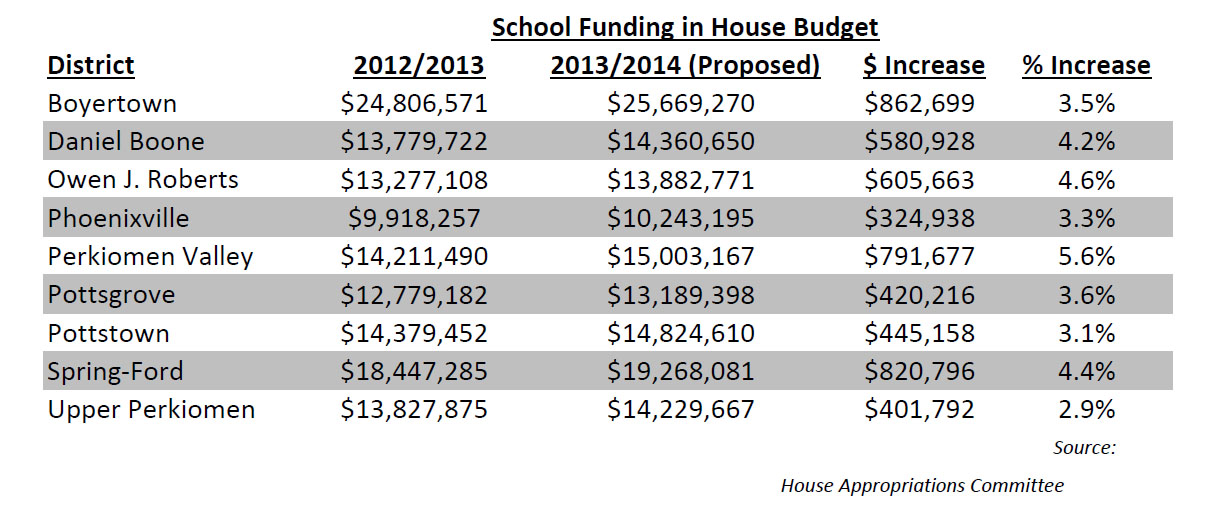
The story ran with this spread sheet I put together with information released every year by the House Appropriations Committee.


As you can see, the largest increase in total dollars, as well as the largest percentage increase, went to the Perkiomen Valley School District, not exactly a poor district, but also twice the student population of Pottstown or Pottsgrove. 

The smallest increase, again by dollars and percentage, went to Upper Perkiomen, followed by Pottstown in a close second.

I have conducted this analysis over the past several years as a way to localize the state budget's impact on the school districts we cover. 

But, quite understandably, Stoll has a different job and he has a Harrisburg perspective on these things. 

I imagine he sees things from the standpoint of who gets the largest share of the state budget pie on a more state-wide scale.

We, on the other hand, look at things from the standpoint of how much does the budget provide to the school districts we cover? Which of those got the most/least? How does that compare to last year?

But Stoll raised an excellent point.

"As you see in the attachment, Pottstown gets the largest per-student amount of any Montco school (Aside from Bryn-Athyn and their 7 students) and receives the largest percentage of their total funding from the state," Stoll wrote in his e-mail to me.

This is the attachment that he is referring to:


The figures he is pointing to are the $4,647 per student figure and line that shows Pottstown gets 33.6 percent of its revenue from the state under the budget passed by the House.

Two other local districts, Upper Perkiomen at 33.3 percent and Pottsgrove at 26.7 percent, come in right behind Pottstown.

(We will ignore, for the sake of brevity, the fact that the state once funded 50 percent of most school budgets, because that will further complicate an already complicated discussion.)

The other districts, as the chart above shows, must raise much more of their revenue from local sources, which means mostly property taxes.

"As I am sure you know, school funding is driven out by a funding formula that takes into account a district’s wealth and their ability to raise money locally. This formula delivers a larger amount of state funds to poorer school districts," Stoll wrote.

I had believed this to be true under Gov. Rendell, a change which came about as the result of the "costing out study," which looked at how much successful school districts spend per student, and trying to apportion state funding along the same lines.

The Pennsylvania School Funding Campaign, described it like this: the study "was to determine what it costs for all of our students -- no matter where they live -- to attain state academic standards. The study of equity was to address the growing gap between high- and low-spending districts."

To no one's surprise, the study, completed in December 2007, "concluded that Pennsylvania was under-funding K-12 education by more than $4 billion and that the system then in place relied too heavily on local property taxes."

The result of the change in formula was that Pottstown began getting a larger share of funding, funding which was applied largely to early education efforts and which bore fruit with higher test scores in the elementary grades, all of which made Adequate Yearly Progress in 2009.

However when Gov. Corbett took office, through no fault of his own he inherited a budget that had plugged a very large revenue hole drive by the financial crisis with about $700 million in federal stimulus funding, a gap that had to be closed. 

No one envied him that task.

But his solution was a little ham-handed. He proposed to "level-fund" schools with the same amount of state money spent the year before.

This solution had the Harrisburg view, not the local view. Because locally, it was anything but "level."

As we reported in May, 2011, Corbett’s initial budget proposal, when analyzed by Good Schools Pennsylvania, "showed each Pottstown School District student will get $609 less in state funding under the plan. Each classroom in the district will lose more than $15,000 in state funding."

"At the other end of the spectrum, each Lower Merion student will lose only $83.81 — or $2,095 per classroom — under Corbett’s plan," we reported in 2011.

That may have been because, as Stoll has pointed out, Pottstown was getting more state funding per student to begin with, but it sure didn't seem like "level-funding" to local school officials scrambling to balance budgets.

Ultimately, the impact that year was less severe than Corbett had first proposed, but Pottstown and other districts still had to cut a number of teaching and administrative positions and toyed with shutting down music and art programs as a way to close its budget gap.

I had the impression that the 2011 budget did away with the funding formula that steered more money, proportionally, to lower-income districts.

But Stoll tells me that is not the case and I have no reason to doubt him.

After all, as a staffer in the House Appropriations Committee, he is surely in a better position to know than I am. 

However, it is hard to square with information I put together in this chart for a story last year on Corbett's budget proposal.


I suppose the difference must be between what Corbett initially proposes, and what the General Assembly finally adopts. 

But even that possibility is undermined by how things shook out locally last year after all the dust had settled:


I think I may be forgiven, after several years of such budget analysis, to have been under the impression that the trend of less school funding for poorer schools was accurate.

Nevertheless, in the battle between what I believed and what the facts are, the facts should win. Trouble is, depending on which set of numbers you use, the fact seems to be mutable.

In a June 17 email, Stoll put it this way:
I understand how the percentages you cite in your story may lead you to think one thing, but as you can see when you look at the details behind the simple percentages, it is a much different story than you portray in your story. “Poorer school districts” clearly receive the lion’s share of state funding. By only talking percentages as you do in your story, you ignore two very important facts — the number of students in the district and the amount of total revenue the districts receives from the state. When you only talk percentage you are ignoring that “poorer districts” receive more of their total revenue from the state.

That is one another thing Stoll and I agreed upon;  that truly the most accurate way to measure state aid is on a "per-student" basis. Ultimately, what reaches each student is what is supposed to make the difference and provide that "level playing field" we all crave for our kids.

I complained that "per-student" information had rarely been provided to us through any state mechanism, and he replied all we had to do was ask. 

Which I did.

This brings us to the next chart (yes, another one), and the second point of discussion between Stoll and myself.

If it is true that poorer school district are getting more state aid than richer districts overall, it sure seems like the increases are tipping in favor of the richer districts.

I made the point to Stoll that the point of the most recent story was in fact to compare increases; and the information we had seen over the past several years suggesting the largest increases were going to richer districts. 

Once we agreed that funding on a per-student" basis is the fairest comparison, surely a comparison of local state aid on a per-student basis would dispel this belief on my part.

So I ran the numbers Stoll sent and put together this chart and I came away feeling undispelled.


Certainly, it does not show the broad disparities that the previous numbers show, although there is a $60 per-student difference from the lowest per-student increase (Phoenixville) and the largest (Daniel Boone).

But notice that Perkiomen Valley's increase per student is only $1 less per student than Pottsgrove's, another struggling district, and only $7 per student less than Pottstown's.

And when you look at the percentage of the increase per student under the House budget plan, notice that again, Upper Perkiomen and Pottstown share the lowest increases.

So color me unconvinced on that score.

Of course (for all of you have read this far without falling asleep, or gone chart-blind) all of this is moot to a large extent.

Corbett's budget proposal is not the final budget.

The House's budget proposal is not the final budget.

Not until the Senate passes a budget, it gets reconciled with the House plan and Gov. Corbett signs it do we get to argue about who got what. 

Up until then, it's all rhetoric.

Even more sobering is that fact that all a final budget truly resolves in these debates is where you point the finger.

The bigger question about the success of an education funding regimen is the final product; what kind of students are we turning out? 

Are we doing all we can to ensure they prepared for the world they will inherit? 

I haven't found a chart yet which answers that question.