Showing posts with label Pennsylvania General Assembly. Show all posts

Friday, November 3, 2017

Could Referendum Open Door to Fair Funding?


So I think I get it.

The referendum question on the ballot next Tuesday is property tax reform in little pieces.

Unable to agree on a complete package that would replace the revenue from property taxes with something that didn't look like they might be raising state taxes, the members of the nation's second-largest, second-most expensive legislature punted.

But that's not necessarily all bad.

The Constitutional restriction against just offering relief to homeowners and farmers was a real-life legal hurdle and made the whole thing more difficult to pull off.

There were some dubious and, as always,
angry people at yesterday's forum.
If approved, it would only cost $7 billion to replace property taxes lost from taxing homes and farms.

That might be more doable on a statewide basis.

Also, it would allow school districts (and boroughs, townships and counties) to still have the stability of property tax revenues on commercial properties.

Now granted, the open-ended nature of what happens next if this is approved is certainly worrisome, given that it would be in the hands of people who can't pass an annual budget on time.

And you can't really blame Pottstown Schools Superintendent Stephen Rodriguez for calling it "smoke and mirrors," when the very real problem of school funding and opportunity by zip code  remains largely unaddressed.

And he's right to say so.

The potential for shenanigans on this thing in Harrisburg, with this open-ended authority, is certainly very real.

After all, the General Assembly has a history of dumping problems downhill to avoid looking like they're raising taxes -- particularly education funding problems.

State Rep. David Maloney, left, is the prime sponsor of the legislation

which brings this referendum to a voting booth near you Nov. 7.
I mean the idea that Pottstown could replace its lost property tax revenue with a sales tax is laughable, and Marlene Armato was right to call them on it.

But consider this.

The legislature enacted the fair-funding formula then cheaped out on implementing it in full because "it would be too much change too fast."

But what if the money coming from Harrisburg to replace the lost property tax revenue were to be distributed through the fair funding formula?

I mean, they're changing the whole system anyway. Isn't it the perfect opportunity to implement the formula in full?

I recognize, it's unlikely.

I mean after all this is Pennsylvania. We're not exactly a "can do" state.

And there are probably 100 obstacles I haven't thought of that would prevent it,

But still, it is a tantalizing thought and wouldn't it be easier to lobby for since its a major change being implemented already?

It's food for thought if this passes.

In the meantime, if you want to get confused, try following the Tweets from yesterday's forum which was supposed to explain it all..

Tuesday, May 16, 2017

Budget Blues and Quid Pro Quo in Upper Pottsgrove

Photo by Evan Brandt

State Sen. Robert Mensch, R-24th Dist., discusses the Pennsylvania budget at the Upper Pottsgrove Commissioners Meeting Monday night.


Bob Mensch says this year's budget discussions in Harrisburg may involve the hardest choices he has ever seen in more than a decade in state politics.

Speaking by invitation of the Upper Pottsgrove Township Commissioners Monday night, he said "we've swept all the corners for revenues. We're at the point now where the budget is hinging on gaming and state stories," neither of which has much to offer over the long term.

"State stores, if we do what's being proposed, is a one-time boost and that's it," he said.

"Gaming is not a growth industry," Mensch warned. "Only about 4 percent of the population gambles. We can expand and put more terminals out there, but we're not really doing anything to grow the economy."

"We're at the point now where, as a state, we';re going to face some increasingly difficult decisions about what we fund and what we don't fund," Mensch said.

"Our revenues are down, primarily our business revenues, our business taxes are down, which means that while the national economy is picking up steam, we're not picking up the same steam because we haven't done what we need to do here in Pennsylvania to encourage business," Mensch said.

You can see the full content of Mensch's comments in this video here:


And while the commissioners discussed a number of subjects Monday night, most of which involved more than $300, it perhaps the bill of $300 which was the most newsworthy.

It seems that when a car show was organized and staged in the parking lot of Pottsgrove Middle School a few months ago, organizers were under the impression there would be no charge.

But weeks later, they received an invoice from the district for $300 because a custodian was on duty because the outside-access rest rooms had to be made available for the event.

That did not sit well with the organizers, township recreation and open space committee and ultimately, the commissioners themselves.

They noted that Upper Pottsgrove spends thousands of dollars each year to upgrade, improve and maintain the soccer fields at Hollenbach Park at the expense of just township taxpayers -- fields made available not only free of charge to the school district, which has students from all three Pottsgrove townships -- but fields to which the district has priority of use.

To add insult to what Commissioners Chairman Elwood Taylor called "an affront," public works supervisor Frank Quinter confirmed that the district has not fertilized the soccer fields at Hollenbach as it had promised to do.

"The township spends thousands of dollars on field maintenance for free use by district and they want to stiff us for $300 bucks," said Open Space Committee Chairman Dennis Elliott in what was perhaps the most pithy quote on that subject.

As a result, Elliott said the Open Space Committee has recommended the commissioners begin exploring the idea of charging the school district for the use of the Hollenbach Park fields.

"Well we don't charge any of the other organizations that use those fields so this could get interesting," noted Commissioners Chairman Elwood Taylor.

Instead, he suggested, it might be better for the township and school district to sit down and try to reach some accommodation.

Stay tuned.

Monday, June 29, 2015

THIS is Why Everyone HATES Harrisburg

With sad predictability, the process of adopting a budget in Pennsylvania has devolved to the usual last-minute maneuvers, rushed half-baked proposals and political stunts that looks for all its chicanery like a cross between speed chess and Let’s Make a Deal.

The opening move, as it always is, belongs to the Governor when he proposed his budget in February.

That budget, if adopted unchanged, would have added $1 million to the coffers of Pottstown Public Schools.

Then comes the long staring contest in which, quite literally, nothing happens for months and months, all while business managers and school boards in Pennsylvania’s 500 school districts are scrying tea leaves trying to figure out where up to one-third of their budget revenues may end up.

Unlike his predecessor, Gov. Tom Wolf has made the most of the time, touring the Commonwealth with his wife and cabinet members, trying to drum up support for his budget and what it will do for public schools, the issue on which he won election.

On the other side of the divide, from February until the 11th hour, the Pennsylvania Legislature, the clown car branch of state government, did absolutely nothing.

Finally, noticing the ticking of the clock, they were spurred into action and responded to Wolf’s budget not by countering his proposals to work out a compromise, but by putting it up for a vote immediately where it was doomed to fail from day one.

Then, the games began.

During what passes for negotiation sessions in Harrisburg, Wolf’s chief negotiator, former DEP Secretary John Hangar, recognizing that the Republicans control both house of the Legislature,  went to the table with some concessions on Wolf’s proposal to tax natural gas drillers.

The GOP reaction, Hangar told the roomful of reporters to whom he rushed afterward, was to say “no.” Just No.

Surely, the $48.6 million those drillers have spent on lobbying those legislators – money that could have been spent on taxes to fund our schools -- had no impact on the legislators’ intractable position.

(By the way, we are the only state in the nation that does not tax Marcellus shale natural gas drillers who are, with depressing regularity, polluting the groundwater of the people unlucky enough to live nearby.)

Now, with just four days until the end of the fiscal year, the Republicans in the House and Senate release a budget which, they say, increases funding for education without raising taxes.

What they don’t say is that it is a 1.8 percent increase from the previous year; the fourth year in which millions had been drained from public school funding. Their budget does not restore those cuts, it simply makes them smaller.

Not included in the $100 million increase for basic education funding, are any increases for job training and education; teacher or professional development; adult and family literacy; career and technical education or early intervention for kids with learning difficulties.

There is a 50 percent increases in their budget for pension payments ($573,320,000)and $6.4 million for community colleges.

Their budget also cuts $2 million for child support enforcement; $131.8 million for child Welfare; $87 million for child health insurance, a 74 percent cut (because kids never get sick).

The fact that in the most recent election, the state’s voters overwhelmingly said they wanted the guy who said he would tax gas drillers to provide more money to schools is irrelevant to the Legislature.

They want to teach Wolf a lesson, the same way they taught Gov. Corbett a lesson – a member of their party for God’s sake – “nothing happens without our say so.”

To them, largely immune from getting voted out of office by their own buffaloed constituents, this is all that matters

This weekend I came across a quote from James Madison that seems appropriate to inject here:
"Knowledge will forever govern ignorance: And a people who mean to be their own Governors, must arm themselves with the power which knowledge gives."
Substitute the word “education” for knowledge and you can see why it might be in the best interest of those in power to ensure the voters don’t have too much of it.

And when you consider that the Republican budget cuts $67,000 for voter registration and education, a 14.6 percent drop, it becomes clearer.

The fact that a cut that small represents 14 percent of voter registration efforts is itself a sad commentary on the value we put on educating people to vote.

Maybe that’s because voters might be upset if they knew that although the Republican budget plan cuts $4 million from budget for the governor’s office; it increases the General Assembly’s budget by 22.5 percent or a whopping $51.4 million.

The $31.3 million it adds to the Senate’s budget alone is an increase of nearly 50 percent, all this for a branch of government whose pile of spending money is already so huge that it could probably close half the state’s budget deficit by itself.

What this means, of course, is that Wolf will veto it, which will leave us at the start of the fiscal year with both branches of government having rejected the others’ budget plan.

This will likely be followed by another weeks-long, or months-long staring contest, with each branch accusing the other of everything from fiscal malfeasance to starving children.

Make no mistake, this will cost us money. 

That’s because while this needless drama plays out, school districts will have to borrow money to cover the deficit created by the failure of our state’s leaders to fulfill their single most important responsibility – passing a Goddamn budget.

In case you were wondering Legislature (not that you care), but this is why everyone hates Harrisburg.


Sunday, June 23, 2013

Running the School Funding Numbers in the State Budget (Or, I Hope You Like Charts)

Michael Stoll is not particularly happy with me.

Stoll is the communications director for the House Appropriations Committee and he contacted me last week to express his displeasure with The Mercury's story analyzing the House of Representatives budget, and how it affected local districts, which first ran on our web site on June 13.

"Your story and the headline are incredibly misleading and fails to accurately explain how school funding is distributed to school districts," he wrote in a June 14 e-mail to me after the story appeared in print.

The print headline read "$28.3B House budget stiffs poorer school districts in Pa."

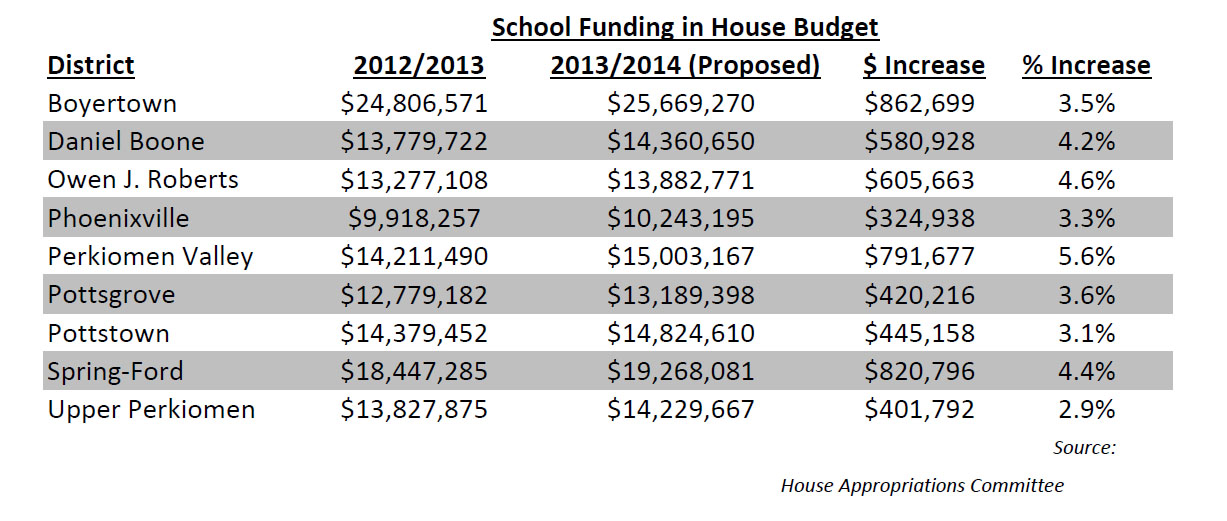
The story ran with this spread sheet I put together with information released every year by the House Appropriations Committee.


As you can see, the largest increase in total dollars, as well as the largest percentage increase, went to the Perkiomen Valley School District, not exactly a poor district, but also twice the student population of Pottstown or Pottsgrove. 

The smallest increase, again by dollars and percentage, went to Upper Perkiomen, followed by Pottstown in a close second.

I have conducted this analysis over the past several years as a way to localize the state budget's impact on the school districts we cover. 

But, quite understandably, Stoll has a different job and he has a Harrisburg perspective on these things. 

I imagine he sees things from the standpoint of who gets the largest share of the state budget pie on a more state-wide scale.

We, on the other hand, look at things from the standpoint of how much does the budget provide to the school districts we cover? Which of those got the most/least? How does that compare to last year?

But Stoll raised an excellent point.

"As you see in the attachment, Pottstown gets the largest per-student amount of any Montco school (Aside from Bryn-Athyn and their 7 students) and receives the largest percentage of their total funding from the state," Stoll wrote in his e-mail to me.

This is the attachment that he is referring to:


The figures he is pointing to are the $4,647 per student figure and line that shows Pottstown gets 33.6 percent of its revenue from the state under the budget passed by the House.

Two other local districts, Upper Perkiomen at 33.3 percent and Pottsgrove at 26.7 percent, come in right behind Pottstown.

(We will ignore, for the sake of brevity, the fact that the state once funded 50 percent of most school budgets, because that will further complicate an already complicated discussion.)

The other districts, as the chart above shows, must raise much more of their revenue from local sources, which means mostly property taxes.

"As I am sure you know, school funding is driven out by a funding formula that takes into account a district’s wealth and their ability to raise money locally. This formula delivers a larger amount of state funds to poorer school districts," Stoll wrote.

I had believed this to be true under Gov. Rendell, a change which came about as the result of the "costing out study," which looked at how much successful school districts spend per student, and trying to apportion state funding along the same lines.

The Pennsylvania School Funding Campaign, described it like this: the study "was to determine what it costs for all of our students -- no matter where they live -- to attain state academic standards. The study of equity was to address the growing gap between high- and low-spending districts."

To no one's surprise, the study, completed in December 2007, "concluded that Pennsylvania was under-funding K-12 education by more than $4 billion and that the system then in place relied too heavily on local property taxes."

The result of the change in formula was that Pottstown began getting a larger share of funding, funding which was applied largely to early education efforts and which bore fruit with higher test scores in the elementary grades, all of which made Adequate Yearly Progress in 2009.

However when Gov. Corbett took office, through no fault of his own he inherited a budget that had plugged a very large revenue hole drive by the financial crisis with about $700 million in federal stimulus funding, a gap that had to be closed. 

No one envied him that task.

But his solution was a little ham-handed. He proposed to "level-fund" schools with the same amount of state money spent the year before.

This solution had the Harrisburg view, not the local view. Because locally, it was anything but "level."

As we reported in May, 2011, Corbett’s initial budget proposal, when analyzed by Good Schools Pennsylvania, "showed each Pottstown School District student will get $609 less in state funding under the plan. Each classroom in the district will lose more than $15,000 in state funding."

"At the other end of the spectrum, each Lower Merion student will lose only $83.81 — or $2,095 per classroom — under Corbett’s plan," we reported in 2011.

That may have been because, as Stoll has pointed out, Pottstown was getting more state funding per student to begin with, but it sure didn't seem like "level-funding" to local school officials scrambling to balance budgets.

Ultimately, the impact that year was less severe than Corbett had first proposed, but Pottstown and other districts still had to cut a number of teaching and administrative positions and toyed with shutting down music and art programs as a way to close its budget gap.

I had the impression that the 2011 budget did away with the funding formula that steered more money, proportionally, to lower-income districts.

But Stoll tells me that is not the case and I have no reason to doubt him.

After all, as a staffer in the House Appropriations Committee, he is surely in a better position to know than I am. 

However, it is hard to square with information I put together in this chart for a story last year on Corbett's budget proposal.


I suppose the difference must be between what Corbett initially proposes, and what the General Assembly finally adopts. 

But even that possibility is undermined by how things shook out locally last year after all the dust had settled:


I think I may be forgiven, after several years of such budget analysis, to have been under the impression that the trend of less school funding for poorer schools was accurate.

Nevertheless, in the battle between what I believed and what the facts are, the facts should win. Trouble is, depending on which set of numbers you use, the fact seems to be mutable.

In a June 17 email, Stoll put it this way:
I understand how the percentages you cite in your story may lead you to think one thing, but as you can see when you look at the details behind the simple percentages, it is a much different story than you portray in your story. “Poorer school districts” clearly receive the lion’s share of state funding. By only talking percentages as you do in your story, you ignore two very important facts — the number of students in the district and the amount of total revenue the districts receives from the state. When you only talk percentage you are ignoring that “poorer districts” receive more of their total revenue from the state.

That is one another thing Stoll and I agreed upon;  that truly the most accurate way to measure state aid is on a "per-student" basis. Ultimately, what reaches each student is what is supposed to make the difference and provide that "level playing field" we all crave for our kids.

I complained that "per-student" information had rarely been provided to us through any state mechanism, and he replied all we had to do was ask. 

Which I did.

This brings us to the next chart (yes, another one), and the second point of discussion between Stoll and myself.

If it is true that poorer school district are getting more state aid than richer districts overall, it sure seems like the increases are tipping in favor of the richer districts.

I made the point to Stoll that the point of the most recent story was in fact to compare increases; and the information we had seen over the past several years suggesting the largest increases were going to richer districts. 

Once we agreed that funding on a per-student" basis is the fairest comparison, surely a comparison of local state aid on a per-student basis would dispel this belief on my part.

So I ran the numbers Stoll sent and put together this chart and I came away feeling undispelled.


Certainly, it does not show the broad disparities that the previous numbers show, although there is a $60 per-student difference from the lowest per-student increase (Phoenixville) and the largest (Daniel Boone).

But notice that Perkiomen Valley's increase per student is only $1 less per student than Pottsgrove's, another struggling district, and only $7 per student less than Pottstown's.

And when you look at the percentage of the increase per student under the House budget plan, notice that again, Upper Perkiomen and Pottstown share the lowest increases.

So color me unconvinced on that score.

Of course (for all of you have read this far without falling asleep, or gone chart-blind) all of this is moot to a large extent.

Corbett's budget proposal is not the final budget.

The House's budget proposal is not the final budget.

Not until the Senate passes a budget, it gets reconciled with the House plan and Gov. Corbett signs it do we get to argue about who got what. 

Up until then, it's all rhetoric.

Even more sobering is that fact that all a final budget truly resolves in these debates is where you point the finger.

The bigger question about the success of an education funding regimen is the final product; what kind of students are we turning out? 

Are we doing all we can to ensure they prepared for the world they will inherit? 

I haven't found a chart yet which answers that question.