Showing posts with label education funding. Show all posts

Sunday, August 28, 2016

The Property Tax Prison of Education Funding

Invisible though they may be to the naked eye, school district borders increasingly trap low-income students in cash-strapped districts struggling to provide the resources available to their wealthier neighbors.


I sometimes wonder how the inherent unfairness that exists in education funding continues without some kind of revolution taking place.

And then I wake up and remember I live in Pennsylvania.

Perhaps because its a bit complicated and takes more than 15 minutes to understand. Perhaps because not enough people feel any kind of connection with those most adversely affected. Or maybe its just the pall of overall apathy.

Usually, people tend to wake up a bit when faced with examples of kids getting the shaft. After all, we all want the best for our children right?

Maybe we need to broaden the definition of "our children" a bit.

Not that we needed any more evidence of the way cleaving to the property tax as the primary funding source for public education undermines students not fortunate enough to live in a wealthy zip code, but there's more anyway.

It comes in the form of a new report by an organization called EdBuild, a non-profit national organization dedicating to bringing "common sense and fairness to the way states fund public schools."

Their study, "Fault Lines," takes a look at America's most segregated school district borders.

From the examination of more than 33,000 borders between school districts, they the chose the worst 50, the 50 places in America where a line on a map separates well-funded public schools from their polar opposite.

It may surprise you to know that those 50 worst school disparities are concentrated in just 14 states and Pennsylvania is tied with New York for third place. Yay.

Both states have six such districts but perhaps the most shameful part about all of it is that borders between Reading City Schools and those wealthier districts which surround it comprise four of Pennsylvania's six worst disparities.

According to the report, 48 percent of Reading's school children live in poverty.

And four of the districts which surround it -- Schuylkill Valley, Governor Mifflin, Wilson and Wyomissing -- have respective poverty rates of just 10 percent, 11 percent, 11 percent and 12 percent.

We all know these communities to some extent or another. And they are the poster children for the three sentences in the report that crystalize what Pennsylvania's property tax-reliant school funding system is doing to our children.
"Socioeconomic segregation is rising in America's schools, in part because of the structure of education funding. the over-reliance on locally raised property taxes to fund public schools gives wealthier communities the permission to keep their resources away
from the neediest schools. This creates a system of school district borders that trap low-income children in high concentrations of poverty, while more privileged peers live in better resourced communities, often right next door."
Now, if that does not describe the conditions under which Pottstown schools labor every day, then slap my face and call me Sally. Obviously, it also describes Reading.

And we need to recognize this is not just affecting "them."

According to the Center for Education Policy Analysis, more than 26 million school children -- 48 percent of all school-age children living in America -- live within the bounds of a high-poverty school district, as cited in  EdBuild's report.

That's half the children in America folks.

Half.

They are "our children."

And as the Fault Lines report sadly observes:
"Often, just on the other side of an invisible but effectively impermeable district border, their more privileged peers live in better-resourced communities and are taught in classrooms where they are able to learn and grow with abundant resources that are unencumbered by the challenges their peers face every day."
That is the reality that half America's children now face thanks to our over-reliance on property taxes and our inability to find another way fund schools.

Those challenges that children in poverty face every day -- and the impact those challenges have on their education -- are well established.

Financial insecurity, high rates of crime, mental, emotional and physical health problems that create trauma in the lives of these young Americans -- literally physiological changes that affect their brain development -- all make succeeding in school that much harder, as if they did not have enough to contend with already.

Add to that limited access to quality early education and its no wonder that they fall behind the minute they walk into their first kindergarten classroom.

To its credit, Pottstown Schools have addressed these problems -- PEAK is a state and national model for providing the best early education possible on a limited budget; and new efforts to understand and address the impacts of trauma on school children are now underway.

But Pottstown schools cannot single-handedly force the state to bridge the funding gap that still exists despite the positive step toward a fair funding formula, and as a result, the school must spend more becoming a driver of the very high-tax, low-tax base merry go-round that creates the problems they face in the first place.

As Pottstown School Board member Thomas Hylton said last week. "We can't keep going on like this. We're going to have to get creative."

And sadly, the burden for untying this Gordian knot will remain firmly on the shoulders of individual school districts so long as our well-paid state legislatures continue to spend their time worrying about meaningless minutiae like who sells us our alcohol instead of how our schools are funded.

It's within Harrisburg's power to address this problem, and to do so with limited political pain, always the top consideration under the copper dome.

An effort now being championed by Pottstown Mayor Sharon Thomas and highlighted by The Mercury in May when former state representative and Monroe County Comptroller Kelly Lewis came to town to talk about an organization called Equity First.

He argued, rather convincingly, that the increase in education funding contained in the two most
recent state budgets can do the most good by setting aside a portion of the new pool of education funding to be targeted specifically to the 180 school districts in Pennsylvania which are underfunded by $937 million every year.

That would still provide more money for the 320 over-funded districts, just not as much.

Pottstown by the way, is Pennsylvania's 14th most underfunded school district. It won't surprise you, given what EdBuild found, to know that Reading is number one on this unenviable list.

Pottstown School District is underfunded every year by $11 million, according to the commission report, said Lewis.

That’s more than 18 percent of this year's $59.6 million Pottstown Schools budget which, by some miracle, did not raise taxes for the second straight year.

Providing an additional share of the additional state educating funding is not a new idea.

In fact it is one of the many recommendations made last year by the fair funding commission, created by former Gov. Tom Corbett and headed by outgoing Republican Representative Mike Vereb of our own Montgomery County, suggesting as much as an additional 10 percent to the underfunded districts over 10 years to help them catch up.

But the General Assembly, in its particular myopic way, focused only on authorizing the formula, not bothering to make sure the funding was arranged to ensure the formula actually does the most good for the schools that need it most.

This allows legislators to go home to the voters and say they did the right thing by "adopting the formula" without most of those voters understanding that they gave out teaspoons to a fleet of floundering ships and said "you're welcome."

As I see it, there are only two ways this changes:
  1. Legislatively, either through the current legislators getting a clue or by replacing them with some who do.
  2. Or Pennsylvanians finally wake up to their raw deal their children are being handed and we get that revolution.

Wednesday, September 4, 2013

Your Chance to Talk Property Taxes, Education Funding

South Hall of Montgomery County Community College's 

West Campus
The House Democratic Policy Committee will hold a public hearing to discuss property taxes and “education funding cuts” at 2 p.m. Monday, Sept. 9 at the Montgomery County Community College’s West Campus South Hall on College Drive.

“The committee will hear from stakeholders — including school board members, superintendents, education advocates and the AARP — who will discuss education funding cuts and their impact on property taxes,” according to information posted on the Facebook page of state Rep. Mark Painter, D-146th Dist.

“Since 2010-11, the average classroom in Pennsylvania public schools has lost $11,575 in annual funding, and the poorest school districts have lost more than $20,000,” Painter posted.

“I remain disappointed that the overall state budget failed to adequately or fully fund public
Mark Painter
education as a whole. While the state legislature completed the budget process in early July, sadly, it did not restore the $1 billion in education funding cuts that Gov. Tom Corbett has delivered and retained in his last two budget cycles,” Painter said in his post.

“Children and their families are adversely affected when school districts are underfunded. This lack of funding, which has been a hallmark of the state budgets under Gov. Corbett, causes many school districts to make hard choices. I don’t support teacher lay-offs or cuts in vital programs such as music and art while property taxes continue to rise,” Painter wrote. “This double-edged sword of diminishing educational programs and rising taxes is unsustainable.”

Sunday, June 23, 2013

Running the School Funding Numbers in the State Budget (Or, I Hope You Like Charts)

Michael Stoll is not particularly happy with me.

Stoll is the communications director for the House Appropriations Committee and he contacted me last week to express his displeasure with The Mercury's story analyzing the House of Representatives budget, and how it affected local districts, which first ran on our web site on June 13.

"Your story and the headline are incredibly misleading and fails to accurately explain how school funding is distributed to school districts," he wrote in a June 14 e-mail to me after the story appeared in print.

The print headline read "$28.3B House budget stiffs poorer school districts in Pa."

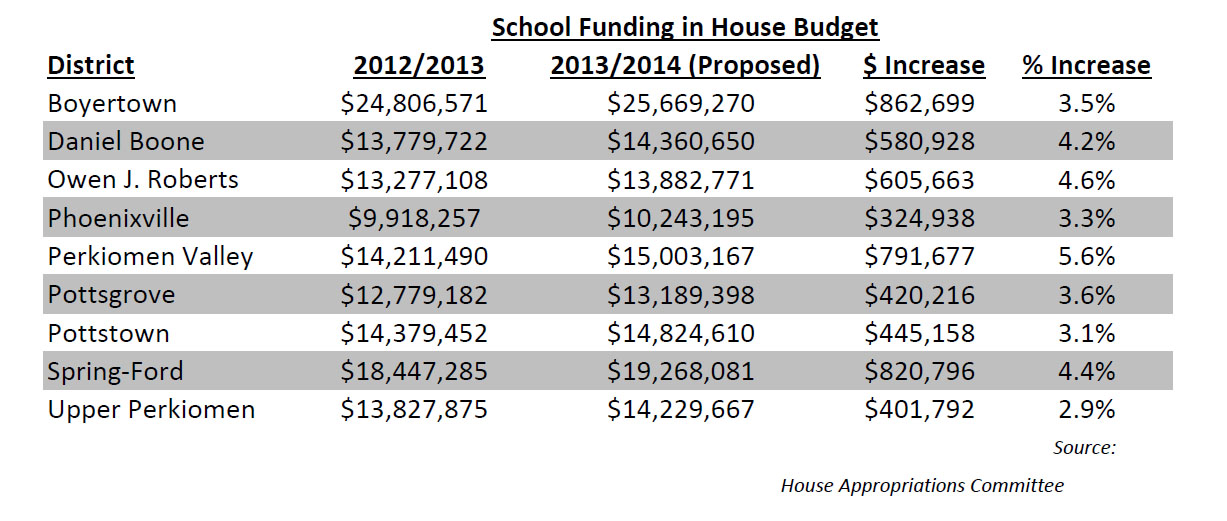
The story ran with this spread sheet I put together with information released every year by the House Appropriations Committee.


As you can see, the largest increase in total dollars, as well as the largest percentage increase, went to the Perkiomen Valley School District, not exactly a poor district, but also twice the student population of Pottstown or Pottsgrove. 

The smallest increase, again by dollars and percentage, went to Upper Perkiomen, followed by Pottstown in a close second.

I have conducted this analysis over the past several years as a way to localize the state budget's impact on the school districts we cover. 

But, quite understandably, Stoll has a different job and he has a Harrisburg perspective on these things. 

I imagine he sees things from the standpoint of who gets the largest share of the state budget pie on a more state-wide scale.

We, on the other hand, look at things from the standpoint of how much does the budget provide to the school districts we cover? Which of those got the most/least? How does that compare to last year?

But Stoll raised an excellent point.

"As you see in the attachment, Pottstown gets the largest per-student amount of any Montco school (Aside from Bryn-Athyn and their 7 students) and receives the largest percentage of their total funding from the state," Stoll wrote in his e-mail to me.

This is the attachment that he is referring to:


The figures he is pointing to are the $4,647 per student figure and line that shows Pottstown gets 33.6 percent of its revenue from the state under the budget passed by the House.

Two other local districts, Upper Perkiomen at 33.3 percent and Pottsgrove at 26.7 percent, come in right behind Pottstown.

(We will ignore, for the sake of brevity, the fact that the state once funded 50 percent of most school budgets, because that will further complicate an already complicated discussion.)

The other districts, as the chart above shows, must raise much more of their revenue from local sources, which means mostly property taxes.

"As I am sure you know, school funding is driven out by a funding formula that takes into account a district’s wealth and their ability to raise money locally. This formula delivers a larger amount of state funds to poorer school districts," Stoll wrote.

I had believed this to be true under Gov. Rendell, a change which came about as the result of the "costing out study," which looked at how much successful school districts spend per student, and trying to apportion state funding along the same lines.

The Pennsylvania School Funding Campaign, described it like this: the study "was to determine what it costs for all of our students -- no matter where they live -- to attain state academic standards. The study of equity was to address the growing gap between high- and low-spending districts."

To no one's surprise, the study, completed in December 2007, "concluded that Pennsylvania was under-funding K-12 education by more than $4 billion and that the system then in place relied too heavily on local property taxes."

The result of the change in formula was that Pottstown began getting a larger share of funding, funding which was applied largely to early education efforts and which bore fruit with higher test scores in the elementary grades, all of which made Adequate Yearly Progress in 2009.

However when Gov. Corbett took office, through no fault of his own he inherited a budget that had plugged a very large revenue hole drive by the financial crisis with about $700 million in federal stimulus funding, a gap that had to be closed. 

No one envied him that task.

But his solution was a little ham-handed. He proposed to "level-fund" schools with the same amount of state money spent the year before.

This solution had the Harrisburg view, not the local view. Because locally, it was anything but "level."

As we reported in May, 2011, Corbett’s initial budget proposal, when analyzed by Good Schools Pennsylvania, "showed each Pottstown School District student will get $609 less in state funding under the plan. Each classroom in the district will lose more than $15,000 in state funding."

"At the other end of the spectrum, each Lower Merion student will lose only $83.81 — or $2,095 per classroom — under Corbett’s plan," we reported in 2011.

That may have been because, as Stoll has pointed out, Pottstown was getting more state funding per student to begin with, but it sure didn't seem like "level-funding" to local school officials scrambling to balance budgets.

Ultimately, the impact that year was less severe than Corbett had first proposed, but Pottstown and other districts still had to cut a number of teaching and administrative positions and toyed with shutting down music and art programs as a way to close its budget gap.

I had the impression that the 2011 budget did away with the funding formula that steered more money, proportionally, to lower-income districts.

But Stoll tells me that is not the case and I have no reason to doubt him.

After all, as a staffer in the House Appropriations Committee, he is surely in a better position to know than I am. 

However, it is hard to square with information I put together in this chart for a story last year on Corbett's budget proposal.


I suppose the difference must be between what Corbett initially proposes, and what the General Assembly finally adopts. 

But even that possibility is undermined by how things shook out locally last year after all the dust had settled:


I think I may be forgiven, after several years of such budget analysis, to have been under the impression that the trend of less school funding for poorer schools was accurate.

Nevertheless, in the battle between what I believed and what the facts are, the facts should win. Trouble is, depending on which set of numbers you use, the fact seems to be mutable.

In a June 17 email, Stoll put it this way:
I understand how the percentages you cite in your story may lead you to think one thing, but as you can see when you look at the details behind the simple percentages, it is a much different story than you portray in your story. “Poorer school districts” clearly receive the lion’s share of state funding. By only talking percentages as you do in your story, you ignore two very important facts — the number of students in the district and the amount of total revenue the districts receives from the state. When you only talk percentage you are ignoring that “poorer districts” receive more of their total revenue from the state.

That is one another thing Stoll and I agreed upon;  that truly the most accurate way to measure state aid is on a "per-student" basis. Ultimately, what reaches each student is what is supposed to make the difference and provide that "level playing field" we all crave for our kids.

I complained that "per-student" information had rarely been provided to us through any state mechanism, and he replied all we had to do was ask. 

Which I did.

This brings us to the next chart (yes, another one), and the second point of discussion between Stoll and myself.

If it is true that poorer school district are getting more state aid than richer districts overall, it sure seems like the increases are tipping in favor of the richer districts.

I made the point to Stoll that the point of the most recent story was in fact to compare increases; and the information we had seen over the past several years suggesting the largest increases were going to richer districts. 

Once we agreed that funding on a per-student" basis is the fairest comparison, surely a comparison of local state aid on a per-student basis would dispel this belief on my part.

So I ran the numbers Stoll sent and put together this chart and I came away feeling undispelled.


Certainly, it does not show the broad disparities that the previous numbers show, although there is a $60 per-student difference from the lowest per-student increase (Phoenixville) and the largest (Daniel Boone).

But notice that Perkiomen Valley's increase per student is only $1 less per student than Pottsgrove's, another struggling district, and only $7 per student less than Pottstown's.

And when you look at the percentage of the increase per student under the House budget plan, notice that again, Upper Perkiomen and Pottstown share the lowest increases.

So color me unconvinced on that score.

Of course (for all of you have read this far without falling asleep, or gone chart-blind) all of this is moot to a large extent.

Corbett's budget proposal is not the final budget.

The House's budget proposal is not the final budget.

Not until the Senate passes a budget, it gets reconciled with the House plan and Gov. Corbett signs it do we get to argue about who got what. 

Up until then, it's all rhetoric.

Even more sobering is that fact that all a final budget truly resolves in these debates is where you point the finger.

The bigger question about the success of an education funding regimen is the final product; what kind of students are we turning out? 

Are we doing all we can to ensure they prepared for the world they will inherit? 

I haven't found a chart yet which answers that question.


Wednesday, May 29, 2013

Prison Expansion Protested in Pottstown

Prison expansion protesters marching from Philadelphia to Harrisburg staged a rally outside the Pottstown Regional Public Library Monday.


Blogger's Note: We received the following press release from Decarcerate PA:

Two dozen marchers making their way from Philadelphia to Harrisburg rallied at the Pottstown Regional Public Library Monday afternoon to demand an end to prison expansion and education cuts. 

The march is being organized by Decarcerate PA, a grassroots coalition, and is co-sponsored by a broad alliance of community groups, nonprofits, labor organizations, education advocates, and formerly incarcerated organizers. 

The “March for a People’s Budget: Stop Prison Expansion Now!” began on May 25th and is scheduled to arrive in the state capital on June 3rd—just as the legislature returns to debate the budget. 

The marchers are demanding that the General Assembly take a stand against Pennsylvania’s out-of-control prison growth. In particular, they are asking legislators not to grant the Department of Corrections its requested $68 million increase in funding while prison construction continues, and to cancel the $400 million prisons slated to be built on the grounds of SCI Graterford in Montgomery County.

Marchers arrived in Pottstown dressed as construction workers, holding “stop signs” reading “STOP Prison Expansion” while dancing and chanting, “Fund education, not incarceration!” 

The marchers are calling attention to the impact of recent budget cuts on Pottstown. “Pennsylvania does not want, does not need, and cannot afford any more prisons,” said Decarcerate PA member Brian Mertens. 

“We want to see our taxpayer dollars invested in the things that make our communities stronger, like education, health care and social services, not in building more prison cells.” 

The Pottstown School District has seen cuts of more than $1.5 million between 2010-2011 and the proposed budget for next year. Meanwhile, Governor Corbett’s budget for 2013-2014 includes a $68 million increase for the Department of Corrections, even as his administration claims the prison population is decreasing.

“We’ve written letters, circulated petitions, held protests, and even engaged in nonviolent acts of civil disobedience,” said Leana Cabral of Decarcerate PA, who was arrested in November for blocking a prison construction entrance with a school desk and an apple. 

“Governor Corbett and legislators like to talk about being prison reformers, but they don’t walk the walk. So we’re walking all the way to Harrisburg to make sure they know we won’t go away until Pennsylvania stops building prisons and starts reinvesting in our communities.”

Sunday, April 8, 2012

Has the American Dream Been Left Behind?

The wildly successful "Left Behind" book series imagines a series of events that revolve around what the "end times" some see described in the Bible's Book of Revelations.

But recently, I have had a few revelations of my own, and I think if something doesn't change, what we may already be witnessing is the "end times" of the American Dream as more and more Americans get "left behind."

It all starts, as so many things do, in our schools; or at least it is one of the places where it is most clearly reflected.

Conducted by Stanford University over 50 years, a new study has found that the gap in student achievement between students of rich families and those from poor families continues to widen.

Stanford researcher Sean Reardon found that the gap in test scores between the higher income and low-income children has grown by about 40 percent and is now nearly twice as large as the achievement gap between white and African-American students.

 "If you have money, generally your neighbors have money, which means you probably have access to better child care and preschools, and better elementary schools, parks and libraries," Reardon told the Stanford University News in this Feb. 13 article..

 
Cuts to social programs over the past several decades also may have had an effect, Reardon said.

"It's harder to be poor in America than it used to be," he said. "Some aspects of the social safety net have gotten weaker, and programs to help families through hard times have been dismantled."

Stanford researcher Sean Reardon
"It means that it's harder and harder to achieve the American dream that says it doesn't matter where you start, as long as you work hard you can rise above," he said.

Certainly, through history, family wealth has provided an advantage.

But there was a time in America when a good public education leveled that playing field, so that talent and ability allowed our best minds to rise to the top, what the founding fathers envisioned as a "meritocracy."


Now, as concerted efforts to use what's wrong with public education as a rationale to slowly starve public education continue to gain traction, it's what your parents portfolio holds, rather than what your skull holds, which pre-determines your success.

"We had expected the relationship between family income and children's test scores to be pretty stable over time. It's a well-known fact that the two are related,"Readon told the Stanford publication

Fareed Zakaria
"But the fact that the gap has grown substantially, especially in the last 25 years, was quite surprising, striking and troubling," he concluded.

Not surprising, but equally troubling was a recent post I saw on Fareed Zakaria's  GPS blog.

It suggests that as a society, we would rather imprison our youth then educate them.


"In the past two decades, the money that states spend on prisons has risen at six times the rate of spending on higher education," Zakaria wrote. 

"In 2011, California spent $9.6 billion on prisons, versus $5.7 billion on higher education. Since 1980, California has built one college campus; it's built 21 prisons. The state spends $8,667 per student per year. It spends about $50,000 per inmate per year."

As former Pottstown Borough Council President Jack Wolf once sagely said to me, "no matter what people say, look at their budget to see where their priorities are."


If that's true, and in a nation obsessed with wealth I think it's fair to assume it is, it is a sad commentary on what we have done to the American Dream Readon described and what Teddy Roosevelt, another president navigating the waters of an obscene wealth gap, used to call "the square deal."

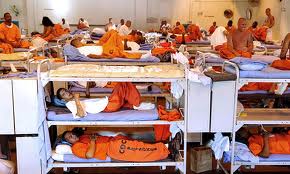
An undated photo from the California Corrections Dept.
It's more than money, it's people.


"The total number of Americans under correctional supervision (prison, parole, etc.) is 7.1 million, more than the entire state of Massachusetts," wrote Zakaria.

He added that. "Adam Gopnik writes in the New Yorker, "Over all, there are now more people under 'correctional supervision' in America...than were in the Gulag Archipelago under Stalin at its height."


America was once the "land of opportunity," where even if you didn't want to conquer wall street, a good public education and a good work ethic meant a good shot at a good job and that could support a family without mortgaging their future.


But those jobs seem fewer and far between these days and more and more families continue to slip beneath the poverty line where, the Stanford study tells us, their children will be statistically less and less able to achieve in school, dooming them to repeat the cycle and increasing the likelihood they will end up behind bars.

When you look at the long view, it becomes obvious that in many ways, we are shooting ourselves in the foot because the status quo is simply unsustainable.


Consider this demographic inevitability -- we're getting older.

By 2030, seniors will be 20% of the U.S. population
According to this blog on The New York Times web site: "In 2008, an estimated 39 million people in the United States were 65 or older — just over 13 percent of the population. By 2030, when all surviving baby boomers will be over 65, the report projects there will be 72 million seniors, about 20 percent of the population."

"Living longer does not come cheaply, the blog reports. "After adjustment for inflation, annual health care costs for the average senior increased from $9,224 in 1992 to $15,081 in 2006."

Ouch.

So we will be living longer, have fewer people working to pay into Social Security and Medicare and have more people than ever requiring more expensive medical care.

By itself, this demographic is frightening enough.

But now multiply the fiscal impact by the number of people who could be educated and trained to contribute toward those costs, but who we are incarcerating instead, making them a drain on our  society and economy instead of a resource.

Is this the only option left for paying our
medical costs as seniors?
Scared yet?

I am.

To better understand how a drop in the number of working-age adults affects an economy supporting a large senior population, read Megan McArdle's excellent analysis of Europe's financial problems in this month's Atlantic magazine.

The basics are that for an economy to grow its way out of deficit, which is the more efficient and less painful way than cutting costs, it needs a steady population growth to provide the workers and consumers that will push the economy toward health.

It also needs young people who are at the start of their earning cycle, and willing to take risks, rather than those at the end who, quite naturally, want to conserve what they have to live their remaining years in comfort.

But now, even those who are not yet at the end of the earning cycle, want their pile to be bigger.

Not only is America getting demographically heavy at the tail end of the life cycle, we are hoarding the money and keeping it from funding an adequate education that not only provides productive citizens to pay for our golden years, but also keeps them out of jail.

Not only is this morally preferable, but it's far less expensive, to educate children rather than to imprison them.

(But for some reason, it's far less politically palatable. I would hate to think the reason for that is that,  according to the Federal Bureau of Prisons, blacks makes up nearly 40 percent of the federal prison population but only 13 percent of the total population of the nation over all, according to the U.S. Census.)
Even Wall Street is starting to see the undeniable.

Not only is it wrong, it's unsustainable.

Even Wall Street is getting clued in to the fact that we are shooting ourselves in both feet.

A report last fall in Bloomberg noted that: "A widening gap between rich and poor is reshaping the U.S. economy, leaving it more vulnerable to recurring financial crises and less likely to generate enduring expansions."

"Left unchecked, the decades-long trend toward increasing inequality may condemn Wall Street to a generation of unimpressive returns and even shake social stability, economists and financial-industry executives say," Bloomberg reported.

Since 1980, about 5 percent of annual national income has shifted from the middle class to the nation’s richest households. That means the wealthiest 5,934 households last year enjoyed an additional $650 billion -- about $109 million apiece -- beyond what they would have had if the economic pie had been divided as it was in 1980, according to Census Bureau data, Bloomberg reported. 

“Income inequality in this country is just getting worse and worse and worse,” James Chanos, president and founder of New York-based Kynikos Associates Ltd., told Bloomberg Radio. “And that is not a recipe for stable economic growth when the rich are getting richer and everybody else is being left behind.”

Remember when we pledged that there would be "No Child Left Behind?"