Showing posts with label Mitt Romney. Show all posts

Wednesday, May 22, 2013

The Vote


So if we're all lucky, you're reading this after having voted and seen some of the results come in -- the "will of the people."

As I write this Tuesday afternoon, the local results are unknown.

But what's important in a big picture kind of way, is that there will be results -- not something you can say in lots of places in the world, or at least not results you can believe.

Most Americans view voting as a commonplace thing; something you do twice a year if you remember.

African-Americans had to fight for fair voting rules.
But it is one of the few places that the corporate oligarchs who control so much of what happens in this country -- where you live, what you're paid, what you know -- do not yet fully control.

At least for now.

One way to control voting is to control who votes.

Just ask blacks in the Jim Crow south; and women before 1920 when the 19th Amendment was ratified.

Since its inception, much of the democratic history of our great Republic has been a history of limiting voting to those likely to continue the policies and viewpoint those who benefit from being in power.
So did women.

And a parallel, often lesser-known history, has unfolded in the fight by those disenfranchised by such efforts to win the right to vote.

I'll spare you the usual, well-worn axioms that if you don't vote, you can't complain; or that (some) veterans died to preserve the right to vote.

(Many, such as those who fought in undeclared wars in the Philippines, Vietnam and Iraq, mostly fought to advance the "American interests" of the oligarchs of their day. This does not make their sacrifice any less noble, only more tragic.)

The fact that such well-worn arguments about voting are so often trotted out at election time doesn't make them any less true.

Sadly, if voter participation rates are any indication, too few Americans find them inspirational enough to motivate them to actually vote.

But if the recent debate over background checks for gun purchasers is any indication, nothing motivates a person who takes their unused rights for granted more than a perceived effort to take them away.

So perhaps there is a re-surgence in the offing.

Like it or not, there are efforts out there to undermine your right to vote -- unless you're a rich white guy that is.

Like it or not, the "typical" American voter is no longer
a white male. Get used to it.
As the inexorable crush of demographics changes the face of the "average American," like a tsunami of molasses that you see coming slowly but can do nothing to avoid, Hispanics will soon be the majority of this country.

And they vote.

The Obama campaign recognized this and capitalized on it as the national GOP continued to convince itself it would win with a 12-foot fence along the Mexican border.

(Don't worry Republicans, if the Democrats are true to form, they will soon begin to take the loyalty of most Hispanic voters for granted and fritter away their present demographic advantage.)

There is a segment of the Republican party that recognizes this wave, and believes the party needs to do more to appeal to this demographic -- mostly they are realists who govern southern states that already have large Hispanic populations that must be wooed to win.

There is another segment that hopes to win by finding ways to keep that wave away from the polls, which brings us back to the subject at hand.

If you do not think such efforts are underway, then you probably don't vote
either.

If you did vote yesterday, you may have been asked for photo ID, and you would have been legally permitted to refuse and vote anyway.

But that may not be true much longer.

When the Pennsylvania courts suspended Pennsylvania's Voter ID law for the presidential election, and yesterday's primary that followed, it was only delaying the inevitable.

PREMATURE BRAGGART?: Mike Turzai's bragging came 
a little too soon
And if you think this is about preventing fraud, you would work needlessly to find a single example of in-person voter fraud, which is the only thing Voter ID stops.

As famously loud-mouthed Pennsylvania Rep. Mike Turzai made prematurely evident, the entire scheme, cloaked in a shroud if "integrity" was largely about keeping some people from the polls -- people the least likely to have a photo ID as a matter of course.

That means blacks, Hispanics and, of course, the poor.

If you want a taste of the impact of the law's potential consider that "poll workers
wrongly demanding to see photo ID from Pennsylvania voters – especially voters of color – were the most common problem reported during last November’s federal election."

That was the information presented in January to the Democratic Policy Committee Hearing on Voter ID Law & Early Voting.

Pennsylvania voters placed 9,171 complaint calls to the Election Protection hotline on Election Day, second only to California. The number one issue: poll workers wrongly demanding voters show a photo ID.

How PA voted in 2012
Having lost Pennsylvania's electoral votes for Mitt Romney, the Republicans tried a new tac -- change the "winner-take-all" aspect of Pennsylvania's Electoral College votes.

"Split them proportionally," they said, arguing its more "representative" of how the state votes.

In February, The York Dispatch's editorial board put it better than I could:
It's a ploy being considered by Republicans in several other swing states, and one endorsed by GOP National Committee Chairman Reince Priebus after President Barack Obama's re-election.
"I think it's something that a lot of states that have been consistently blue that are fully controlled red ought to be looking at," he said last month.
And the consistently red states? They presumably would continue allocating all of their electoral votes to the winner, meaning the only effect of changes like Pileggi is suggesting would be to siphon electoral votes from Democratic candidates.
It's a shameless attempt to rig the system, but better than the one Pileggi floated last year. That one would have allocated electoral votes based on our congressional districts -- our heavily gerrymandered congressional districts.
Me? I say it doesn't go far enough.

If the Republicans want a truly representative Democracy, let's do away with the Electoral College all together.
Seven of the 10 most populous states voted blue in 2012.
Do Republicans really want to start a conversation about
distributing votes proportionally? OK.

Do they really want to live in a country where the "representative" weight of the ten most populous states -- California, Texas, New York, Florida, Illinois, Pennsylvania, Ohio, Georgia, Michigan, North Carolina, which together represent   53.3 percent of the total U.S. population -- decide every presidential election?

Of those states, only Texas, Georgia and North Carolina have voted reliably Republican since 1992, with North Carolina going for Obama in 2008 and George going for Clinton in 1992.

They realize, one hopes, that under such a "popular vote" scenario Al Gore would have been the president who responded to the 9/11 attack.

Yeah, I would imagine their taste for "representation" would dwindle quickly.

The true idiocy of it all is that each state sets its own rules for voting. 

To my knowledge, no other Democracy on Earth does this.

We are one nation. We fought a bloody war over "states rights," and the states rights people lost.

We need one voting system for the nation, so Ohio can't use the power of an incumbent Republican attorney general to narrow the voting window in Democratic areas and leave it broad in Republican ones.

If you wanted to be picayune, I suppose you could have state voting rules for state and local races, but in truth that would just be even more confusing.

In March, President Obama created a commission to look into just that possibility -- away to standardize voting access and registration across the country.

According to the Associated Press: 
The top lawyer for Obama's re-election campaign, Bob Bauer, will co-chair the commission with the top lawyer for Republican Mitt Romney's campaign, Ben Ginsburg.
The goal is to address issues including long lines at the polls, voter registration and voter access.
Invariably, we come together as one nation during a crisis. 

Shouldn't we all vote under the same rules and regulations when we collectively perform the one tasks which literally defines us a nation?

Saturday, November 17, 2012

Obama Landslide at Lincoln Elementary!


Blogger's Note: School information mogul John Armato has sent us the following information about election results at Lincoln Elementary School, where President Barack Obama was the preferred candidate.

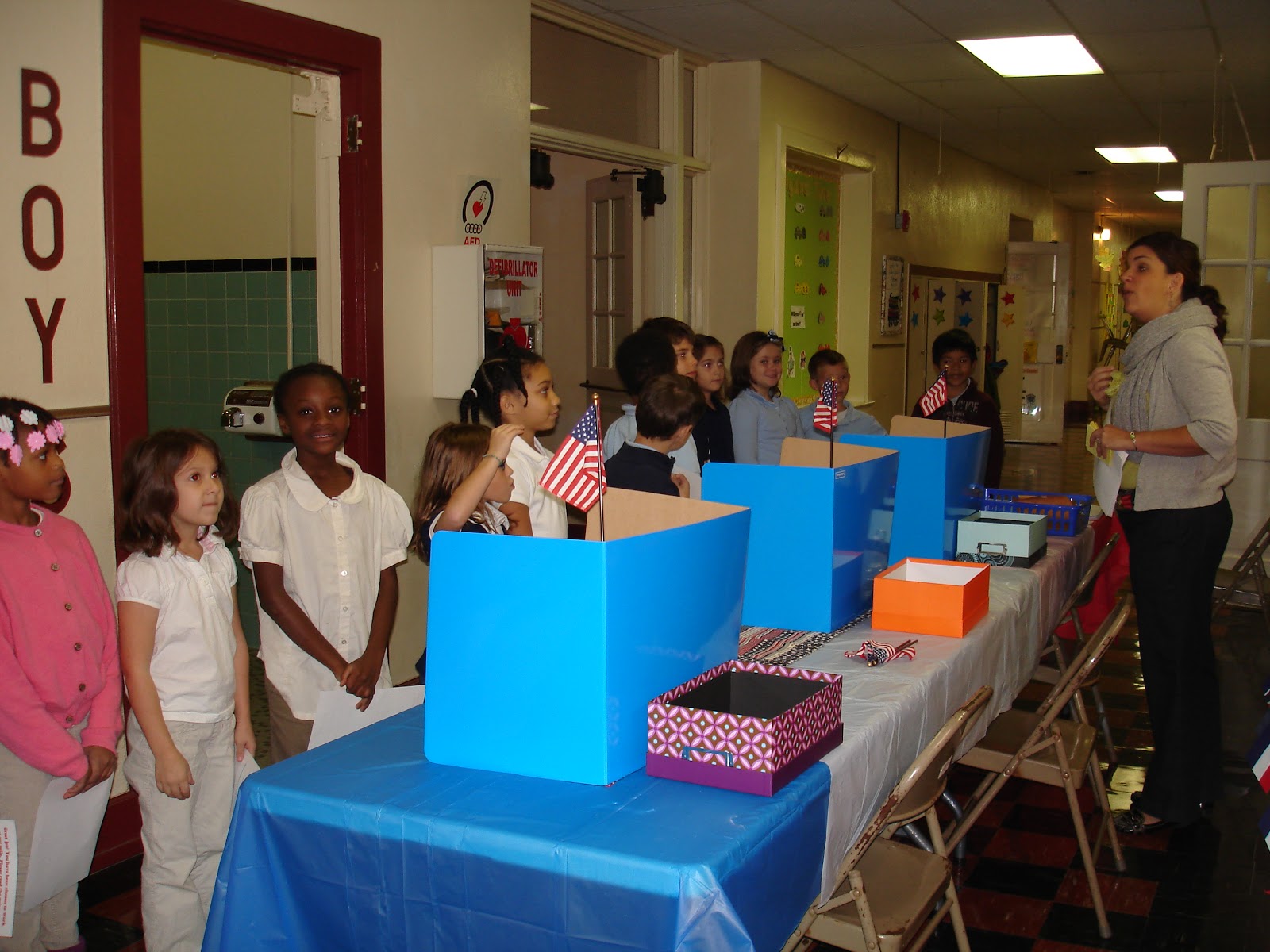
The students at Lincoln Elementary School learned valuable lessons about democracy in our country by studying the electoral process and participating in a school-wide mock election for the presidency of the United States.

Second grade students, under the direction of teachers Leslie Swartz, Heather Kurtz, and Jill Bolonski, organized the school-wide election.

Second graders were particularly excited in the days leading up to the election. Lessons in class gave students an understanding of the political parties, conventions, debates, campaigns, and electoral votes.

Each class signed up for a time to vote. Students were issued voter registration cards and as the classes approached the voting booth they were greeted by second graders who served as poll workers.

Students were given ballot sheets to cast their vote and expressed a great deal of excitement to vote for their favorite candidates.

“This experience involved learning across the curriculum for Lincoln second graders, providing a look at ‘election vocabulary,’ writing experiences, problem solving, and an overview of our American government," said Lincoln Principal Treena Ferguson. "It gave them a meaningful and relevant connection to an important event in our country and left a lasting impression on becoming a responsible citizen.”

The results of the election saw Barack Obama the winner, by a landslide, earning all 50 of the school’s electoral votes and a popular vote margin of 263-47.

(Blogger's Joke: I will leave to you gentle reader to ponder the irony of Gov. Romney's "47" votes.)

Second grade teacher Leslie Swartz evaluated the activity as a tremendous success.

 “The entire school benefited from the activity because it was relevant to what was happening in our nation, it provided an opportunity for teachers to discuss the political process, and students were able to see how a group of citizens come together in a peaceful way to exercise their right to vote; something they will do one day as an adult.”

Thursday, November 8, 2012

It's the Numbers Stupid (an election post-mortem one day too late).

(Blogger's note: I learned after I wrote this post Wednesday that Quigley has not yet conceded and wants to wait until all the absentee votes are counted. If it changes the outcome of the race, we'll have to see how relevant the analysis below really is.)

Tom Quigley's loss Tuesday night in the 146th district statehouse race was a surprise to nearly everyone -- except maybe Tom Quigley.

(DISCLAIMER: Understand Mark Painter fans, this is not a knock on your candidate, who is an earnest and viable candidate. I'm sure he will do fine. This is just a post-election look at the numbers).

Were I a younger man, I would have written this Tuesday night for you all to read Wednesday morning, which is when such analysis is traditionally published.

Tom Quigley
But I'm getting older and Tuesday night was difficult enough as it was and, frankly, I just didn't have the energy.

Anyway, back to my engaging lead sentence.

Obviously, I've known Quigley for many years, ever since he won the seat and took over for the previous Republican holding the seat, Mary Anne Dailey, who took over from the previous  Republican who held if before her ... and so on and so on.

You get the idea.

Anyway, several years ago, Quigley calmly explained to me how well he understood his district.

Given Pottstown's tendency to vote for Democrats, the 146th has always been a balancing act.

He told me, and I'm paraphrasing here: "I know if I break even in Pottstown or fall just short, I'll be OK because I can make it up elsewhere in the district."

And given that the Republican Party in the 146th has the most effective vote counting apparatus around, I've watched those numbers get counted there many times over the years.

As retired dISTRICT Judge Tom Palladino and I were reminiscing Tuesday night, on many election nights I've sat at the right hand of the numbers compiler (or at least looked over their shoulders) since it was Janet Garner in the Elks Club on High Street, using a adding machine and a pencil and, for all intents and purposes, wearing a green eye shade.

Now we use spreadsheets.

And for the numerically challenged among us (Yes, I'm head of the class), spreadsheets really paint a plain picture.

Along the right hand side of where the vote totals for each votingprecinct were being entered, was a number showing by how much Quigley was either ahead or behind in each township, or the borough.

As a result, Quigley knew how close it was going to be early on and each precinct that came in was crucial.

How ironic, I thought, that the clearest evidence that "every vote counts" comes in a year when an unprecedented number of people voted. (More on that later).

All numbers are, of course, unofficial, and include no provisional ballots. But the picture they paint is clear nonetheless.

In Limerick, Quigley was ahead by 657 votes; in Lower Pottsgrove by 487 votes.

In Upper Pottsvgrove he was ahead by 299 votes and in the southern portion of New Hanover that is part of the 146th, he was ahead by 290 votes.

So where was the loss?

Well, in West Pottsgrove he was down by only 51 votes and in Royersford, of all places, by 94. Although surprising, that sure wasn't enough.

Mark Painter
It was in Pottstown, where there was no shortage of straight-ticket voting, that Painter won his victory. There, Painter was ahead by 1,914 votes.

With just one precinct to go, Quigley was down by 326 votes, and he needed the results from Limerick's second voting district, headquartered at the township building on Ridge Pike and home to more than 2,000 registered voters, to make up the difference.

In previous elections, Quigley had won that precinct handily, but this was no regular election and although he won it, he did't win it by enough.

Throughout the 146th, and the county as a whole, voters had turned out in droves and not in the usual patterns.

There was huge voter turn-out Tuesday.
According to unofficial results posted on the Montgomery County web site, no Pottstown polling place had fewer than 400 voters. This in places that are lucky to break 100 in an off-year election.

Those same results show nearly 75 percent of Montgomery County's eligible voters showed up at the polls.

Maybe that's why lines of voters in places like Upper Pottsgrove and New Hanover were out the door and, in Upper Pottsgrove's case, even snaked down Farmington Avenue.

In places like Pottstown's first ward, Obama won more than 80 percent of the vote.

"I think for some of these voters, they weren't even cognizant of the races lower down on the ticket," said Quigley. "Many of them probably did't even know who Tom Quigley is."

As you moved away from the borough's core, the Obama percentages dropped, but were still significant -- 60 percent at Pottstown Middle School.

And it was the numbers, not just the percentages, that really created the wave that blew Quigley out of the water.

The middle school hosted more than 1,200 voters. It is sometimes lucky to break 200, said Judge of Elections Mark Lawler.

In the fourth ward, it was the same -- more than 1,200 voters, 56 percent of whom voted for Obama. In wards five and six, the same: More than 1,000 voters and Obama won both, clocking in at 62 and 63.5 percent respectively.


More interesting was Pottstown's gloriously divided seventh ward.

Voting at the Ricketts Center, just under 1,000, gave 82 percent of its vote to Obama. Further down the ticket, painter won 646 votes to Quigley's 161.

In the Seventh Ward's Rosedale section, Romney won 54.5 percent of the vote and Quigley got 400 votes to Painter's 240.

But while Pottstown's Obama tsunami gave Painter a crucial and immediate advantage, there was a more subtle shift evident as well.

Many more were voting Democratic even outside Pottstown.

Consider some of the totals from the presidential race, totals that actually had me muttering "unbelievable" under my breath.

In Lower Pottsgrove's second district, all results for Obama Vs. Romney were literally within 20 votes of each other, with Obama winning all of them.

Obama won in West Pottsgrove as well and even in Upper Pottsgrove, where Romney won, it was only by a mere 41 votes.

In his analysis Tuesday night, Quigley mentioned not only the Pottstown tsunami, but the changing demographics in places like Limerick, which had previously served as his back-stop.

Limerick hasn't changed that much, with Romney winning all but the fourth precinct.

But Quigley could have made his demographic observation about the entire district, or even the entire county.

Obama squeaked out a victory in some unexpected places, like precincts of affluent Upper Providence and he won two out of three precincts in Collegeville, and one out of three in Perkiomen Township, although Obama was a lost cause in neighboring Trappe.

The same was true in Douglass (Mont.), where Romney held a comfortable lead, as he did in all three New Hanover voting precincts.

But even in places like Schwenksville, Pennsburg, East Greenville and Green Lane, Obama won, barely, and in Red Hill, it was a an effective draw.

And Obama won in two out of three precincts in Skippack, those wins by sizeable margins too.

And in Royersford, Quigley's home town where he was once a popular mayor, turnout in the borough's second voter precinct, where Obama won by 204 votes, Quigley lost by 72 votes.

It seems, therefore, when looking at the numbers, that Quigley lost the election probably not because of anything he did, or Mark Painter did, but because in the 146th, Barack Obama either won most contests or at least fought Romney to a draw.

The election machine tickets told the story.

I didn't have time to check them all, and not all precincts arrived at the old Lakeside Inn that way. (Remember, we still had a newspaper to get out for Wednesday.)

Also, the results posted on the county web site do not list the percentage of straight party voters, but on those tickets I did get to examine, it was an obvious factor.

So what does all this number-crunching mean?

The answer is surprisingly simple.

Every vote counts.

And even in the face of efforts to suppress votes through voter ID, or draw district lines so heavily Democratic or Republican voting blocks can be balanced out by other areas -- a big turn-out can turn all those careful calculations on their head.

And although I find it inspiring, it also stirs the cynic in me to safely predict it won't happen again for another four years, and even then only if we're lucky and the presidential race is as hotly contested as this one was.

In the meantime, for local elections that have a disproportionately larger effect on our lives, the numbers will, in all likelihood, tell a different story.


Saturday, November 3, 2012

Back in the Swing of Things

PA may be a swing state again, just in time for the election.
True to its fickle nature, Pennsylvania has prove once again that you can't afford to ignore it.

Why do I say this, because the ever-changing state of the presidential race now has us back in the swing state category -- at least according to the Washington Post.

Thursday, the paper reported that former Massachusetts governor and Republican nominee Mitt Romney now sees light between the voters and the state's electoral votes.

In addition to Pennsylvania, Michigan and Minnesota are also viewed by the Romney camp as being within reach.

How do we know this? Why money of course. That's all that matters in politics any more.

Following on the heels of buys by the Super-PACS that are supporting (but not coordinating) with his campaign, Romney's campaign is now spending its own money as well for ad buys in both Pennsylvania and Minnesota.

"In response, Obama’s campaign has thrown ads on television in all three states but advisers said the decision was made out of prudence, not concern," according to the Post.

"Unlike in past presidential campaigns, both sides are flush with cash and have extra funds to play with down the stretch," the paper reported.

So what does that mean for you and I?

Campaign ads. Endless, nauseating, negative campaign ads.

It was just two months ago that I bemoaned our loss of status as a swing state. I guess you should be careful what you wish for.

But hey, that's the price we pay for being in a place where our opinions cannot be taken for granted.

So there you have it folks. We may well be among the crucial American voters who decide this election.

Please don't make your decision based on the ads.

Go the candidate's web sites:
-- Barack Obama
-- Mitt Romney

Find out what you can. Check out factcheck.org for some actual information on the whoopers being told by both sides.


Friday, September 14, 2012

We Don't Mean a Thing if We Ain't Got that Swing (State)

Is Pennsylvania a "swing state" no more?

Well, folks, it appears that both presidential campaigns have decided to leave us Pennsylvanians alone for a while.

Mary Wilson, over at WHYY's Newsworks web page, reports that Mitt Romney and Barack Obama seem to agree on one thing after all -- Pennsylvania may not be a swing state in the November election.


"Shortly after the Republican National Convention, two Romney-allied super PACs announced they would pull their television ads out of Pennsylvania, saying the state isn't competitive for Romney at the moment," Wilson reported.


"A superPAC supporting President Barack Obama followed suit, citing polls showing the commonwealth is leaning toward Obama. Then, the president's own re-election campaign halted ads."


"That's pretty telling when you consider the fact that four years ago, when you look at the entire presidential campaign in its totality, more money was spent on Pennsylvania television than any other state in the union," Franklin and Marshall pollster G. Terry Madonna told Wilson.


Although Pennsylvania has gone for the Democrat in the last five presidential elections, the margin has been pretty close, despite the Democrats having a registration edge.


Back in 2008, there were just six swing states in play at the end of the election, while the 2004 campaign featured 11 swing states, according to the May 9 edition of The Constitution Daily, the daily publication of Philadelphia's own National Constitution Center.


They reported as follows:
The New York Times list for 2012 includes Colorado, Florida, Iowa, New Hampshire, Nevada, Ohio, Pennsylvania, Virginia, and Wisconsin.

The USA Today swing state map in May.
The USA Today/Gallup list has the same nine states as the New York Times, with the addition of New Mexico, North Carolina, and Michigan.

The Politico list excludes Michigan and calls New Mexico, North Carolina, Pennsylvania, and Wisconsin “soft” swing states.

The Real Clear Politics projected electoral map adds Maine, Minnesota, New Jersey, Oregon, Georgia, Indiana, South Carolina, and Montana to the list of potential swing states.
 A "soft" swing state? What the heck is that?

"The key to watch," the site wrote in May, "which states get the most campaign spending in proportion to their electoral counts."

So if spending goes down, especially compared to our fat 20 electoral collage votes, perhaps that does mean we are soft.

More recently, last month to be exact, Philly.com ran the analysis by The Constitution Daily which indicated that the election may, as usual, be decided in Ohio and in Florida, at least if campaign spending is the lead indicator.

This is how The Guardian newspaper saw the numbers Aug. 24.
"Among the eight states, Ohio leads Florida as a recipient of campaign financing, with $56 million, compared with $51 million for the Sunshine State," they reported.

The nine states that mattered, according to that analysis, were Ohio, Florida, Colorado, Iowa, Nevada, New Hampshire, North Carolina, Pennsylvania and Virginia.

"All nine states were won by Barack Obama as the Democratic candidate in 2008. It looks like eight of the states are in play, while both campaigns are ignoring Pennsylvania and its 20 electoral votes, apparently assuming those votes will go to the president," wrote Scott Bomboy, The Constitution Daily's Editor-in-chief.

"In fact, more TV advertising money has been spent in New Hampshire, with its four electoral votes, than in Pennsylvania," he wrote.

Two Pennsylvania governors, the current and the former, both think its a mistake for the campaigns to count Pennsylvania out.

Gov. Tom Corbett told Newsworks that he thinks Pennsylvania is winnable for Romney.

His predecessor, Ed Rendell, said he believes the Romney campaign's pull-out of resources is a feint and that money will roll back in closer to the election in an attempt to swing the state Romney's way at the last minute.
Brian Williams singled out Montgomery County as
a place where the election would be decided.

Only time will tell.

In the meantime, at least we'll be spared the bulk of the campaign commercials.

I must confess I found the idea that the election might be decided among just a few states, Pennsylvania being one of them, kind of exciting.

In fact NBC anchor Brian Williams told Daily Show host Jon Stewart that the election would be decided "in places like Montgomery County right outside Philadelphia."

I got chills.

But I also felt burdened with the potential responsibility of the outcome.

"Really? You want us to decide? Have you met us"

As Uncle Ben told Peter Parker, with great power comes great responsibility.

Friday, November 11, 2011

Gerlach Picks a Pony


A day after Democrats made history in Montgomery County by taking a majority of the county commissioner seats, Republican Congressman Jim Gerlach (R-6th Dist.) made a choice.

He chose moderation.

He endorsed Mitt Romney as the Republican candidate for president.

His choice is very understandable. 

The announcement was made through his re-election campaign, a near-permanent enterprise made necessarily by the razor-thin margins with which Gerlach has won reelection three times.

It is not yet clear (to me at least) what Gerlach's new Congressional district will look like, but if history is any teacher, it will be shifted to include even more loyal Republican voters.

His current district includes Pottstown, but not the three surrounding Pottsgrove townships, which were sliced off and handed over to a Lehigh County-based congressman, Charlie Dent, during the last redistricting 10 years ago.

He has another portion of Montgomery County, which has an increasingly Democratic-leaning voter base, but that has been offset each election by heavy Republican votes in Chester County and, to a lesser extent, Berks County -- but only barely.

As I reported last month, during his entire tenure in the House of Representatives, of all 1,740 general house election races since 2002, Gerlach's reelection has been the only one in the country decided by less than 5 percentage points each time.

Gerlach knows close calls well, which is perhaps why he tried to make lemonade from lemons and parlay his long political career into a brief run for governor. (He also knows, apparently, that as goes Philadelphia and the surrounding suburbs, so go Pennsylvania elections.)

It's unclear whether Gerlach offered his support for Romney (or was asked for it) before or after the only Montgomery County candidate associated with the Tea Party (Jenny Brown) also received the lowest vote total of the county commissioner election.

A call to his campaign office seeking comment was not returned.

Nevertheless, when viewing the wild fluctuations and turbulent personalities involved in this year's Republican contest -- Herman Cain, Rick Santorum, Rick Perry, Newt Gingrich, Ron Paul -- it's probably not surprising that Gerlach chose safety.

His only other real choice in a year in which more far-reaching Republican initiatives and candidates were defeated at the polls, was Jon Huntsman. But here again, Gerlach was smart enough to pick the candidate more likely to win.

Here is the announcement as it appeared in my e-mail in-box:

Mitt Romney today announced the support of Pennsylvania Congressman Jim Gerlach.
“President Obama’s massive stimulus bills have not helped Pennsylvania,” said Mitt Romney. “Instead of creating jobs, President Obama has just increased government spending. I will work with leaders like Congressman Gerlach to cut spending and get our economy on the right track so that Pennsylvanians know their children will have a bright future.”

“It is clear that President Obama’s policies of the last three years have failed,” said Congressman Jim Gerlach. “At a time when our budget deficits have skyrocketed and unemployment remains dangerously high, we need a radically different approach in Washington. Mitt Romney has demonstrated that conservative leadership and solutions can fix the problems our country faces. I look forward to working with him to address these issues.”