Showing posts with label George Washington. Show all posts
Monday, February 15, 2016
The First Four
Today is the day that some of us get to stay home from work or school because -- presidents.
Given the impracticality of giving people the day off for both George Washington's birthday and Abraham Lincoln's birthday, the holiday bureau, or whomever makes these decisions, combined them into a single "President's Day" holiday.
To be honest, I don't think too many of us sit around pondering past presidents all day. No doubt we're too busy resisting the urge to take advantage of the great sale prices at our local Buick dealership.
But it is worth a ponder, especially when the question of who will be the next president looms so large on our consciousness.
It seems reasonable on President's Day to look at the question of the next president within the framework of past presidents, good and bad.
Who were the best presidents? Why are they favored and what characteristics did
they have that we would like to see in the next president?
Is it Teddy Roosevelt's muscular leadership style?
Wilson's idealism, the dichotomy of an unwavering belief in world peace contained within the frame of an unapologetic racist?
Is it Kennedy's particular blend of inspiration, pragmatism and a history scrubbed clean by tragedy?
Although they all brought unique qualities to the office, so much of what it means to be president can be found among the first few.
Consider that the "father of the Constitution," James Madison, conceived of the presidency mostly as a kind of clerkship, carrying out the wishes of the legislature, which he, veteran of many state legislatures that he was, considered to be the supreme representation of the will of the people.
But almost from the beginning, the chief executive's post captured the imagination of the electorate and the post, for better or worse, has come to epitomize the America of each president's time.
Ray Raphael convincingly argues in his book "Founding Myths" that this should not be so.
American history is so much more than a list of presidents, he writes.
The United States came about, Raphael says, not just because of the actions of great men, but, more importantly, by the collected actions of thousands of unnamed patriots.
Raphael writes that those leaders whose names now echo through the history books, sometimes falsely, were merely following the trends of history and the will of a people bent of self-governing; and that the study of American history these days suffers from a kind of "presidential chic."
He is essentially right, but its hard to write a history of everybody.
Regardless of the arguments to the contrary presidents have, from the beginning, symbolized their times and the nation they led, for better or worse.
And when it comes to making the most of symbolism, few compare to our first president.
George Washington may not have been the most lettered of the founders, but his
desire to be considered a gentleman fed a deeper understanding of symbolism, and of appearances than perhaps his more well-read patriots could appreciate.
Ben Franklin once quipped that left to their own devices a roomful of men would inevitably elect the tallest of them as their leader.
This was certainly true of Washington.
But luckily for us, this was his particular genius and he more than any other understood that everything he did would be precedent-setting -- everything from policy to protocol.
Few people held in awe by their contemporaries felt the weight of that responsibility more keenly and, as a result, considered every action a careful balance between preserving the prestige he required to lead the country, and what was best for that country in the long-term.
Consider that when Washington set out to visit every state, he was would usually
stop a mile or so outside of every town, climb out of his carriage and up onto his white charger and ride in ahead of his baggage train, the way the people would expect a military hero to do.
Today, that action might be seen as craven. But at the time, it was necessary to cement a disparate and far-flung people into having some kind of national identity.
As Madison said: "The Presidency alone unites the conjectures of the public."
But Americans tire of heroes and by the time he walked away from power -- making him the "greatest man in the world," according to King George III, his former enemy -- he was being pilloried on the highly partisan press of the day, much like any other politician.
If Washington was the example of everything we say we want in a president, his successor was the opposite.
Poor, brilliant, flawed, insecure, proud, patriotic John Adams.
Just as we had never had a president, we had never had a second president and
he wrongly believed that keeping all Washington's people in his cabinet -- a cabinet filled with political opposites held together almost entirely by the power of Washington's prestige -- was the right way to go.
Bad decision. Their loyalty was to Washington and Adams, a prickly patriot not well-suited to inspiring comrades to personal loyalty, was not well served by the decision.
Ever the paradox, the steadfast patriot who took on airs, Adams oversaw perhaps the worst and best actions a president has ever taken.
He allowed himself to be talked into signing the alien and sedition act, jailing those who wrote ill of the government; a more anti-American law it would be hard to imagine.
But while he was manipulated at home by his own party, and a temperament ill-suited to the constant criticism inherent in the office, he refused to be manipulated by the conniving French.
For the good of the country, he fulfilled the wishes of his political enemies -- Thomas Jefferson and James Madison -- and kept the nation out of war with France, something the self-confirmed Anglohile considered to be the greatest achievement of his one-term presidency.
Jefferson, whose flair for the dramatic was at its best when he held his pen, declared his too-close-to-call election to the office to nevertheless by a "second revolution" -- conveniently papering over the fact that it was brought about by another irony of American history.
His political enemy Alexander Hamilton maneuvered to provide Jefferson the votes he needed in the House of Representatives to break the electoral tie because Hamilton would rather have the country in the hands of an honorable man with whom he fervently disagreed, than a candidate from his own state he considered to be unscrupulous.
But it was Jefferson's successor, and legislative right hand, who was the first truly modern president.
By the time Madison took office, political parties or "factions" as the politicians of the day called them, had taken firm hold of the American political system, never to be dislodged.
Although he was among those who had warned of their dangers, Madison was also the political realist best-suited to roll up his sleeves and get dirty to get things done -- some at the time said all too willingly.
Years of making deals in the trenches of the Virginia Legislature and in the House of Representatives and Senate had prepared Madison for the inescapable facts of American politics, that compromise is necessary to get things done.
He was willing enough to do it, to risk his reputation both to history and his own "faction," for the good of the country.
History has been kind of Madison, and rightly so. But compromise, his signature skill as a founder, has lately fallen on hard times.
Public education undermined, our history re-written, compromise is now viewed not as the result of reasonable accommodation among reasonable people, but a weakness that shames the nation, particularly by some of those now running for the presidency.
There is a fine line to be walked in leading such a large, powerful and diverse country.
Absolutism is not leadership, and compromise is not weakness, it is a necessity.
Let's all hope we can elect a president who recognizes this.
Saturday, February 8, 2014
New Washington Insights at Hopewell
![]() |
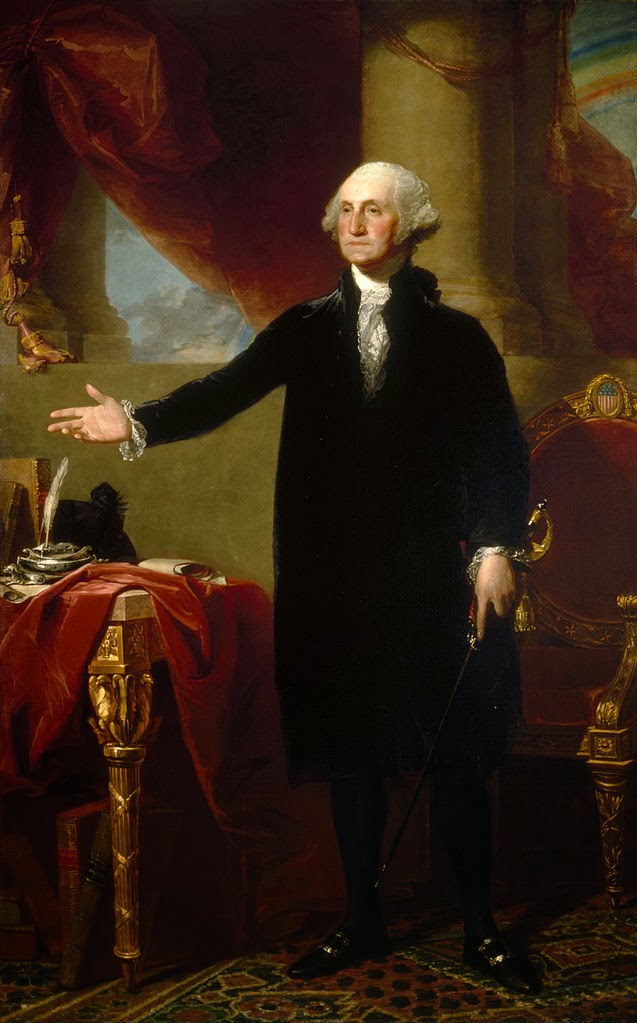
| The Landsdowne portrait |
Sponsored by the Friends of Hopewell Furnace, the free program will begin at 2 p.m. in the park’s Conference Center.
Using the famous Landsdowne Portrait, McDermott will discuss how Gilbert Stuart included symbols that reflected Washington’s career and legacy.
Stuart painted the portrait in 1796 and it has served as a guide for Presidential portraits ever since.
Dona McDermott manages the extensive archives and collections at Valley Forge.
A 30-year career employee of the National Park Service, McDermott has also worked at Independence Hall and Hopewell Furnace.
Before joining the National Park Service, she worked at the Atwater Kent Museum in Philadelphia and the Peter Wentz Farmstead in Worcester.
She holds a Bachelor of Arts in History from Eastern University and a Master of Arts in history and certification in Museum Studies from the University of Delaware.
In 1771, Mark Bird established Hopewell Furnace. Bird raised a militia in support of the American Revolution and sent badly needed supplies to George Washington at Valley Forge during the harsh winter of 1777-1778.
There are numerous records of Hopewell cannon and shot being used by Continental forces during the Revoluntionary War. One hundred and fifteen big guns for the Continental Navy were made at Hopewell, and ten inch morter shells from Hopewell were used in the final battle at Yorktown in 1781.
While at Hopewell Furnace National Historic Site visitors are encouraged to go into the village, tour the buildings and learn about the Iron Making Industry and why Hopewell Furnace is important to our nation’s history.
With grounds accessible on Mondays and Tuesdays, the park is fully open 9 a.m. to 5 p.m. Wednesday through Sunday and is located five miles south of Birdsboro, PA, off of Route 345.
For more information stop by the park's visitor center, call 610-582-8773, visit the park's web site at www.nps.gov/hofu, or contact the park by e-mail at hofu_superintendent@nps.gov.
Thursday, January 24, 2013
Presidential Timbre
![]() |
| George Washington took the oath of office on a balcony of Federal Hall in New York City. |
Many of the traditions observed Monday by President Obama were set by our first president when he took the first oath of office at Federal Hall in New York City, the nation's temporary capital.
But don't take my word for it, not when you will have the opportunity to have the word of an expert.
![]() |
| Gordon S. Wood |
For example, I've interviewed former Secretary of State and Hill alum James Baker twice and it was a genuine "local" story each time.
The latest opportunity comes next month and the public is invited.
History geeks among the invited public (yes, you in the back; you and me both) will understand then when I tell you why I am excited about this coming President's Day on Monday, Feb. 18.
Let's face it, most of us think of President's Day as a day of stupid car commercials with bad actors dressed up as Lincoln and Washington.
This is all well and good for the cause of commerce, but it is hardly the respectful, thoughtful commemoration we all might hope the day would be.
But we'll have that opportunity to make it exactly that Feb. 18 when presidential scholar Gordon S. Wood, who is at The Hill as this year's David R. Dougherty Senior Teaching Fellowship of American History speaker.
His talk begins at 7:15 p.m. and will be held in the Alumni Chapel on The Hill campus.
![]() |
| An expert on the Revolutionary period, Wood understands the importance of the role Washington played in the nation's earliest and, some might say, most dangerous days. |
Dr. Wood is the Alva O. Way University Professor and Professor of History Emeritus at Brown University.
But while that indicates his qualifications, he is so much more than that. To me, at least, the best recommendation to attend his talk is that he is one of the best modern authors books on American history that I have ever read.
Of course I'm not the only one who feels that way.
Certainly 1993's Pulitzer Prize committee felt that way when they awarded him the prize for "The Radicalism of the American Revolution," a book of his which I have yet to read but which my sister (only recently come to history) recommends strongly.
Born in Concord, Mass. in 1933, Wood received his bachelor's from Tufts, his Masters and his Doctorate from Harvard.
According to his curriculum vitae, Wood has taught at Harvard, William and Mary, University of Michigan, Northwestern and Brown universities.
![]() |
"The Radicalism of the American
Revolution" won the Pulitzer Prize
in 1993.
|
According to his faculty page at Brown, where he has taught since 1969, Wood is: "the author of the 'Creation of the American Republic, 1776-1787' (1969), which won the Bancroft Prize and the John H. Dunning Prize in 1970, and 'The Radicalism of the American Revolution' (1992), which won the Pulitzer Prize for History and the Ralph Waldo Emerson Prize in 1993. 'The Americanization of Benjamin Franklin' (2004) was awarded the Julia Ward Howe Prize by the Boston Authors Club in 2005. 'Revolutionary Characters: What Made the Founders Different' was published in 2006. 'The Purpose of the Past: Reflections on the Uses of History' was published in 2008. His book in the Oxford History of the United States, 'Empire of Liberty: A History of the Early Republic, 1789-1815'" was published in October 2009.
Wood reviews in the New York Review of Books and The New Republic. He is a fellow of the American Academy of Arts and Sciences and the American Philosophical Society.
So, in other words, no slouch when it comes to the founders all sides of current political debate love to cite.
One of the things the recent spate of scholarship on the founders has helped me to understand is the importance of Washington to the founding of the nation.
While this may sound like a statement of the obvious, it is not always immediately obvious to a reader.
Unlike the other founders, Washington was not college-educated; he was not a "man of letters" as Jefferson, Adams and Franklin were. Therefore, he has left less of his own thoughts behind for us to get to know him.
One quote attributed to Franklin in reference to Washington being chosen to preside over a meeting has Ben saying: "We always choose him to lead us because he was always the tallest man in the room."
In some ways, that epitomizes Washington's role in our founding. He may not have been well-educated, but while the other founders believed in the power of reason and rhetoric, Washington better understood the power of symbolism -- and most of all when it came to him.
It is because of this understanding that he was able to be "the tallest man in the room" and be the one person all the squabbling factions of the Revolution could agree upon as the first president.
And as such, he understood that everything he did would set a precedent, not only in what he said at the Oath of Office, but in his foreign policy and how he dealt with such insurrections as Pennsylvania's own "Whiskey Rebellion."
I look forward to hearing Dr. Wood's thoughts on the man.
I am currently reading "Empire of Liberty," which I recommend to all people who, like me, wonder "what happens AFTER you win the war?"
![]() |
"Revolutionary Characters" was published
in 2006.
|
Unlike the other founders, Washington was not college-educated; he was not a "man of letters" as Jefferson, Adams and Franklin were. Therefore, he has left less of his own thoughts behind for us to get to know him.
One quote attributed to Franklin in reference to Washington being chosen to preside over a meeting has Ben saying: "We always choose him to lead us because he was always the tallest man in the room."
In some ways, that epitomizes Washington's role in our founding. He may not have been well-educated, but while the other founders believed in the power of reason and rhetoric, Washington better understood the power of symbolism -- and most of all when it came to him.
It is because of this understanding that he was able to be "the tallest man in the room" and be the one person all the squabbling factions of the Revolution could agree upon as the first president.
![]() |
"Empire of Liberty" was published in 2009
and currently sits on my nightstand.
|
I look forward to hearing Dr. Wood's thoughts on the man.
I am currently reading "Empire of Liberty," which I recommend to all people who, like me, wonder "what happens AFTER you win the war?"
Or, to put it another way, the final words of Robert Redford's character in "The Candidate" who had just successfully won a seat on the U.S. Senate -- "Now what?"
I can also recommend "Revolutionary Characters," which, like the recently read "Lincoln at Gettysburg" by Garry Wills, helps the modern reader understand the context of the times and attitudes in which the people we now revere did the great things we all know they did.
Hope to see you in the chapel.
Tuesday, September 18, 2012
Constitutionally Speaking
So what did you do for Constitution Day?
Me? I served on jury duty. (I'd like to pretend I arranged it that way for the purposes of riding a high horse for this blog post, but I must give credit for the coincidence to whatever or whoever oversees such things.)
Nevertheless, being a journalist I was pretty much guaranteed not to be picked as a juror and once I told the judge that I had indeed investigated civil claims as part of my job, it was pretty much a foregone conclusion that I would not be a juror in a civil case about a car crash -- another circumstance about which I have written so many articles that it no doubt disqualified me from being considered impartial.
Two-hundred and twenty five years (and one day) ago, 39 men signed what would become the framework of the world's longest lasting Republic.(We won't count the democratic monarchies for our purposes here today.)
National Constitution Day does not work up the kind of patriotic fervor that say Independence Day or Veteran's Day does. Maybe that's because there is no war involved and instead of being about fighting, it's about agreeing.
Constitution Day should recognize one thing that sadly has become positively un-American -- compromise.
When did meeting in the middle become anathema to America?
On the way home from jury duty, I was listening to an NPR report about the "fiscal cliff," the next financial crisis we may all face because rather than compromise and reach a budget deal over the debt ceiling last year, members of Congress kicked the can down the road and set a new deadline by which they would do their jobs.
Missing the deadline means we "fall off the fiscal cliff." I am loathe to explain the particulars here due to the likelihood of error contained in the explanation, but rest assured that anything that involves falling off a cliff is rarely good news.
Despite this grave danger to the economy both sides say they want to save, they're going to put off this important work, apparently, because they want to keep their jobs rather than do them, Congress is headed home to ask for your vote and have pushed off the tough decisions until after the November election.
Remember, they just came off a five-week break in August during which they got in touch with their constituents by cutting ribbons and sending you mass mailings and me press releases about what a good job they're doing.
They've got their work cut out for them. Approval ratings are hovering around 13 percent.
This will leave the the matter of whether the nation goes fiscal cliff-diving up to a lame-duck Congress which will either be bitterly licking its wounds or patting itself on the back, causing the word "mandate" to fall out of their mouth at every turn.
Neither seems like fertile ground for compromise.
That leaves the current Congress four months to reach one fiscal agreement for what is likely to be one year. Let's remember that that's how long it took to reach agreement on the entire Constitution!
While the debates 225 years ago were no less spirited, and certainly the issues were just as important that September in Philadelphia, one characteristic existed within those men that allowed them to make this country, something whose absence now may break this country -- a willingness to compromise.
In American politics, "compromise" it is now a synonym for "weakness."
At the founding of our country, however, it was our strength.
Alexander Hamilton arrived in Philadelphia with visions of a president for life and a unicameral legislature.
James Madison arrived hoping to curb the un-checked idiocy of state legislatures left to their own devices (a problem with which we ruefully remain cursed).
George Washington arrived hoping to maintain his stature as the first among prominent Americans.
Most of the others who arrived, thought they would be tinkering around the edges of the Articles of Confederation, as they had tried to do months before in Annapolis.
Everyone got some of what they wanted, but not everything.
Instead, what emerged was a new framework of government that continues to operate, however clumsily, to this day.
It remains a wonder but, like all things older than the present, it could not predict all things to come.
It could not predict abortions or automatic weapons; super highways or super-PACs; global warming or the global economy.
And so it has remained, what we call, perhaps with a dab of hope, "a living document," something that can adapt to the changing times.
And we have never stopped trying.
At only 4,543 words, the original, un-amended Constitution is one of the world's shorter guiding documents.
But members of Congress have, in their wisdom over the ensuing years, proposed more than 11,000 amendments to make it better, everything from banning flag burning, to banning gay marriage.
It is perhaps a testament to what the framers could foresee -- the callowness of politicians -- that they made the process of amending the Constitution so onerous, that only 27 of those proposals have become amendments.
It speaks, perhaps, to one of the primary reasons the Constitution was necessary; because the founders' belief that elevated men could be counted upon to put their own interests aside for the good of the greater polity turned out to be a little pie in the sky.
The painfully divergent paths that state legislatures undertook under the leadership of less than scrupulous men, soon threatened to tear the country apart.
There was no single currency, no single entity to negotiate treaties, tariffs or taxes and a sense of every state for itself.

And so the founders gave way to the framers. The foundation for freedom had been built on high-flying philosophy, due largely to the rhetorical skill and extensive reading habits of one Thomas Jefferson.
But Jefferson and Adams, the two who could most take credit for the Declaration's tone and contents, were both overseas when the Constitutional Convention convened.
Although no less brilliant, the men who crafted the Constitution had, I think, the harder job.
It's is easier to rally people against something, in the first case English colonyhood, particularly to fight against oppression; than it is to get them to rally for something, particularly something that is destined to contain elements they don't like.
Winning wars is for heroes. Cleaning up afterward and trying to have everyone get along fairly is a job for grown-ups.
Soaring phrases about freedom are good for starting and winning wars, but they won't run a country. A system had to be set up, practical matters had to be worked out and the experiment that Enlightenment thinking had been working decades to undertake was finally at hand.
It was a typically muddle American event, with some crucial questions, like slavery, put off until later. And maybe that's where the tradition of kicking the can down the road started.
But the consequences of that failure to find a middle ground came roaring back to us in the form of the Civil War.
We're 225 now. Perhaps its time we acted our age, started learning from history and started to listen to each other enough to find common ground and move the country forward.
Otherwise, we may be the generation which oversees the failure of that ongoing experiment.
(If you have the day off today, you can see six rare original drafts and copies of the Constitution at the Historical Society of Pennsylvania at 1300 Locust St. in Center City from 11:30 a.m. to 4:30 p.m. on Tuesday, Sept. 18. Admission is free.)
(Also Click here for a link to the U.S. Constitution Center just down the road in Philadelphia to learn more about our Constitution. Maybe I'll see you there.)
Me? I served on jury duty. (I'd like to pretend I arranged it that way for the purposes of riding a high horse for this blog post, but I must give credit for the coincidence to whatever or whoever oversees such things.)
Nevertheless, being a journalist I was pretty much guaranteed not to be picked as a juror and once I told the judge that I had indeed investigated civil claims as part of my job, it was pretty much a foregone conclusion that I would not be a juror in a civil case about a car crash -- another circumstance about which I have written so many articles that it no doubt disqualified me from being considered impartial.
Two-hundred and twenty five years (and one day) ago, 39 men signed what would become the framework of the world's longest lasting Republic.(We won't count the democratic monarchies for our purposes here today.)
National Constitution Day does not work up the kind of patriotic fervor that say Independence Day or Veteran's Day does. Maybe that's because there is no war involved and instead of being about fighting, it's about agreeing.
Constitution Day should recognize one thing that sadly has become positively un-American -- compromise.
When did meeting in the middle become anathema to America?
![]() |
| The "Fiscal Cliff" looms and Congress is going on vacation. |
Missing the deadline means we "fall off the fiscal cliff." I am loathe to explain the particulars here due to the likelihood of error contained in the explanation, but rest assured that anything that involves falling off a cliff is rarely good news.
Despite this grave danger to the economy both sides say they want to save, they're going to put off this important work, apparently, because they want to keep their jobs rather than do them, Congress is headed home to ask for your vote and have pushed off the tough decisions until after the November election.
Remember, they just came off a five-week break in August during which they got in touch with their constituents by cutting ribbons and sending you mass mailings and me press releases about what a good job they're doing.
They've got their work cut out for them. Approval ratings are hovering around 13 percent.
This will leave the the matter of whether the nation goes fiscal cliff-diving up to a lame-duck Congress which will either be bitterly licking its wounds or patting itself on the back, causing the word "mandate" to fall out of their mouth at every turn.
![]() |
| It's the "art" of compromise...get it? |
That leaves the current Congress four months to reach one fiscal agreement for what is likely to be one year. Let's remember that that's how long it took to reach agreement on the entire Constitution!
While the debates 225 years ago were no less spirited, and certainly the issues were just as important that September in Philadelphia, one characteristic existed within those men that allowed them to make this country, something whose absence now may break this country -- a willingness to compromise.
In American politics, "compromise" it is now a synonym for "weakness."
At the founding of our country, however, it was our strength.
Alexander Hamilton arrived in Philadelphia with visions of a president for life and a unicameral legislature.
James Madison arrived hoping to curb the un-checked idiocy of state legislatures left to their own devices (a problem with which we ruefully remain cursed).
George Washington arrived hoping to maintain his stature as the first among prominent Americans.
Most of the others who arrived, thought they would be tinkering around the edges of the Articles of Confederation, as they had tried to do months before in Annapolis.
Everyone got some of what they wanted, but not everything.
Instead, what emerged was a new framework of government that continues to operate, however clumsily, to this day.
It remains a wonder but, like all things older than the present, it could not predict all things to come.
![]() |
| The three branches of government we all learned about in school. |
And so it has remained, what we call, perhaps with a dab of hope, "a living document," something that can adapt to the changing times.
And we have never stopped trying.
At only 4,543 words, the original, un-amended Constitution is one of the world's shorter guiding documents.
But members of Congress have, in their wisdom over the ensuing years, proposed more than 11,000 amendments to make it better, everything from banning flag burning, to banning gay marriage.
It is perhaps a testament to what the framers could foresee -- the callowness of politicians -- that they made the process of amending the Constitution so onerous, that only 27 of those proposals have become amendments.
It speaks, perhaps, to one of the primary reasons the Constitution was necessary; because the founders' belief that elevated men could be counted upon to put their own interests aside for the good of the greater polity turned out to be a little pie in the sky.
The painfully divergent paths that state legislatures undertook under the leadership of less than scrupulous men, soon threatened to tear the country apart.
There was no single currency, no single entity to negotiate treaties, tariffs or taxes and a sense of every state for itself.

And so the founders gave way to the framers. The foundation for freedom had been built on high-flying philosophy, due largely to the rhetorical skill and extensive reading habits of one Thomas Jefferson.
But Jefferson and Adams, the two who could most take credit for the Declaration's tone and contents, were both overseas when the Constitutional Convention convened.
Although no less brilliant, the men who crafted the Constitution had, I think, the harder job.
It's is easier to rally people against something, in the first case English colonyhood, particularly to fight against oppression; than it is to get them to rally for something, particularly something that is destined to contain elements they don't like.
Winning wars is for heroes. Cleaning up afterward and trying to have everyone get along fairly is a job for grown-ups.
Soaring phrases about freedom are good for starting and winning wars, but they won't run a country. A system had to be set up, practical matters had to be worked out and the experiment that Enlightenment thinking had been working decades to undertake was finally at hand.
It was a typically muddle American event, with some crucial questions, like slavery, put off until later. And maybe that's where the tradition of kicking the can down the road started.
But the consequences of that failure to find a middle ground came roaring back to us in the form of the Civil War.
We're 225 now. Perhaps its time we acted our age, started learning from history and started to listen to each other enough to find common ground and move the country forward.
![]() |
| One of the original drafts of the Constitution is on display today at the Historical Society of Pennsylvania. |
(If you have the day off today, you can see six rare original drafts and copies of the Constitution at the Historical Society of Pennsylvania at 1300 Locust St. in Center City from 11:30 a.m. to 4:30 p.m. on Tuesday, Sept. 18. Admission is free.)
(Also Click here for a link to the U.S. Constitution Center just down the road in Philadelphia to learn more about our Constitution. Maybe I'll see you there.)
Tuesday, February 28, 2012
The Year of Legislating Dangerously
So I confess, at first I was willing to shrug my shoulders at the PA House of Representatives’ unanimous passage on Jan. 24 of a resolution declaring 2012 as the “Year of the Bible.”
After all, this is the same group of individuals who spent time debating the identity of the state reptile in 2009 while the Commonwealth’s budget was overdue by a month and wallowing in red ink.
Why should we expect them to start doing their jobs now?
Further, denying the Bible as a central focal point in the development of western civilization is a fool’s errand. It inhabits western literature, laws and traditions.
![]() |
| PA Rep. Rick Saccone |
Then we ran an op-ed piece on TheMercury opinion page Sunday in which the resolution’s sponsor, western PA Rep. Rick Saccone, peddled the same statement about his resolution that is on his web site and has been published in half a dozen places around the Commonwealth.
In it, he attempts to appropriate the nation’s founders as assumed supporters of his case that such resolutions, however “non-binding,” are not inappropriate and to suggest that the founders would agree, thus rendering them inherently patriotic and inviolable.
This is a particular pet peeve of mine and is in fact the reason I started several years ago reading up on these wealthy white men founders of ours.
I was tired of having George Washington and Thomas Jefferson thrown up as unassailable bulwarks of Conservative politics.
As it turns out, what I found is that the founders were not the marble statues imbued with bedrock convictions chiseled in stone that we have come to mythologize them as being, but human beings with faults, doubts and uncommon insight.
They were, to put it simply, men of their times, the close of a period of thought called the Enlightenment.
They were attempting to build a republic larger than anything ever imagined and they were leaders in a country founded by adventurers and refugees from a Europe where the mixing of church and state had bred centuries of warfare over whose interpretation of that selfsame book was correct and whose was heresy.
![]() |
| This issue is squarely at the intersection of ... |
In his first inaugural address, Jefferson alludes to this history noting: “And let us reflect that, having banished from our land that religious intolerance under which mankind so long bled and suffered…”
Remember, it was nearly 200 years between Plymouth Rock and the Declaration of Independence and the country that was then being established was stepping carefully on religious questions.
The goal of the founders Saccone cites was not to found a Christian nation, favoring one of many factions of Christianity fighting overseas over the other, but a nation in which Christians – and the faithful of every and any other religion – could worship as they pleased without interference from the state and without oversight from the state.
I won’t deny that many of the values on which the country was to be founded have a basis in Christianity and the Bible – after all, they were nearly all Christians of a sort themselves and it was what they knew and where they came from.
But it’s not that simple.
Nothing ever is.
As Jon Meacham wrote in his excellent 2006 work on the subject, “American Gospel: God, The Founding Fathers and the Making of a Nation,” many of the founders Saccone cites, were not so much Bible thumping Evangelicals as they were “Deists.”
Wikipedia defines Deism as “a religious philosophy which holds that reason and observation of the natural world, without the need for organized religion, can determine that the universe is the product of an all-powerful creator. According to deists, the creator rarely, if ever, either intervenes in human affairs or suspends the natural laws of the universe.
“For them, Jesus of Nazareth was a great moral teacher – even the greatest in all history – but he was not the Son of God,” Meacham reveals.
In fact, the Rev. Dr. James Abercrombie, rector of the church George Washington attended with his wife, when asked about Washington’s religious beliefs replied directly: “Sir, Washington was a Deist.”
Nonetheless, Rep. Saccone plays the game of quotes (one in which I myself have indulged on more than one occasion) to bolster his case, citing Benjamin Franklin, Thomas Jefferson, John Adams, Andrew Jackson and Abraham Lincoln to infer they would be likely supporters of his resolution.
Lincoln is a little after the founder’s time, but as an American icon, he’s always a good one to throw in.
Saccone cites Lincoln saying “I believe the Bible is the best book God has ever given man.”
To which I provide this statement of Lincoln’s: “The Bible is not my book nor Christianity my profession.”
And who knew Lincoln better than his wife?: “Mr. Lincoln's maxim and philosophy were: ‘What is to be, will be, and no prayers of ours can arrest the decree.’ He never joined any Church. He was a religious man always, I think, but was not a technical Christian.”
What are we to believe? (Thus, the point of the game of quotes.)
It’s important to remember that in addition to being men of their time, the founders were also politicians and were speaking to a nation populated by people who, if they had ever read any book at all, likely had read the Bible and little else.
So while Saccone presents us with Jefferson saying (chiseled in granite I might add) “God who gave us liberty,” he ignores the fact that Jefferson also cut up his Bible to remove all reference to miracles by Jesus, leaving only his moral teachings.
Is this the act of a man who reveres the Bible as the inerrant word of God, as Saccone’s resolution insists it is?
Saccone selects from among Jefferson’s many beautiful phrases words chosen for him on a memorial built more than a century after his death.
But what did Jefferson himself chose to be remembered by?
![]() |
| Thomas Jefferson's tombstone |
Among the three things Jefferson himself chose to be chiseled in the granite of his tombstone, and of which he was presumably the most proud, was his authorship of “the Statue of Virginia for Religious Freedom.”
That most worthy document, written at a time when the state of Virginia was providing salary to Episcopal ministers, actually warns against the very thing Saccone would have us embrace.
Jefferson writes that since “God hath created the mind free; that all attempts to influence it by temporal punishments or burthens; or by civil incapacitations (italics mine), tend only to beget habits of hypocrisy and meanness…”
It further warns against “the impious presumption of legislators (again, italics mine) and rulers, civil as well as ecclesiastical, who being themselves but fallible and uninspired men, have assumed dominion over the faith of others, setting up their own opinions and modes of thinking as the only true and infallible; and as such endeavoring to impose them on others as the only true and infallible…”
To put it in today’s vernacular: “God gave me free will to believe as I see fit, who the hell are you to tell me what I should believe when God himself left the choice up to me?”
In his 1782 work “Notes on the State of Virginia,” Jefferson writes: “Millions of innocent men, women, and children, since the introduction of Christianity, have been burnt, tortured, fined, and imprisoned; yet we have not advanced one inch toward uniformity. What has been the effect of coercion? To make one-half the world fools and the other half hypocrites.”
Does Saccone not know Jefferson is the author of the phrase “a wall of separation between church and state?”
This is the man to whom Saccone would have us look as someone who would endorse the Pennsylvania government’s endorsement of a religious book?
It seems an odd choice when one looks beyond simple monuments.
But then, that is the source Saccone quotes as his evidence of the founders’ implied blessing.
True, George Washington used a Bible when he took the oath of office.
![]() |
| 'Washington was a Deist' |
But in 1789, when a group of clergymen complained that the Constitution contained no mention of Jesus Christ, Washington replied: “I am persuaded, you will permit me to observe that the path of true piety is so plain as to require but little political direction. To this consideration we ought to ascribe the absence of any regulation, respecting religion, from the Magna-Charta of our country.”
Perhaps the most ridiculous citation of all is for Saccone to have invoked John Adams in his defense of governmental support for the Bible.
If ever there was a founder who cast a skeptical eye at organized Christianity and its chief book it was John Adams.
There are too many quotes to choose from, but perhaps this one, from one of his last letters to Jefferson in 1825, will convince the reader that Mr. Adams would not have likely jumped on the Saccone resolution bandwagon:
“There exists, I believe, throughout the whole Christian world, a law which makes it blasphemy to deny or doubt the divine inspiration of all the books of the Old and New Testaments, from Genesis to Revelations. In most countries of Europe it is punished by fire at the stake, or the rack, or the wheel. In England itself it is punished by boring through the tongue with a red-hot poker. In America it is not better; even in our own Massachusetts, which I believe, upon the whole, is as temperate and moderate in religious zeal as most of the States, a law was made in the latter end of the last century, repealing the cruel punishments of the former laws, but substituting fine and imprisonment upon all those blasphemers upon any book of the Old Testament or New. Now, what free inquiry, when a writer must surely encounter the risk of fine or imprisonment for adducing any argument for investigating into the divine authority of those books?”
None of which is to say that religion does not have a place in the public square.
It always has and it always will.
It is, to a lesser or greater extent, the motivator and guide for most public figures and thus inherent in their beliefs on which their actions are based and therefore inseparable from the public actions they take.
As Meacham observed: “Our finest hours – the Revolutionary War, abolition, the expansion of the rights of women, fights against terror and tyranny, the battle against Jim Crow – can be partly traced to religious ideas about liberty, justice and charity. Yet theology and scripture have also been used to justify our worst hours – from enslaving black people, to persecuting Native Americans, to treating women as second-class citizens.”
Meacham further writes: “If totalitarianism was the great problem of the 20th century, then extremism is, so far, the great problem of the 21st.”
He intuits, correctly I believe, that “extremism is a powerful alliance of fear and certitude; complexity and humility are its natural foes.”
And if ever there was a complex relationship in our history, and one greatly in need of not a little humility, it is the relationship of religion and government.
All of which is a long-winded way of pointing out that even more than 200 years ago, the question of religion’s role in U.S. government was being debated, a debate which has not yet been settled and will not be settled by Rep. Saccone’s resolution.
Speaking of which, Saccone’s statement in The Mercury talks a lot about how the founders would certainly endorse his “simple resolution” but fails to quote a single line from it.
You can read the entire text here. It’s not long.
And, in truth, I have little argument with the majority of its text – that is until we get to the final resolved clause, in which there is: “recognition of both the formative influence of the Bible on our Commonwealth (still historically true) and our national need to study and apply the teachings of the holy scriptures (italics mine).”
It is this last line that crosses a line and instead of simply recognizing the undeniable influence the Bible had on the formation of the nation, now takes a formal position that the government is calling on its citizens to study and apply the teachings of one religious book.
![]() |
| Will 2013 be the Year of the Koran in PA? Not Likely. |
Were I convinced that Rep. Saccone would next year be calling for a “Year of the Koran,” followed by a “Year of the Tao-Te-Ching,” and then a “Year of the Veda,” I might be inclined to simply see this as a respectful recognition of the importance of religion.
But given Rep. Saccone’s sponsorship of House Bill 2029, which is similar to an anti-Sharia law law in Oklahoma that was recently struck down by a federal court, I think rather that instead, this is a way for Rep. Saccone to have the government of Pennsylvania place the Bible and Christianity on a higher plane than other religions.
I doubt you would find a founder who, no matter his private beliefs, would support that as an official government action.
And that is a dangerous precedent to let slip past us without notice, or, as Rep. Saccone and the leadership in the House did, slip into a stack of resolutions deemed “non-controversial.”
In fact the matter of the resolution’s passage has led to its own little controversy within the House itself. Also approved unanimously in the stack with the Year of the Bible were such constitutionally weighty resolutions as:
· designating the week of Jan. 22 through 28, 2012, as "Nurse Anesthetists Week" in Pennsylvania.
· designating the month of January 2012 as "Financial Aid Awareness Month" and commending the work of the Pennsylvania Higher Education Assistance Agency and the Pennsylvania Association of Student Financial Aid Administrators.
· recognizing the month of January 2012 as "Cervical Cancer Awareness Month" in Pennsylvania.
· designating February 3, 2012, as "Wear Red for Women Day" in Pennsylvania.
![]() |
| Is this who you want telling you which religious books to emulate? |
Now, some of the legislators, chiefly from Philadelphia, guilty of VWR (Voting Without Looking) want a “do-over,” not having noticed that they were taking a step closer to establishing a state religion.
Should we be surprised they voted without paying any attention?
Let’s leave that question unanswered while we ponder these questions:
· Are the finances of the Commonwealth of Pennsylvania in such solid shape that we should spend time debating the separation of church and state?
· Have the hundreds of structurally deficient bridges in Pennsylvania, among the most in the nation, now been fixed so that we can spend time the separation of church and state?
· Have we solved the problem of rising pension payments for state and education workers to the satisfaction of all so we can now spend time debating the separation of church and state?
· Have the geniuses in Harrisburg finally solved the puzzle of regressive property taxes and figured out a fair and equitable way to fund public education in the Commonwealth (as the state Constitution requires) so that we can now spend time debating the separation of church and state?
· Has the second largest legislature in the country figured out a way to cut its size and expenses, or even how to create legislative districts that cross fewer than five county borders so that we can we can now spend time debating the separation of church and state?
· Have any of the dozens of other more immediate problems facing Pennsylvania, problems those legislators were elected to solve, been addressed to the satisfaction of the people who put them there to the point where we can waste what little time these people actually spend legislating (or getting anything done for that matter) on debating the separation of church and state?
I think if there were any position for which you argue universal support from the, it would be less talk about Bibles and more actual work on behalf of the people who elected you.
I put it to you that we would all be much more impressed with Rep. Saccone if he and his fellow House members would unanimously adopt a resolution declaring 2012 as “The Year of the Effective Legislature.”
Follow Evan Brandt on Twitter @PottstownNews
Monday, February 20, 2012
It's Your Day Mr. President
So it turns out I couldn’t resist writing a President’s Day post after all.
With the presidential campaign in high gear and high dudgeon, it occurred to me that today is as good a good day as any to step back and look at the job itself, and what we Americans expect from it.
The American President is, in many ways, a paradox.
He (or she) is the single most important and powerful person in a country that is theoretically ruled by “the people.”
When we like who is in office, we want to hand over as much power and authority as we can find to ensure they can get done the things with which we agree without getting bogged down by that pesky and useless Congress.
We trust them to use that power wisely.
![]() |
| Home to the world's most exclusive job. |
When we don’t like who is in office, we are shocked, “shocked!,” at the degree to which that skunk is grabbing power and circumventing Congress, which most closely represents the will of the people.
We do not trust them to use that power in a way with which we agree.
In order to become president, one must have, to put it mildly, a pretty strong ego; but to show it on the campaign trail would be a deadly error, because who wants a president who thinks he’s better than you?
In order to become president, one must satisfy and cater to as many different points of view and interests groups as possible in order to cobble together a majority.
But we say we want a president who is resolute and unwavering in his beliefs.
Thus we ridicule candidates who “voted for it before I voted against it,” or candidates who campaign to undo a health care system that was created based on the candidate himself championed and instituted with great fanfare a few years ago when he was a governor.
But don’t we want a president who knows how to compromise and negotiate?
We want a president who respects the law, but also one who ignores laws that prevent him (or her) from doing what we want.
In other words, respect the law, but not the stupid ones.
Few of the early presidents we revere today could ever be elected in a modern campaign.
Needless to say, it is no easy job.
Some are great, some rise to greatness under impossible circumstances, and others couldn’t manage greatness if it was their middle name.
And the office changes many of them, if not their beliefs than often their perspectives.
Many of our earlier presidents (Jefferson, Madison, Adams) did not think the post terribly important in comparison to the legislative branch, a kind of a clerk assigned to implement the wisdom of the body politic.
![]() |
| Gerald Ford |
But that all changed, of course, once they took the oath.
(I once saw in interview with Gerald Ford in which he said then when he was in the House, he could not believe the stupidity of the various occupants of 1600 Pennsylvania Ave. But once installed as president, Ford said with a smile that it was the idiocy of Capitol Hill which astounded him.)
![]() |
| Thomas Jefferson |
Jefferson was appalled at the level of power Hamilton and his fellow Federalists were trying to attach to the presidency, but once there himself, he hesitated only slightly before agreeing to the Louisiana Purchase, something he considered to be outside his Constitutional authority.
Adams, my favorite and most curmudgeonly of the early presidents, was desperate to be recognized by the nation by being selected as president, but was not terribly well equipped for the job.
His temperament was not well suited for managing disparate views, a skill Washington had developed over his years in the military. And Adams had made the mistake of keeping most of Washington's cabinet, which meant they had no loyalty to him.
![]() |
| John Adams |
(But despite signing the dreadful Sedition Act, he did prevent war with France and he did prevent Hamilton from amassing a giant army that he intended to march through to South America, claiming all kinds of territory for the U.S. It seems Hamilton had as many dreams of empire as the man who killed him.)
As a writer and lover of good writing, it took me some time to warm up to George Washington. He was the least educated of the founders and probably the least prolific in his letters, which were always stiffly formal, much like the man.
But Washington understood some things particularly well, image and symbolism among them, which remain among the most important aspects of the job today.
As a person who was self-conscious about his lack of education, Washington was acutely aware of the importance of (and jealously guarded) the image he projected.
(Franklin once quipped that any body of men would inevitably elect the tallest man in the room as their leader.)
My favorite anecdote about the father of our country was that when he went on his tour to visit every state (a brilliant public relations maneuver if ever there was one) he made sure to stop the carriage outside of towns, so he could ride into town, in full uniform, on his white charger.
![]() |
| George Washington |
He knew that as first president, every thing he did would set a precedent. So, as he had been careful to do all his life, he was very conscious about how he conducted himself in every way, giving forethought to how it would affect future presidents in a way that is rare today.
Washington played to his strengths, which did not include being a great military strategist, but did include being a great leader.
He walked the balance between being graceful and aloof, and being a man of the people; between exerting authority and forcefulness when necessary and being conciliatory and flexible when it was in the nation’s best interests.
Because he was so well-loved, he was given the benefit of the doubt by the nation in a way that future presidents would no doubt envy. But even Washington was being pilloried by the end of his second term.
There is another aspect of the presidency which bears examination; the power and importance with which we invest it and thus divest ourselves of.
Not long ago I read an interesting book titled “Founding Myths: Stories That Hide Our Patriotic Past” by Ray Raphael.
Among other things, Raphael explores the paradox of the presidency, calling the recent interest in the founders, the presidents in particular, “presidential chic.”
While they were certainly extraordinary men, he makes the important point that there were thousands of other extraordinary men and women who, because they were not rich, educated, wealthy or published, have been forgotten by history despite doing remarkable things together.
He observes history needs heroes but that sometimes the right ones are not always chosen.
Ex: Paul Revere did not succeed in his mission but others did, why do we remember him and not them?
Farmers throughout Massachusetts effectively ended British rule and instituted self-government a year before Lexington and Concord. Why do we not learn this in school?
His point, which I think bears repeating, is that presidents are indeed extraordinary men (and one day women), even if only just because they have achieved the office.
But the United States was founded by thousands of people who did great things, who understood the issues at hand and who took risks that were, at times, greater than those whose names now ring through our history.
Remember the presidents yes.
But remember who put them there as well.
Subscribe to:
Posts (Atom)