Showing posts with label Pottstown Metropolitan Regional Planning Committee. Show all posts

Thursday, May 25, 2017

Home Prices in Montco Are on the Rise


How much is your house worth?

That is a question every homeowner ultimately asks, only to find it answered when it goes onto the market.

But how much is everybody's house worth? Well, counter-intuitively, that is something that can be answered with greater certainty. At least if you are the Montgomery County Planning Commission.

Their annual report on the cost of housing was released recently and reviewed Wednesday night by the Pottstown Metropolitan Area Regional Planning Committee.

The short answer is -- "more."

According to Montgomery County planner Donna Fabry, the median sale price in the county rose by $8,150 in the last year -- an increase of about 3 percent.

Its the fifth increase in the last nine years, according to the study.

Market rate sales increased and reached its highest total since 2007 with 11,441 units sold and the median sale price being $278,500, according to county figures.

The median price for a new detached single home in Montgomery County increased by 11 percent to $499,990 and the median price on all new units of all types averaged out to $448,524 in 2016, a 14 percent rise over 2015, the report said.

This was due to more detached homes being built and single family attached home prices decreased by 3.9 percent to $336,875.

Among Bucks, Chester, Delaware and Montgomery Counties, Montco home prices increased the most in absolute dollars, while Delaware County homes increased by a higher percentage.

Within Montgomery County, New Hanover Township homes had the highest prices between $309,000 to 409,000, similar to Upper and Lower Providence, Collegeville, Skippack and Marlborough.

Pottstown, Lower Pottsgrove and West Pottsgrove had the lowest prices, ranging between $111,659 and $198,450. Upper Pottsgrove, Douglass and Limerick had slightly higher prices, ranging between $213,348 and $299,500.

Homeownership demand in the county has decreased, due to the increasing popularity of rental units "as many young people struggle to save money in the face of student debt, stagnant wages and the rising cost of living," according to the report.

The millenial generation is expected to turn to homeownership later in life than their parents did. The multi-family housing unit market has also turned away from townhouse toward luxury apartments "with amenities such as clubhouses, pools and dog runs," according to the report.

As a result, rents are being driven higher, with a 15 percent increase in Montgomery County from 2010 to 2015. The median rent rose from $1,057 per month to $1,214.

By contrast, the median home price over the same period rose by only 2 percent in Montgomery County, from $265,000 to $270,350.

"The demand for walkable town centers and mature suburbs with distinct neighborhoods served by multiple modes of transportation is expected to continue increasing," according to the report.

"In 2016, boroughs like Jenkintown, Ambler and Rockledge saw some of the highest percentage median price gains in the county," the report said.

Montgomery County Planner John Cover said "that trend bodes well for Pottstown," although he also acknowledged that "people move for jobs and schools with a good reputation," two areas where Pottstown does not often rise to the top of the list.

Many communities "saw growth not only in construction of new units, but in housing turnover. The increase in housing turnover is partially due demographic in nature due to the generational transfer of housing from baby boomers to millenials," according to the report.

Not much else of interest at the planning meeting. What was interesting can be found in the Tweets below.

Tuesday, May 14, 2013

$200K Park Mini-Grant Program Now Open

Got plans? A new program offers mini grants of as much as $25,000 for park improvements.

A mini-grant program for park improvements in the eight municipalities that comprise the Pottstown Metropolitan Regional Planning Committee is now accepting applications.

Eight grants of up to $25,000 each will be awarded to towns which participate in the regional planning effort to help fund park improvements that promote recreation.

Funding for the grants comes from the Pennsylvania Department of Conservation and Natural Resources and is being facilitated by the Pottstown
The municipalities of the Pottstown Metropolitan

Regional Planning Committee.
Area Health and Wellness Foundation.

At this point, the "Request-for-Proposals" phase, the regional planning committee and the foundation are inviting the region’s eight member municipalities to apply for funding for the planning or development of park improvements. 

Applicants may request up to $25,000 for the proposed project. Applications for the first round of funding will be accepted no later than Sept. 6.

The purpose of the Parks Mini-Grant Program is to support and implement the recommendations included in the 2012 Penn State Study, Planning and Design Strategies for Healthy Living, Parks, and Recreation in the Pottstown Region, which provides a road map for each municipality to improve its community and parks built environment. 

The PSU study recommendations are consistent with the PMRPC’s regional comprehensive plan, county greenway plans, and PA Outdoor Recreation Plan recommendations. 

Active play for toddlers was among the

Penn State study's recommendations.
The funding made available by this RFP will assist municipalities in undertaking park improvements that add amenities to existing park facilities and improving previously acquired park land by adding green features, pathways, signage, or other enhancements.

Preference for funding will be given to proposals that add park amenities recommended by the Penn State study, which can be found at: http://www.pottstownfoundation.org/pages/psu-report.htm.

The Pottstown Metropolitan Regional Planning Committee (PMRPC) is comprised of two representatives from each of the Region’s eight participating municipalities, including Pottstown Borough, Douglass, New Hanover, West Pottsgrove, Upper Pottsgrove, and Lower Pottsgrove in Montgomery County and North Coventry and East Coventry Townships in Chester County. 

Picnic pavilions were also recommended in the Penn State study.
PMRPC members address multi-municipal issues and oversee implementation of the Pottstown Metropolitan Regional Comprehensive Plan, currently one of the largest multi-municipal planning efforts taking place in Pennsylvania.

The Pottstown Area Health & Wellness Foundation’s mission is to enhance the health and wellness of area residents, providing education, funding and programs that motivate people to adopt healthy lifestyles. 

Visit www.pottstownfoundation.org for more information about the Foundation. 

Discover Pottstown area's online community at www.missionhealthyliving.org to learn and share great information on how to lead a healthier life. You can also follow Mission Healthy Living on Facebook and Twitter.

Funding eligibility is limited to member municipalities of the Pottstown Metropolitan Region, including Douglass, Lower Pottsgrove, New Hanover, Upper Pottsgrove, and West Pottsgrove Townships, and Pottstown Borough in Montgomery County, PA, and North Coventry and East Coventry Townships in Chester County

All project applications should demonstrate consistency with the goals of the Pottstown Regional Parks Mini-Grants partners – DCNR, PMRPC, and PAHWF.  

Projects are expected to achieve funded expectations within a 12-month contract term; however, early completion of projects is encouraged. Grants require a minimum 10 percent cash match to be demonstrated either at the time of application or within the duration of the 12 month contract.

Applications for the first round of funding will be accepted until Sept. 6. 

For more information about the Mini-Grant program and to access application materials, visit the Pottstown Metropolitan Region’s website at PMRPC.PottstownMetroRegion.com.


Tuesday, April 16, 2013

Managing Your Green

Fragmented forest space, like this, has too many edges to be
effective forest.
So as it turns out, all open spaces are not created equally -- at least not when it comes to the wildlife and natural services they are intended to perform.

In short, round is better.

That was just part of the lesson Peter Williamson, vice president of preservation services for the Natural Lands Trust, had for the Pottstown Metropolitan Regional Planning Committee recently.

Williamson was there to talk about the various aspects of open space management with which municipal officials may not be familiar.

Now in its 60th year, Williamson said Natural Lands Trust has 41 preserves and one quarter of them are in Montgomery County.

Better to have one large forest, like this.
One thing those years have taught the preserve managers, Williamson said, is that
fragmented open space does not provide the range or benefits or larger sized preserves, and further, that "edges" reduce that effectiveness even more.

For example forest edges allow more light and more invasive species to protrude deeper into the forest, reducing its effectiveness at water retention and as habitat for native species, he said.

Invasive species are perhaps the second largest problem facing preserved open space, both in meadows, marshes and forest.

Dumping fast-moving storm water into streams, causes
erosion like this.
Another challenge is deer which are multiplying in southeast Pennsylvania with no natural predators and eat everything below six feet high.

And lastly, there's storm water.

For many years, storm water was something engineers wanted to get rid of as quickly as possible. Then, when it was realized the sudden influx of high-velocity water to streams was damaging, it became necessary to hold or retain the water, to allow it to be absorbed into the ground and released through the ground as stream base flow as a more constant rate.

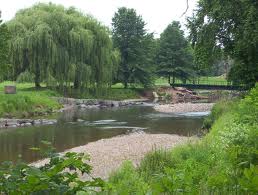
A healthy stream bank looks like this.
Any municipality that owns or manages open space, therefore, faces these challenges, Williamson explained.

When considering meadows, he provided several recommendations.

Only mow twice a year, around St. Patrick's Day and the Fourth of July. This allows the grasses to provide cover to animals that need them.

"Mow the edges, along roads, and it gives the property a managed feeling without impacting the wildlife," he suggested.

Also, plant a mix of warm and cool season grasses, so the meadow is more weather resilient and green for most of the year.
Mowing a meadow along the roadside, gives it
a managed look while preserving habitat.

To learn more, particularly about storm water management, mark your calendar for May 30.

That's when the organization's annual "Green Futures" event will be held, this year right here in Pottstown at the Montgomery County Community College's Pottstown Campus.

Click here for details and sign-up information.

Sunday, December 16, 2012

Goodbye Andy

Photo courtesy North Coventry Township's Facebook page.
North Coventry Supervisor Andy Paravis, who died Friday, introduces
former governor Ed Rendell, right, during a 
2010 visit to 
Camp  Fernbrook, the preservation of which was dear to Andy's heart.
"You should be writing about this. What's the matter with you?" said the deepest, most gravely voice you've ever heard rumbling over the phone line.

If I had a dollar for every time I heard that in a conversation with Andy Paravis, I wouldn't be struggling to get by on a reporter's salary.

As I prepared the story about Andy's passing Saturday, I kept hearing that voice in my head, and then the "heh, heh, heh" chuckle that always followed it.

I tell people who tell me I'm too liberal that I've voted for plenty of Republicans, and it's true I have.

But, being a resident of the borough, I never had the honor of voting for Andy Paravis.

My loss really.

As I spoke to people about Andy Saturday, the examples of his leadership kept popping up, and I knew I couldn't fit them all into the newspaper. (The story was already too long....)

But I also couldn't keep them to myself.

Although I am a huge fan of the work Andy did preserving forest, agricultural and open space, and firmly believe that to be his greatest legacy, my favorite memory of Andy had to do not with success, but disaster.

It was June, 2005 and the Schuylkill had blown its banks again, creeping into South Pottstown and making long-time residents shake their heads, and new residents wonder what the hell they were thinking when they moved there

I remember it was hot, very hot, and a town meeting had been called in North Coventry Elementary School where hot, unhappy people were looking for answers.

"People were on their last nerve," recalled Supervisor Jim Marks, who also remembered the day.

I've seen my share of such gatherings and they are a minefield for a public official. The slightest error in phrase or fact can be the trigger for shouting and angry recriminations.

But Andy, who I'm pretty sure had recently completed another round of therapy to keep his cancer in check, climbed up onto the stage without hesitation.

He spoke plainly, and plainly felt the anxiety of his neighbors.

When he didn't know the answer to something, he said so, but promised to find out.

And they believed him.

"We know you're doing all you can Andy," said someone in the crowd.

Color me impressed. Not that I wasn't already impressed with how dedicated and relentless he was about keeping as much of North Coventry green as he could.

But this was in a whole different category.

This was not policy, this was leadership.

It was evident, these people believed and trusted what an elected official was telling them.

When the crisis came, they believed him because they knew him, and they knew he had never lied to them, or prevaricated or side-stepped an issue they cared about.

This meant he could be blunt.

All the better.

"What's the matter with them over there in Pottstown?" he once asked me several years ago after a particularly lunk-headed vote. "We've been trying to figure that out for years," I replied with a sigh.

Although, being the Pottstown and Pottsgrove reporter, I covered few North Coventry meetings, I did see Andy regularly at the meetings of the Pottstown Metropolitan Area Planning Committee.

It was here, where matters of regional significance were discussed, that Andy most often sidled up after the meeting to tell me about some obscure state legislation that would make open space preservation worse, or better.

"What's the matter with you? You work at a newspaper, you're supposed to know this stuff," he would growl with that sideways smile of his. "You should be writing about this."

"Ahhhh, I'm just kidding ya, pal" he'd add after a pregnant pause, hitting me on the arm.

But he was just letting me off the hook. He was right. I should have been, or someone should have been writing about this stuff. It's boring, but vitally important.

We often lamented the decline of watchdog journalism together and I knew this was his way of pointing out that this was just another example of something that was slipping through the cracks.

I would tell Nancy (that's Nancy March, the editor at The Mercury) and we would agree something should be done.

Then, one of two things would happen.

John Strickler, The Mercury's photo editor, a lifer if ever there was one, would stride up to her desk and say "fire at ---fill in the blank -- I'm going" and we would forget about HB 365784B that we had just resolved needed exploration.

With a smaller staff, that stuff gets left on the cutting room floor when spot news happens.

The other thing that would happen is Nancy and I would both pause, and realize with four reporters covering  30 towns, three counties and nine school districts, we quite simply could not devote the resources necessary to do the job properly.

But that wouldn't stop Andy from trying again the next time he saw me. I would explain the above and he would say "come on, this is important."

Despite what many might think, 25 years of local journalism has not completely soured me on elected officials.

When you cover the issues and decisions they face, the taxpayers who want better services and lower taxes, the meeting gadflies who consume their meeting time complaining about not getting return phone calls, the boring meetings, often for little or no pay, you develop some sympathy for the shoes they walk in.

It doesn't excuse some of their behavior, ineptness or self-dealing, but it makes it understandable.

Nearly all those I've known, get involved out of a sense of civic duty, a belief that they can help, or, never good, the belief that no one can help but them.

I always had the impression that Andy, like many, got involved because something happened he didn't like -- the Town Square development off Route 100. That's not unusual.

What was, in my experience, was that his interest in public service did not evaporate once that issue was settled. More unusual, I think, was his discovery that he had an aptitude for this kind of work.

He said once that he remembered as a kid watching with dismay when a mall was built in Montgomery Township, right along the township line, so at least half the traffic, police and storm water impact was burdened on a neighboring town which got none of the tax benefit.

(Sound familiar West Pottsgrove?)

That was his driver, he said, for pursuing regional cooperation with such vigor.

And he walked the walk.

When the Pottstown Regional Comprehensive Plan was being developed, Andy's was the loudest voice insisting that commercial development had to be pushed into the borough.

He knew that the best way to keep open space from being developed, was to give that development an alternative place to go.

"Pottstown should be the center of the region," he said over and over as he tried to coax township officials from West Pottsgrove, New Hanover and Douglass (Mont.) away from the siren song of property tax revenues offered by strip mall and cookie-cutter housing developers.

But "local control" has a long and selfishly guarded tradition in Pennsylvania and officials used to being the bosses of their own kingdoms chafed at the suggestion that people from other towns should have a say in how THEIR town gets developed.

"Plays well with others" is not often a high grade among municipal officials in the Keystone state.

Andy fought the fight anyway, mostly because he was not selfish. he did not have an out-sized idea of his importance in the larger scheme of things, he did not crave higher office, he just wanted to make his little corner of the world a little bit better and he didn't care too much who got the credit, as long as it got done.

And in many ways, he was a better friend to Pottstown than many of the borough's own officials.

And I'm proud to say I considered him mine as well.

Andy had the bad luck to die in the midst of a news event that is bound to overwhelm the news of his passing. Part of me thinks he might have said "just as well" and not wanted people to make a fuss over his absence.

But when the news of Newtown has faded, too soon and too likely overshadowed by another gun-fueled tragedy, Andy's absence will still be felt in the regional conversation.

His death leaves a big hole in greater Pottstown's political and environmental landscape; one I only hope someone else will step up to fill.

Seems to me we owe him that.

Friday, December 14, 2012

Mini Grants Will Aid Area Parks

Pottstown's Memorial Park
Improvements to parks eight towns that comprise the Pottstown Metropolitan Regional Planning Committee can be funded under a new “mini-grant” program that provides as much as $25,000 for improvements and to promote recreation.

The funding for the min-grants — eight of them — comes from an overall grant from the Pennsylvania Department of Conservation and Natural Resources.

It will be administered by the Pottstown Area Health and Wellness Foundation and the regional planning committee.

Both have been working together already to seek funding for a “circuit rider” parks director who could help promote, manage and schedule park activities throughout the region.

The announcement follows on the heels of a study of regional parks, undertaken for the foundation by School of Architecture and Landscape Architecture of The Pennsylvania State University.

The study looked at each park’s resources and ways in which they could be used more extensively.

Two years ago, Town Square Blogger Sue Repko, who writes the Positively Pottstown blog, subsequently wrote a series of articles profiling the parks highlighted in the study.
A map of parks in North Coventry Township

“The Foundation is pleased to leverage funds from outside of the community so more people can be physically active,” said Dave Kraybill, Executive Director of the Pottstown Area Health & Wellness Foundation.

Helping makes parks more attractive and more used fits in with the foundation’s goal of encouraging fitness and a health lifestyle among the residents of the tri-county area.

The foundation operates a web site — www.missionhealthyliving.org — dedicated to encouraging a healthy lifestyle. The web site includes a long list of area parks and the resources available there.

The grants are “a great opportunity for the municipalities of the Pottstown Metropolitan Region to work together to improve local open space parcels and recreation,” said PMRPC Chairman, Ed Reitz, of Douglass (Mont.) Township.

Funding for the grants comes from the Keystone Recreation, Park and Conservation Fund (Key 93), the Environmental Stewardship Fund (Growing Greener 1) and federal funding sources, according to information provided by the Montgomery County Planning Commission, which provides consulting services to the regional planners.

“Our grant investments work to bolster our vision for the strength of our economy, the vibrancy of our communities, the health of our families and our quality of life in Pennsylvania,” DCNR Secretary Richard Allan said in a prepared statement.

“These grants allow us to partner with communities so that they can expand and improve the wonderful assets that make the places we call home vital and attractive,” he said.

DCNR is the primary source of state support for Pennsylvania recreation, parks and conservation initiatives. Grant funding from DCNR assists hundreds of communities and organizations across Pennsylvania to plan, acquire, and develop recreation and park facilities, create trails and conserve open space.

First established in 2005, the Pottstown Metropolitan Regional Planning Committee is comprised of two representatives from each of the region’s eight participating municipalities, including Pottstown Borough, Douglass, New Hanover, West Pottsgrove, North Pottsgrove and East Pottsgrove in Montgomery County, as well as North Coventry and East Coventry Townships in Chester County.

Members address multi-municipal issues and oversee implementation of the Pottstown Metropolitan Regional Comprehensive Plan, currently one of the largest multi-municipal planning efforts taking place in Pennsylvania.

Ironically, this example of success in obtaining state funding for recreation by working together is counter to the trend elsewhere in the region; most specifically with the Northern Federation of Chester County Towns, which has lost three member towns in 2012 — East Nantmeal, East Vincent and South Coventry — largely over a regional recreation plan which urged exactly the kind of cooperation among towns that resulted in the grant for the regional planning committee towns.

The success in obtaining the grants supports contentions made by Charles Jacob, Supervisor of Warwick Township and chairman of the Northern Federation of Chester County Towns, that the towns pulling out of the cooperative rather than work out their differences are shooting themselves in the foot.

Both he and the Chester County master plan, Landscapes, note that funding sources, especially state funding, tends to favor cooperative efforts among municipalities, thus cutting the cost for individual municipalities which are looking to plan for their future needs.

The towns that pulled out cited an absence of by-laws and procedures for accounting for money that paid for the parks study.