Friday, December 26, 2025

The Memory Tree


Growing up, I was the only member of our family of four, until it fractured, that was a full-on  advocate of Christmas.

I was always the one who wanted to decorate, much to my parent's dismay, setting up the tongue-depressor manger my sister had made and playing with the resin Creche figures (especially the winged angels) like action figures.

Kung-Fu Jesus had a mean side-kick.

It was certainly not religious fervor that drove this. We were not churchgoers in our family. I think it was more that I understood that this was a special time. Like everyone having a birthday at the same time.

And it was not because of the gifts.

Don't get me wrong, like any kid I wanted the toys I wanted (particularly Dinky's James Bond Aston Martin, with the ejector seat and pop-up bullet-proof shield) and moon-based interceptors from the British program UFO. But even so, that was not top billing for me.

In fact, I'm not very good at gift-giving at all. Always late, always panic-buying and misjudging what people would like, always on the receiving end of the wan smile and a "thank you so much" upon the unwrapping. 

One year when I was a child, I determined to be organized and bought them all in August, hid them in my closet, and then totally forgot about them and went into my usual panic three days before Christmas.

I've have enjoyed the experience of finding the actual "perfect gift" for someone on my list, as has happened a few times, but then there was everyone else -- getting something awkward and destined for the attic or the white elephant table at the church store.

One year, before we were married but working and living together in Cold Spring, NY, my big gift for Karen was a hair dryer. She was (is) always running late and getting into the car to go to work with wet hair. I was often saying she would get a cold and I thought this showed how much I cared. 

She told me gently, with a wan smile, she was going to consider the art book I also gave her that year of paintings from the Hudson River School as her "big gift."

I was cynical for a time in that way that only young people who know everything can get. "It's just so commercial." You know that mindset. It's still true, but I'm less militant about now as I mellow with age.

Shortly after we started dating, I foolishly tried to skip her family's Christmas celebration, hoping to duck out on the whole thing. But the next time I came for a visit, we all sat down and they all gave me all the presents I would have opened at Christmas. And it was a lot, including a full-on tool box.

I had arrived empty-handed. It hadn't even occurred to me to get them gifts.

Not my finest moment and the very definition of painfully awkward to the point that I tried to justify being mad at them for getting me gifts and putting me in that position. Weak tea I know.

This ornament shows Karen holding our sleeping
baby, Dylan, on his very first Christmas.
I had thus learned that Christmas was big in her family, so I reached back to my younger days and let it be big for me too, just not the presents.

I love the music of Christmas and my collection of wide-ranging Christmas music from Motown, to Irish, to Blues to Medieval monk chants is banned in our house until after Thanksgiving, although I do cheat a bit on my attic office CD player as the mercury dips. 

(In fact, I have some on as I write this.)

I like the food at Christmas, particularly because my son has turned into an enthusiastic cook and I love watching he and Karen work together, concocting and creating new recipes for baking or dinner, while I continually wash dishes and cut vegetables.

And of course, there is drinking and the celebrating together. What's not to like?

If we could do all that without the gifts, I would be fine. But both my wife and my son are natural and excellent gift givers and I would be robbing them of their primary enjoyment if I tried to stop it. 

So I don't.

We have a very extensive decorating scheme at home, perfected over the years by my wife's good taste.  I am the mostly willing labor, given that my wife Karen walks with a cane and it's hard to decorate with one hand. Besides, she is busy with afore-mentioned gifting, which I am happy to leave in her capable hands.

One year at the Kristkindlemarket in Bethlehem, Karen
discovered these works by an artist named Connelly.
They keep mysteriously accumulating.
Over the years, we have assembled quite the collection and it takes me a good two weeks to get it all in place, although it's a little easier now that we don't set up the train and the little Christmas town.

As I bring bin after plastic bin down from the attic (no longer kept in the crawl space thanks to the squirrels -- see my previous works) I grumble and grouse. But I am always gratified when the whole thing finally comes together. 

(Facebook friends will know this from my relentless postings)

But the centerpiece of it all for me, as by now you have surely guessed, is the tree.

I have tried gently advocating for a fake tree over the years, but Karen is a purist and argues as long as we (me) can still carry it in and set it up, we're getting a real tree. (The day this is no longer possible is fast approaching).

She likes the smell and I can't argue, it does smell nice.

We have the routine down. Years ago she ordered a "swivel straight" tree stand which has a detachable clasp I bring to the tree lot we go to every year on Cedarville Road to make sure the base of each year's very big tree can be shimied into it. 

This year's tree is about seven feet. Our house was built in 1916 and we have eight-foot ceilings, so why skimp? Besides, we have a lot of ornaments to hang.

I finagle the eight-foot A-frame ladder into the living room and together Karen and I put on the lights, and the ribbon, passing them around to each other on each side and I tie off the tree with fish line.

Sebastian, one of the two cats we inherited
from my late sister-in-law is no stranger
to Christmas decor.
Experience is a hard teacher and we began using the fish line after having more than one tree tip over on us. 

Most famously, a tree we called Sasquatch, was free, but oh the price we paid. 

Our late friend Matthew had cut it down in his yard and offered it to us. Ever the sharp-eyed bargain hunter, I jumped at the chance for a free tree. Karen had her doubts.

But Sasquatch had not grown up on a tree farm and Sasquatch was not tame, as was made plain the morning we heard him come crashing down one tragic morning as we bustled about getting ready for work and school.

Many an ornament lost their luster that morning.

There was another tree, in the apartment on Farmington Avenue we rented right after moving to Pottstown, that was dubbed "the Suicide Tree." We had not noticed it's twisted trunk when we purchased it. And no matter how we turned it, it always looked like it was struggling to hurl itself through the second floor window.

But tree lore aside, what matters to me in all this is that the tree, vital though it may be, is the vehicle for the ornaments. 

I have seen people who have theme trees, white or red, with matching ornaments, and I wish them the joy of their choices. For us, me in particular, each ornament is a memory preserved in frosted glass, felt, wire or plastic.

Our tradition is we buy one new ornament every year, a rule I frequently violate. After 32 years of marriage, 26 of them with a child, you can imagine the collection has grown, not counting the ornaments we each brought to the relationship.

I have two I painted as a child, a felt Joseph and Mary my mother's mother made and Karen has some from her family. One heirloom from her grandmother was a victim of Sasquatch's pique.

These ornaments from my sister-in-law are
'Old School' Oz.
Karen's late sister Patty took Christmasing to unimagined levels and when we cleaned out her apartment, we found an indescribable volume of decorations, gifts and ornaments that boggles my mind to this day. 

Two entire Christmas villages, one of which I suspect was never set up. Gifts and ornaments still in their original packaging. 

A select few of hers, including a full set of Wizard of Oz ornaments she was keeping as a gift for Karen but never got the chance to give before cancer took her, now adorn our tree as a way for us to remember her at her favorite holiday.

She also gave us the re-usable twisted tin Victorian tinsel whose hanging marks the end of the often days-long tree trimming process.

There are the ornaments Dylan chose at the Virginia Museum of Transportation in Roanoke, purchased while visiting my late in-laws.

An entire set of wooden animal ornaments date back to before Karen and I were married and were on a newspaper-funded travel assignment to Boston, back when newspapers paid for such things and before we had a one-ornament-per-year rule. 

Those who have followed our recent struggles with Pottstown's psychotic and destructive urban squirrel sub-species will understand that each year I vacillate between putting up the squirrel ornament: "will it summon the destructors, or appease them by hanging it in a place of prominence?"

We have an extensive set of Harry Potter ornaments (including a Sorting Hat as our tree-topper) that ultimately will belong to Dylan. The timing of those books hit the sweet spot of his childhood and I read them all to him out loud (including on a plane ride on which a passenger in front of me asked me to keep going when my throat got sore. Apparently, she was a fan of my Hagrid, my best voice impression. I suspect the other passengers were less enamored.)

Each year, we watch all the Potter movies between Christmas and New Year's, calling out our favorite lines from the kitchen while fetching another cocktail or another cookie.

There are a few Star Trek/Star Wars ornaments, a Thor and a dancing Batman from the 1960s TV program; and a U.S. Senator Blutarski, in full toga. (If you know, you know). 

Edna Mode screams 'NO CAPES' whenever you press the button.

And of course there is the house and "major award" from "A Christmas Story." 

There is a cat popping out of a box that represents one half of the exceptionally long-lived "bachelor cats" I brought into the marriage -- Jake and Elwood. This one is dubbed the "Jake in the box."

There is a "spoon licker" ornament, one of the "Yule Boys" from Iceland's holiday traditions, a well-chosen gift from Karen's sister Jennifer, who, more adventurous than we, visited there with her husband David last year.

My sister-in-law Evie, who wisely married Karen's brother Tommy has gifted us with several very artful ornaments which go up ever year, this despite the short-lived "gifts-only-for-children" rule I tried so hard to implement.

Among the most treasured are the hand-made ornaments. 

There was no way Karen was going to let Dylan grow up without being a dedicated gift-giver and each year, she would pick a craft project for the two of them to work on, often an ornament, to give to the family that routinely gave him so much. 

My favorite are the gold-wire ornaments wrapped around a Christmas tree bulb and shaped to look like insects.

The older I get, the sappier I get, trying to choke back tears at the end of "It's a Wonderful Life," and failing miserably.

Each year, as I pull one ornament or another from its box or paper wrapping I call out to Karen in the other room, invariably busy with her own Christmas business, "honey, remember this one?"

"Yes dear," she'll respond, even though she can't see it. 

Like a family Bible, the tree ornaments tell the story of our family's life together. 

But unlike a fixed written record, each year we get to re-create those memories in a new pattern on the tree, a new way to treasure them each Christmas.

It's the best gift of the season. 

Wednesday, April 16, 2025

When Your Local News Source is 'Stripped for Parts'

Photo Courtesy of John Armato
Prior to showing the film to the Pottstown community April 8 at The Hill School's Center for the Arts, director Rick goldsmith, right, and I spoke to students at Pottstown High School about the role local journalism plays, or should play, in a healthy democracy.


When I watched "Stripped for Parts: American Journalism on the Brink" at the free public screening in Pottstown on April 8, I was seeing it for the fourth time.

It is unquestionably a good film, and it has won many awards. If you come across another opportunity to see it, I can't recommend it strongly enough. But then, I do love a good documentary. 

However, given that the film's subject is about the willful destruction of something I love, it can get a little hard to watch over and over again. Just ask Rick Goldsmith, the director of the film, who has taken it to so many screenings, he does not show up to speak until the film is over.

Specifically, the film is about how Alden Global Capital, which owns The Mercury, began buying up newspapers across the country a few years ago not to run or improve them, but, as the title suggests, to strip them of their assets, and their value and run them into the ground until there is nothing left to feed on.

The screening I helped arrange would not have happened without the graciousness of The Hill's head of school, Kathleen Devaney, who agreed to host the showing, and The Newspaper Guild/CWA Local 38010 out of Philadelphia, of which I am a member. The Guild covered Goldsmith's travel and lodging expenses at The Three Daughters Bed & Breakfast on High Street.

The post-film discussion panel fearuted, from left, myself,
film director Rick Goldsmith, Bill Ross from the News Guild 
and former Mercury Sports Editor Austin Hertzog.
The Guild even lent us their executive director Bill Ross for the evening to be part of the panel discussion which followed the screening. 
Also crucial was Hill School journalism teacher Alec Swartz, who helped arrange the technical aspects of the screening and acted as moderator for the panel discussion which followed.

As I tried to convey when I fumbled my way through the introduction to the screening, at its essence, the film is about loss.

The loss is not just mine, but the greater Pottstown community's loss, and the country's.

As the last local reporter at The Mercury, I have lost support, working in a newsroom with colleagues and resources to be able to do this vital job as well as it needs to be done.

The greater Pottstown community has lost coverage of important local news, insight into why things are happening when they are happening, and that ineffable connection that comes from everyone working off the same set of facts.

And, as Professor Peggy Abernathy makes clear in the film, the hollowing out of local news means the nation is losing an engaged public. The loss of local news means people vote less, volunteer less, run for office less and it means a growth in corruption.

But there are glimmers of hope to be found at the film's end. There we learn about the journalists who left, or were let go, from The Denver Post, who formed the non-profit news site, The Colorado Sun, to see if there is another way to provide this vital service.

And it is a public service, as Goldsmith said during the panel discussion that followed the film, like public schools, or the fire or police departments, none of which are required to generate a profit to preserve their continued existence. (In fact, police departments are usually the most expensive part of any municipal budget.)

The April 16 edition of Voices of Monterey Bay.
We also learned about Julie Reynolds -- the apex level investigative journalist featured in the film who revealed the inner workings of Alden Global Capital  -- who helped to start a local news site called Voices of Monterey Bay after leaving the Alden-owned local paper where she worked, The Monterey County Herald.

Hopefully, each community will find a way to replace what is being lost. Otherwise, it will be replaced by something that does not see local news as a public service, but as a way to mislead voters. 

Called "Pink Slime" after the "it's almost-ground-beef" scandal when it was found in school lunches across the country, these replacement news sites look like local news, but are actually owned by partisans pushing misinformation.

"According to a report from NewsGuard, a company that aims to counter misinformation by studying and rating news websites, the websites are so prolific that 'the odds are now better than 50-50 that if you see a news website purporting to cover local news, it's fake,'" The Guardian reported last June.

We couldn't let Rick goldsmith's visit to Pottstown
pass without paying a pilgrimage to old Mercury building.
This is particularly worrisome when considering the state of news literacy among the younger generations That was a subject former Mercury reporter Frank Otto raised during the audience question period after the screening.

Ryan Johnston, assistant principal at Pottstown High School, had said something on this subject to Rick and I while we were waiting for the students to file in to the auditorium and it was a bit of an epiphany for me.

"For these kids, 9-11 is history. It happened before they were born."

That set me on my heels, and I thought about the news environment in which they have been raised. Forget Walter Cronkite, they never even had the experience of only three TV channels and news anchors being "the most trusted man in America."

Instead they grew up with and endless stream of possible information sources, most of them more interested in being entertaining and attracting clicks and likes than with being trustworthy.

Rick Goldsmith speaks with Hill School students on
April 8, prior to the screening of his film.
When Rick and I spoke to students who run The Hill News later in the day, we explored that topic some more and most of the students did not even have a favorite, trusted source for news.

Many happen upon it in their feeds on their phones and do not necessarily differentiate between real news and chatter.

This is not their fault. 

We cannot condemn them for not doing something no one ever taught them to do. For many my age or a little younger, we grew up with news in the house. Our parents got the paper, or watched the 6 O'Clock news and it is second nature to us. 

We are the ones who invented smartphones, and social media without setting any kind of guidelines for its use or much thought to the impact it might have. Frankly, we did not know ourselves.

But that only makes the threat of "Pink Slime" all the more insidious as this generation moves up the aging ladder into adult life and become the people who vote and run everything.

This is one of several reasons I am passionate about informing people about the importance of local news and the need to preserve its function.

More than 100 people showed up April 8 for the 
free screening of the documentary "Stripped for Parts:
American Journalism on the Brink."
And, as I replied to Frank, it's our jobs as local news providers to reach out and find a way to connect with kids, where they are; not relying on "but this is the way we've always done it" and expect them to fund us.

It is also worth observing that for many young people, their first real connection to local news is through athletics. When the local sports reporter interviews them about their performance that day, or their team's chances in the big game, that is often their first experience with local news. 

And often, it's a good one. We should capitalize on that.

To drive the point home, as the evening wound down, Austin told me someone came up to him and said that Austin had interviewed him years ago, and then he produced the clipping of the story.

Youth sports is also one of those crucial common ground areas where adults can put aside their political labels. As I said Tuesday night, the MAGA father and Libtard father can both agree on one thing, they want to root for their kids' team.

So I've mentioned the panel discussion and question period several times. All of this, including the film itself, was captured by our friends at PCTV and is being aired this week around 9 p.m. on channels 22, 28 and 98.

Rick is still trying to get his movie picked up by HBO, PBS or even Netflix, so he asked PCTV President Gus Tellis to refrain from showing the movie on his YouTube channel, for obvious reasons.

However, I have helpfully shot full videos of both the panel discussion as well as the question period, which I have posted on my YouTube channel.

But as you have no doubt already noticed by now, I have embedded them here for easy viewing.

Please forgive the shakiness and questionable audio, I shot it from my TV sitting on my couch accompanied by two very curious cats.

Here's hoping you get something out of all this -- if nothing else, a better understanding of the challenges local news faces -- and perhaps together we can come up with a way to save it.

Friday, November 15, 2024

Anthony Brandt: 1936-2024

Some of the books my father wrote or edited over his lifetime.

My father Anthony Scott Brandt, author, historian, journalist and poet, died quietly in his sleep last night just before midnight at the Kanas Hospice Center in Quogue in eastern Long Island. It was seven days before his 88th birthday.

My father, left, and his brother Charles with their dog 
King, with some fish they caught in Brant Beach
Son of Grace Scott and Axel Hjalmar Brandt, he was raised in Westfield, NJ and spent his summers with his brother, the late Charles Brandt, on Long Beach Island in the section, appropriately called, Brant Beach (named after a type of duck, not our family, but who's complaining?) 

There, he learned to sail and often waxed nostalgic about being alone all day on the bay in his "sneak box" sailboat, which had a dagger board center keel you could pull up so it could go up onto the ice when duck hunting in the winter, which he never did to my knowledge.

A graduate of Westfield High School and Princeton University, in 1958 he married my mother Barbara (Rescorla) in Cranford, NJ and two years later, my sister Katherine Grace Brandt was born. I followed four years after that.

He was enrolled in the ROTC in college and afterward, he and my mother spent several very hot and uncomfortable months in Oklahoma where he was assigned to be trained as a forward observer, directing artillery fire. He became, to hear him tell it, quite good at it and the howitzer sight he gave me years ago remains one of my most cherished mementos of his life, primarily because of what it meant to him.

The young father at Christmas at his brothers' in Westfield.
After he was discharged, the young family lived first in Manhattan while my father attended Columbia and my mother attended nursing school.

They soon moved to Hunter Brook Road in Yorktown, Westchester County, NY. There he met his best friend, the late photographer Carter Jones, who, my dad said, lived more fully in the moment than anyone he had ever known. Jones died tragically in a plane crash and decades later my dad dedicated a memorial poem to him in his 2020 book of poetry, "The Only Available Word."

He got a job working for Fairchild Aircraft where he was commissioned to write history of the company and a biography of its founder, the late Sherman Fairchild, who died before the book was written. Shortly afterword, the company board of directors decided the biography was not worth the cost.

Then we moved to the hamlet of Shrub Oak into a large, rambling farmhouse built during the Civil War, and which, at one point, was a hotel, as evidenced by the numbers on the door of the three third-floor bedrooms.

In every house he lived, the walls were lined with books.
Dad worked in an office on the first floor with its own door out to the front porch, filled floor to ceiling with books. It had once been a doctor's or dentist's office. Just getting to the desk required some deft maneuvering among the stacks of books and magazines on the floor and other furniture.

He often demanded quiet of the children playing outside, myself among them, and ultimately moved his office to one of the third-floor bedrooms to get better distance from childhood mayhem.

It was in Shrub Oak that he wrote and published his first Book, "Reality Police, The Experience of Insanity in America."

To do research, he had himself committed to a mental hospital, relying on my mother to get him released when the time came, which she dutifully did.

For his efforts, he was rewarded with a lawsuit by the psychiatrist whose questionable methods he had exposed. It was a financial burden that hung over him for years, due in large part to the publishers' failure to give the book a "libel reading" before publication.

On the back deck of their High Street home with friends.
And although the book did not exactly fly off the shelves, it did attract enough attention that he was called to testify before Congress, which he did wearing his favorite blue denim jacket, an act of quiet defiance that I have always admired.

After 15 years of marriage, my parents divorced. My sister being away at private school, an educational path not of her own choosing, my mother and I moved to Pleasantville, NY and my father moved to an apartment in nearby Ossining, where he was living with the woman he had left my mother for.

Thankfully, that relationship did not last and soon enough, my father met and married, in 1981, a much better match -- my stepmother Lorraine Dusky, an indomitable and accomplished journalist in her own right who was more than a match for my dad's tendency to assume he was always right about everything.

At his favorite table at The American Hotel with his kids.
(It was Lorraine, who, in 1965 at the age of 23, had broken the newsroom glass ceiling out of the "women's pages" and into the hard news section at the "Democrat & Chronicle" newspaper in Rochester, NY where she was the only female reporter in the city room, who confirmed my growing desire to become a newspaperman with her tales of daring do in service to her readers.)


Subsequently, dad became a well-known and well-regarded magazine writer, writing for such publications as The Atlantic, Connoisseur, Esquire, Psychology Today and American Heritage.

When last we spoke last week, he recalled pieces he wrote for Psychology Today titled 'Selves,' "it was the longest piece they ever published," he told me; and "Rite of Passage" for The Atlantic, about his mother's struggle with Alzheimer's disease, as being among what he considered to be his most memorable articles.

The National Geographic explorer series
For several years, he was the "Ethics" columnist for Esquire and then a book reviewer for Men's Journal. As such, he received dozens of free books in the mail every day and every visit meant coming home with free books selected from the piles of freebies in his front office.

He and Lorraine even had a he said/she said column called "Two Sides of the Story" in Glamour magazine for a time which I found to be quite amusing, mostly because of how honest they were.

My father also edited a book of Thomas Jefferson's letters from the time he spent in Paris. I had just read David McCullough's biography of John Adams and dad and I spent an enjoyable few months debating who was the greater founding father.

(My dad admired Jefferson's endless curiosity, his obvious genius and, for obvious reasons, his way with words. I insisted that while Jefferson wrote beautifully about freedom and offered advice about being frugal and self-reliant, as a slave-holder who lived his life in debt, he was a hypocrite. Adams, although boastful and a bit full-of-himself, also tended to look inward and be much more critical and honest about his own faults. He was, I argued, much more genuine in his self and in his passion for other people's rights.)

Dad then became an expert on Lewis and Clark when he edited their journals for an explorers' series published by National Geographic. He wrote the introductions for the other books in the series on subjects ranging from the Incas, to the discovery of Tutankhamun's Tomb, the Oregon Trail and Amelia Earhart.

He also edited a book called "The Tragic History of the Sea, Shipwrecks from The Bible to the Titanic," which he kindly dedicated to his grandsons, Eli Gunther and Dylan Brandt.

That interest in explorers and his never-ending fascination with man's relationship with the sea, eventually wound up filling the pages of "The Man Who Ate his Boots, The Tragic History of the Search for the Northwest Passage," a very readable history focusing on the doomed efforts of Sir John Franklin, who famously led several failed missions to find the passage and win glory for the British empire.

(One can't help but notice how often the word "tragic" turns up in his works.)

During his many years in Sag Harbor, an authentic sailing town on the north shore of the south fork of Long Island, dad was also a public official, serving as the chairman of the Architectural Review Board.

Dad loved living in Sag Harbor.
Lorraine served for several years on the village zoning board and talk of local politics and local issues was always high on the agenda around the dinner table.

As such, dad also wrote regular newspaper columns for the local papers, The Sag Harbor Express and The Southampton Press (although never about anything on which his board would rule, at least not while in office). He even won an award for one of his columns from the New York Press Association.

In later years, dad turned to subjects closer to home.

Dad during a reading of his poems at Canio's bookstore.
He wrote a book of short stories, which included a short memoir about his boyhood days on Long Beach Island, titled "The People Along the Sand."


In the end, he came full circle, back to where he started.

He returned to poetry.

He wrote two books of poetry, "The Fast," and "The Only Available Word."

Those who were his friends on Facebook had the opportunity to read the many poems he posted there as well as the spirit moved him.

For as long as I can remember, even after his first book came out, my father talked about writing a book about the American Dream, a subject he found endlessly fascinating. He spent a lifetime collecting books on the subject.
No Sag Harbor reading was complete without the
celebration that followed. Here is dad with Harris Yulin.

I was so happy to hear that in the last year, he finally finished it, a labor of love which had become more difficult as it became evident that over the past year he had been suffering a series of mini-strokes.


Hopefully, we will soon see it published and enjoy, for one last time, his insights on the human and American condition.

We had recently discovered that his body was riddled with prostate cancer that had spread and he refused all treatment.

He said he did not want to be drawn into the medical-industrial complex and spend thousands of dollars to stay alive for a few more days or months.

I am thankful that my sister and I were able to say our goodbyes to him and that he was at peace with the coming end. I am also thankful for his wife Lorraine who handled what needed to be handled and stayed with him as much as possible so he was not alone. That was not easy.

He was ready to go, and told us so, particularly after the most recent election results.

When I fulfilled one of his last requests and gave him a summary of the headlines in that day's New York Times, all of which were about the Trump victory and transition, and climate change-driven disasters, he smiled thinly and said "looks like I am getting out of here just in time."


Wednesday, February 2, 2022

PHS Students Get 'Instant Decisions' From Colleges

Photos from Pottstown School District
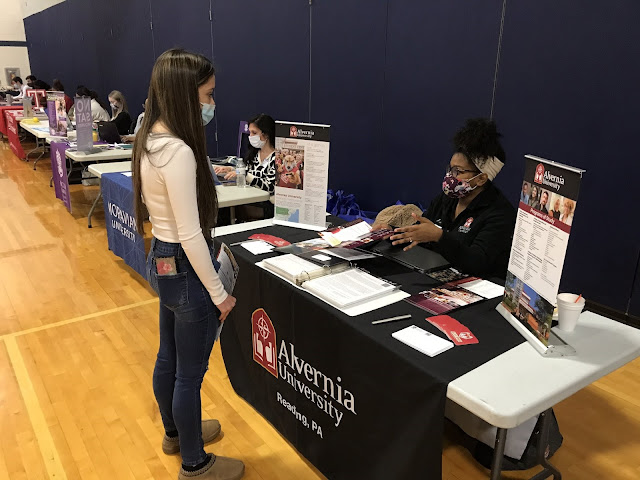
A Pottstown High School student talks with a representative of Alvernia University during Instant Decision Day.

Blogger's Note:
The following was provided by the Pottstown School District.

Pottstown High School seniors found out, when your school district's mission is to prepare each student, by name, for success, being accepted to college may only take an instant. 
Enam Robinson is getting a 'full ride' to
attend Cheyney University

Recently admissions counselors from 28 colleges were on hand at Pottstown High School to take part in Instant Decision Day. 

The event was organized by the high school College and Career Counselor Susan Pritt. 

Counselors met one on one with seniors to discuss their application and transcript for admission. 

Over 110 acceptances were awarded to students, including full financial scholarships to Cheyney University for Enam Robinson and Kennedy Cole to Lincoln University. 

Members of the junior class also had the opportunity to meet with the counselors and discuss how to best prepare for the college admission process next year. 

Pritt said "this is a proud moment for our students to see their hard work paying off. Being able to bring all these schools together with our students and take some of the stress out of the acceptance process is a relief to students and parents and gives us another reason to say, proud to be from Pottstown."

Kennedy Cole is getting a 'full ride' to
attend Lincoln University

The colleges in attendance were: 
  • Alvernia University, 
  • Arcadia University, 
  • Bloomsburg University, 
  • Clarion University, 
  • Cheyney University, 
  • Cedar Crest College, 
  • Delaware State University, 
  • Delaware Valley University, 
  • Eastern University, 
  • East Stroudsburg University, 
  • Elizabethtown University, 
  • Harcum College, 
  • Harrisburg University, 
  • Immaculata University, 
  • Kutztown University, 
  • Lebanon Valley University, 
  • Lincoln University, 
  • Lock Haven University, 
  • Manor College, 
  • Mansfield University, 
  • Millersville University, 
  • Montgomery County Community College, 
  • Moravian University, 
  • Neumann University, 
  • Penn College of Technology, 
  • Shippensburg University, 
  • St. Luke's Hospital School of Nursing, 
  • Temple University, 
  • Widener University.

Sunday, January 30, 2022

With 'Disenchanted,' These Princesses Have had It!


 Blogger's Note: The following was provided by Steel River Playhouse.

Poisoned apples. Glass slippers. Who needs ’em?! 

Not Snow White and her posse of disenchanted princesses in this hilarious adult musical that’s anything but Grimm. 

The original storybook heroines are none-too-happy with the way they’ve been portrayed in today’s pop culture so they’ve tossed their tiaras and have come to life to set the record straight. 

Hear how they really feel as Steel River Playhouse presents the musical Disenchanted! opening on Feb. 4 and running through Feb. 20.

Forget the princesses you think you know – these royal renegades are here to comically belt out the truth.
Written by Dennis T. Giancino and directed by Alicia Brisbois this show from Broadway Licensing is sure to leave you laughing. 

The cast features Alicia Huppman as Snow White, Liana Henrie as Cinderella, Ren Dougherty as Sleeping Beauty, Alessandra Fanelli as Belle, Taylor Patullo as The Little Mermaid, Nicole Napolitano as Rapunzel, Christina Concilio as Hua Mulan/Pocahontas/Princess Badroulbador and Kena Butts as
The Princess That Kissed The Frog. 

Adult language, themes and content make this a show decidedly not for children.

“It’s our pleasure to bring our favorite princesses’ truths to the stage," said Managing Director Rita Pederson.

So, book your babysitters, grab your dates, sisters and girlfriends and buy tickets for this show.

The show runs Fridays and Saturdays at 8 p.m. and Sundays at 2 p.m.. In addition there will be special Saturday matinees at 2 p.m. on Feb. 12 and Feb. 19. 

Tickets are $29 for adults, $24 for Seniors 65+, and $17 for students. 

Tickets may be purchased online via the link at www.steelriver.org, or by calling the box office at
610-970-1199. 

For more information about volunteer opportunities or other questions email info@steelriver.org. 

Friday, December 31, 2021

GOP's Fair Funding Defense Reveals its Classism


At first, I wasn't sure I had read it right. 

“What use would a carpenter have for biology?” 

The question had been asked by a lawyer named John Krill. He had asked it of Matthew Splain, the superintendent of the rural Otto-Eldred School District in McKean County.

Splain is also the president of the board of directors of the Pennsylvania Association of Rural and Small Schools, which is one of the plaintiffs in a much-watched case being now being argued in a Harrisburg courtroom.

In their lawsuit, Splain and his fellow plaintiffs assert that the Keystone State's ridiculously unfair system for funding public education is not only, well, ridiculously unfair, but also a violation of the state Constitution.

That Pennsylvania's school funding system is unfair was established right after the ironically named "fair funding formula" was adopted and immediately ignored for all but new school funding, meaning poorer districts, like Pottstown, get far less in state funding than the formula says they are entitled to receive.

As we've written in this space before, Pottstown gets $13 million less every year from the state than the formula says it should to put it s students on an even playing field with those in wealthier districts. 

Although the formula's money is still missing, the creation of that formula provided the basis for an apples-to-apples -- or rather a student-to-student -- comparison of school funding. And that's where the Constitution comes in.

The Pennsylvania Constitution includes a clause requiring that the state provide a "thorough and efficient" system of public education. 

Our state, ranked near the bottom on the national list of fair public education funding, is trapped in a system that relies heavily on property taxes, meaning wealthy school districts have more money to spend on education.

It means a lot of other things too -- like the state's elected officials get to hoard money and boast they haven't raised state taxes and then turn around and blame state-mandate-burdened school districts for local tax hikes.

It also means poorer districts-- often with  higher minority populations, which struggle to provide resources to students already starting school with all the disadvantages poverty imposes -- must then tax their lower-income communities at a higher rate just to provide basics.

All too often, extras like well-equipped athletic facilities, advanced placement courses or even adequate bathrooms are beyond their budgets.

The racial injustice embedded in this ongoing theft of student potential is so pronounced that POWER In Faith, a faith-based advocacy group fighting for fair funding, calls it, accurately, "educational apartheid."

So one might expect that the lawyer defending the system wedged in gridlock by the General Assembly's Republican majority would not be so tone deaf as to suggest that poorer students have no need of an adequate education.

Krill's question evoked the kind of whiny question we all used to hear asked in middle school: "Why do I need to know when the Emancipation Proclamation was signed?" or "When are we ever going to use algebra in the real world?"

Not to be outdone by petulant middle schoolers, Krill took their complaint to the highest levels of Pennsylvania jurisprudence and asked Splain to explain "what use would someone on the McDonald's career track have for algebra 1?"

After doubling down, to my amazement, he went for the tri-fecta.

“Lest we forget, the Commonwealth has many needs," Krill said. "There’s a need for retail workers, for people who know how to flip a pizza crust.”

First, join me in resisting the temptation to remark on the inevitably irony of a highly paid lawyer presenting himself as an expert on what working class folks need to know thinking that pizzas get flipped.

Our time together is short, so let's move on to the more disturbing implications of what Krill is saying.

It would seem that rather than argue that Pennsylvania does in fact provide the "thorough and efficient system of education" the Constitution requires, Krill, who represents Senate President Pro Tempore Jake Corman, R-34th Dist., is essentially arguing "who cares if it doesn't? So what?"

There's a disturbing kind of circular logic at work here: "Why should we spend money making education funding equitable when our failure to do so will ensure you'll never need it?"

He might as well argue "why should Pennsylvania help feed low-income families when they're already starving their kids?"

Breathe.....

Let's forget for a moment that this is a country where children are told "you can be anything you want to be when you grow up. You could be president if you want." Because now, John Krill has already decided that kid's going to end up "flipping pizzas," whatever the hell that's supposed to be.


Let's forget for a moment that Thomas Jefferson believed "That talent and virtue, needed in a free society, should be educated regardless of wealth, birth or other accidental condition; That other children of the poor must thus be educated at common expence."

Let's forget for a moment that John Adams believed "The education here intended is not merely that of the children of the rich and noble, but of every rank and class of people, down to the lowest and the poorest. It is not too much to say that schools for the education of all should be placed at convenient distances, and maintained at the public expense."

And let's forget for a moment that the prescient lawyer who argues poor kids can't succeed and don't need to learn stuff represents a public official who was first elected to his seat in 1998 -- no doubt entirely on merit -- only after daddy Corman retired from it; a true self-made man.

Let us never forget, however, that the courtroom defense the Republican majority selected to defend its policy of failing to follow the dictates of the nation's founders; of refusing to provide equity to poorer, darker-skinned schools; of failing to fund its own fair funding formula is quite simply that "some kids aren't worth it, and mostly, they're poor and Black."

The privilege-infused arrogance of that kind of thinking as a defense of a public policy that undermines the core of the American Dream -- that every child has an equal chance to succeed -- before they can even get up on their feet is not only morally repugnant, but destined to cost more than actually funding education fairly ever would.

After all, the classroom-to-prison-cell pipeline we have now in Pennsylvania continues to cost millions more than a classroom-to-successful-citizen pipeline ever would.


Just ask Benjamin Franklin: "general virtue is more probably to be expected and obtained from the education of youth, than from exhortations of adult persons; bad habits and vices of the mind being, like diseases of the body, more easily prevented than cured."

Thankfully, since old Ben isn't around to ask, we have Margie Wakelin, a lawyer for the Education Law Center representing the plaintiffs, who was on hand to follow up with Splain.

She asked why it might be useful to America to have a future "pizza flipper" know algebra or a future carpenter know biology.

Sadly, Splain had to spell out what Krill can't seem to understand: “We obviously can’t predict what our students will have interest in,” or what careers they might pursue, he said.

Further, giving a timely example of the founders' belief that having well-educated, well-informed citizens makes for a more stable Republic, Splain agreed with Wakelin that it's best "for a retail worker 'to understand basic biology of viruses during a global pandemic' — to decide whether to get a vaccine, what steps to take to keep a business open, or to send children to school for in-person learning," as The Philadelphia Inquirer reported.


Of course, a well-educated, well-informed citizenry in all walks of life capable of critical thinking is the lifeblood of a Republic and necessary for a society whose system of government requires voters to be able to see through the kind of venomous bullshit Jake Corman's lawyer was spewing in that courtroom.

And who could be against that? 

Certainly not the party that values children growing up with the ability to be self-made, to "pull themselves up by their own bootstraps" and to lift themselves out of poverty....

So yeah, I guess I did read it right after all.

Saturday, December 11, 2021

New Event Sunday at Pottsgrove Manor: Frost Fair


Blogger's Note:
The following was provided by Pottsgrove Manor.

Explore the history of the holidays at Pottsgrove Manor on Sunday, Dece. 12 from 11 a.m. to 5 p.m. 

The 18th Century Holiday Frost Fair is a new program that invites the public to immerse themselves in an 18th century style market fair, complete with vendors, demonstrations, and games. Visitors can also explore handmade goods and seasonal crafts from local artisans at the holiday market. This event has a suggested $2 donation per person.

Gather the whole family and dress for the weather to start a new holiday tradition at Pottsgrove Manor’s Frost Fair. 

Learn about gingerbread recipes from the past and see how it was baked at the Bake Oven. Follow the sound of laughter and music to engage with Tucker’s Tales Puppet Theater, and play a fair game to win a prize at one of the three game booths. 

Explore what merchants in the 18th century sold, such as historic art made by At the Sign of the Black Bear alongside woodworking and weaving at Stone House History. Stop over at the hot chocolate tent for a sample of this historic drink, then laugh and make new friends at the tavern. 

Discover the history of Twelfth Night celebrations from the 1750s as the first floor of Pottsgrove Manor will be open for self-guided tours. Hearth cooking in the reproduction kitchen will highlight some of the favorite seasonal treats that you may want to include at your holiday table.

After dark, the interior of the house will be lit by candles.

Find a unique gift for everyone on your list from local artisans, set up in the holiday market. From ornaments to jewelry, pottery, and much more, there is something special at every stall. Hot food and sweet treats complete the day, but the memories of Frost Fair will last all season long.

Frost Fair is an outdoor, weather dependent event. Free parking and complimentary shuttle service will be available at Memorial Park. Follow signs for parking. 

Pottsgrove Manor is following all updated CDC guidelines for the mitigation of COVID-19 at the facility including appropriate mask wearing, social distancing, and capacity limits. All visitors must follow these guidelines.

ABOUT POTTSGROVE MANOR

Pottsgrove Manor exemplifies the restrained elegance of early Georgian architecture popular with wealthy English gentry during the mid-18th-century. Built in 1752 for John Potts, ironmaster and founder of Pottstown, the mansion was situated on a nearly 1,000 acre plantation, which by 1762 included the town of “Pottsgrove.”

As a successful ironmaster and merchant, John Potts, was appointed Justice of the Peace and Judge on the Philadelphia County Court of Common Pleas. He was elected to the Pennsylvania General Assembly from both Berks and Philadelphia Counties.

Although only four acres of original property remain today, Pottsgrove Manor has lost none of its original charm and architectural beauty. The sandstone exterior, elegant interior and fine furnishings reflect the eminence that the Potts family had attained before selling the property in 1783. The mansion has been restored to recreate the lifestyle and times of the Potts family. Pottsgrove Manor is open year-round for guided tours, as well as public programs, school tours, lectures, and workshops. A museum shop on site offers a wide selection of 18th century reproduction items, books, toys, and more.

Pottsgrove Manor is following all state and local guidelines for the mitigation of COVID-19 at the facility. Masks are required for all visitors indoors and recommended for unvaccinated individuals outdoors.

Pottsgrove Manor is located at 100 West King Str. in Pottstown. 

Pottsgrove Manor is operated by the Montgomery County Division of Parks, Trails, and Historic Sites. For more information, please call (610) 326-4014 or visit www.montcopa.org/pottsgrovemanor. Members of the public can also like Pottsgrove Manor on Facebook or follow us on Instagram for updates.