Showing posts with label Pennsylvania Department of Environmental Protection. Show all posts

Friday, March 3, 2017

Zoning Hearing Digs Deeper into Quarry Issues

Photos by Evan Brandt
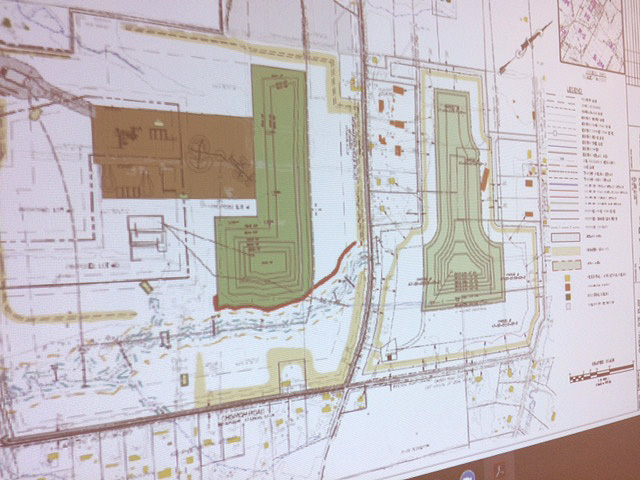
This map shows the first quarry proposal on the left, which has already received zoning approval, and the second, called GR-IV, on the right, which is the subject of the current zoning hearings in New Hanover. Hoffmansville Road splits the two sites. The road at the bottom of the maps is Church and Coleflesh Road is at the right.


The seemingly endless zoning hearings on the 18 acres that Gibraltar Rock would like to open as a second quarry site continued Thursday night with an expert paid by the quarry company disputing testimony from an expert paid by the township.

By strange coincidence, they disagree on several key points.

Currently at issue is the proximity of the site, called GR-IV, to the former Good's Oil site off Route 663, north north of Big Road, the source of significant groundwater contamination in the area.

For months, the two sides have been arguing about whether a quarry operation would have an effect on the contamination or not.
This map, created by the quarry company's consultant, 
EarthRes, shows the area of groundwater draw-down
for each 50-foot level quarry digs.

The quarry expert insists the flow of the contamination "plume" is flowing southwest, under Route 663.

The township expert says the action of pumping groundwater out of the deepening hole in the ground may well draw the chemical contamination into the pit and thus discharged into a tributary of Swamp Creek, which empties into Perkiomen Creek, a source of public drinking water.

Thursday night was scheduled for Lou Vittorio, the quarry's expert from the firm EarthRes, to rebut testimony from the township's witness, Toby Kessler, from Gilmore Associates.

At the next hearing, on April 6, at 6:30 p.m., Vittorio will be cross-examined by the township's special attorney on the case, Robert Brant.

Among the more notable things Vittorio said are that the state recently asked the company to update the chemicals it will test for in its monitoring wells around the proposed quarry site.

This request, which Vittorio said the company has agreed to, comes on the heels of the discovery in July of a concrete vault on the Good's Oil property containing many of the chemicals which polluted neighbors wells as well as some new ones -- primarily pesticides and petroleum products.

He also said that not only does the quarry's discharge permit from the
Gibraltar Rock witness Lou Vittorino, in the foreground,
testifies Thursday to the New Hanover Zoning Hearing Board.
Pennsylvania Department of Environmental Protection need to be renewed every five years -- when the state can make changes to the monitoring and treatment requirements with which the quarry must comply -- but also every time the quarry opens a new "lift," which is another 50 feet down.

His point is that "in the unlikely event" that contamination reaches the quarry pit, there are many opportunities for the state to react and impose new restrictions or a treatment regimen.

Kessler has already testified that the company's treatment regiment is inadequate for the chemicals in question, particularly a suspected carcinogen called 1,4 dioxane.

The hearing ended with Ross Snook, a relatively new arrival in the 17-year quarry saga, who was earlier this week appointed as chairman of the township's newly reinvigorated Environmental Advisory County.
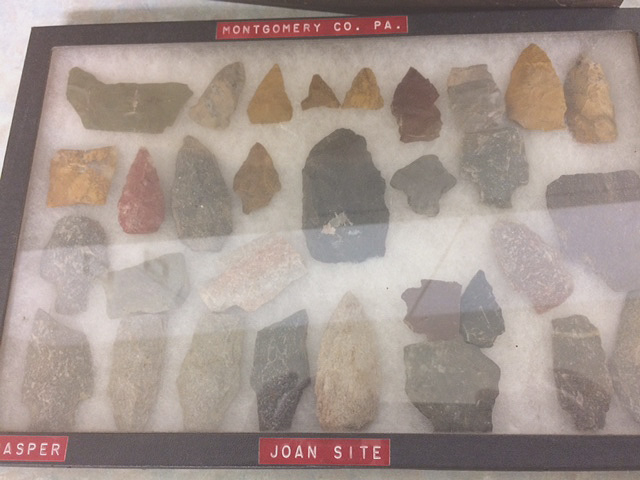
Some of Lee Hallman's samples.
He submitted evidence from the federal Agency for Toxic Substances Disease Registry which he was prevented from submitted two months ago on the grounds of a technicality.

The evidence had to do with the health effects of groundwater contamination at Camp Lejune, a Marine Corps base in North Carolina, and the health effects linked to that contamination. Snook's point is that the Lejune chemicals are similar to the chemicals at issue at the Good's Oil site, such as volatile organic compounds like TriChlorEthylene, or TCE.

He also brought along a man named Lee Hallman, who briefly outlined some of the pre-historic Native American artifacts found on the site of both the first and second quarry proposal sites.

He also brought along samples which he said could be as old as 9,000 years, adding "the site is crucial to Pennsylvania pre-history, which we know so little about."

However his testimony was undermined when he admitted he did not know that the Pennsylvania Historic and Museum Commission has already declared that the quarry operation will not cause any harm to the state's archaeological resources.

Wednesday, December 7, 2016

DEP Took 8,000 Gallons of Pollution Off Oil Site

Photos by Evan Brandt
Barely 30 people attended the public hearing Tuesday night regarding the state's clean-up of the former home heating oil site that was the source of contamination of many area drinking water wells.

The hearing, held at Boyertown Junior High East in New Hanover, was specific to the discovery and draining of a buried pit on the site from which more than 8,000 gallons of dangerous chemicals were removed in July.

The DEP discovered the pit as the result of a deposition given by the property's effective owner Ethan Good (legally the property is owned by trusts under Good's control) in legal proceedings in which he agreed to pay for the clean-up there.

The operation at the site along Route 663, 334 Layfield Road, was once known as Swann Oil, and then the Good Oil Co.

DEP photo of the pit at the Good Oil property
Colin Wade, the DEP official in charge of the investigation of the site, said the liquid found in the pit contained "weathered petroleum, chlorinated solvents, pesticides" and a by-product of petroleum known as poly-aromatic hydrocarbons, or PAHs.

Responding to a question from state Rep. Marcy Toepel, R-147th Dist., Wade said that contrary to what she had first been told, the materials taken out of the pit are "similar" to the pollutants which leached into the groundwater and poisoned area wells.

The discovery of that pollution in 2011, resulted in public water being extended to numerous homes in the area at a cost of $2 million in taxpayer dollars. (This is the money Good has agreed to pay back.)

Wade also said the estimated cost of the removal was about $150,000 and that the contaminants were incinerated off-site at a licensed disposal facility.
State Rep. Marcy Toepel asks a question.

Also, pipes that emptied into the pit, and which seemed to have come from the garage at the facility, where a truck washing operation as well as heating oil storage and sales were once housed, were also discovered.

When asked by Chris Mullaney, an attorney for the Ban the Quarry group, why it took so long to find something so many people seemed to know about, Wade said DEP interviewed former employees and longtime residents, but could not located the pit, which was buried 10-feet underground -- this despite using ground-penetrating radar.

"It's always difficult to find out where people dumped something 40 years ago," said Wade.

DEP Official Colin Wade speaks at the hearing.
Accordingly, Wade said while the discovery of the pit indicates DEP has found one location of "significant" pollution, it will continue to investigate the site and search for more potential sources of contamination.

Mullaney suggested that DEP expand its search to property Gibraltar Rock purchased from Good in December, 2014 that is adjacent to the contamination site and is currently being proposed for expanded quarry operations.

"It's unbelievable, the quantity, variety and intensity of the chemicals found on in the samples," Mullaney said. He added that the Ban the Quarry group is concerned Gibraltar's proposed quarry operation will draw more chemicals out of the ground water and into the open, posing a further threat.

The map on this map shows the area of groundwater
contamination. The proposed quarry operations can be
seen adjacent to the contamination area.
"We hope it doesn't happen, but we're worried," he said.

"It's frightening not to have this (Good Oil) property totally clean before they start quarrying," Bob Meyers said Tuesday.

Currently, the New Hanover Zoning Hearing Board is taking testimony about Gibraltar's proposed expanded quarry operations onto the site adjacent to the former Good Oil.

Experts for Gibraltar said the operation would not draw much if any further pollution, which an expert hired by the township maintains that is a very real possibility and that the methods proposed for treating any contamination found are inadequate.

The next hearing is scheduled for Jan. 5 at 6:30 p.m. at the township building and William "Ross" Snook, the newly appointed chairman of the township's environmental advisory council, is expected to testify.

In the meantime, here are the Tweets from Tuesday night's meeting.

Friday, November 4, 2016

Town's Expert Cross Examined by Quarry Attorney

Image from last month's presentation by Toby Kessler on the potential for quarry operations at the Gibraltar Rock site to exacerbate the pollution at the adjacent Good's Oil Company site of Route 663.

The attorney for Gibraltar Rock had his turn Thursday night, using his cross-examination at a zoning hearing to try to poke holes in last month's testimony by an expert hired by New Hanover Township that operations from a proposed quarry expansion could exacerbate groundwater pollution there.

The attorney, Stephen Harris, was cross-examining Toby Kessler, a hydro-geologist with Gimore and Assoc., a firm the township hired to assess the threat of the contamination spreading.

Prior to Kessler's testimony, an expert from EarthRes, the firm hired by Gibraltar Rock to answer the same set of questions, testified that there was little chance the quarry expansion would affect the groundwater contamination.

The contamination in question came from the from the former Good's Oil Company site on Route 663. The contamination with TCE and 1,4 dioxane, two potential carcinogens, ruined several wells and required a $2 million extension of the public water system to provide safe drinking water to residents there.

Recently, the Pennsylvania Department of Environmental Protection reached an agreement with Ethan Good, who controls the trusts which own the property, to pay for the installation of the new water system and the clean-up costs.

Harris delivered news on that front as well.

He said the DEP has located the concrete pit in which the chemicals were stored and drained it. He said a public hearing to explain those action to the public will be held Dec. 6 at 7 p.m. at Boyertown Junior High West.

Harris also tried to use Kessler's previous testimony about the clean-up of the EPA Superfund site in which the former Bally Case & Cooler Co. polluted wells that supplied the borough of Bally's water supply.

He noted that the levels of 1,4 dioxane the EPA permits to be discharged into the West Branch of Perkiomen Creek, a stream classified as cleaner than Swamp Creek, is higher than the highest levels of contamination found at the Hoff site.

Harris also inferred that since the tributary of Swamp Creek into which the quarry expansion would discharge is not currently a source of public drinking water, a higher pollution clean-up standard might not be required.

The next zoning hearing on the subject was set for Jan. 5 at 6:30 p.m. in the township building, during which residents will be permitted to testify.

Wednesday, September 21, 2016

Storm May Rise Over Looming Stormwater Fees


You might say, you could blame it on the rain.

For about a year, the firm of Amec Foster Wheeler has been putting together a look at Pottstown's stormwater situation.

It found 1,700 storm inlets, 90 miles of streets, 49 miles of storm sewer, 6.5 miles of it stone arches and about half a million in costs.

And it found, as is the case in all of the more than 1,200 municipalities in Pennsylvania, a rising liability for those costs as infrastructure ages and federal and state regulations about pollution get more stringent.

There is no question more costs will be incurred as those regulations come into play. The question that remains open is who will pay and how will those payments be calculated.
Nathan Walker makes his presentation to the borough authority

Authority Chairman Tom Carroll advocated for moving ahead, conferring with borough council and get a jump on issues Pottstown will have to face sooner or later.

But Authority Secretary Jeff Chomnuk pointed out that only .5 percent of Pennsylvania municipalities have taken the steps Carroll was advocating and he worried about "imposing another fee on developed property."

Particularly if surround towns have not acted yet, Chomnuk worried it would add to the perception that Pottstown is an expensive place to do business.

Wouldn't it be better, he suggested, until Pottstown was part of a larger movement. Ultimately, that decision will be made by borough council.

Authority solicitor Vincent Pompo noted that developed places like Pottstown have so far been the places where these ideas are now being tried out. He also warned that the state and federal governments have begun to fine localities who are not living up to their new obligations under the new rules.

Here are the Tweets.


Wednesday, March 30, 2016

Discharge, Distrust and Polluted Groundwater

Photo by Evan Brandt
What remained of the crowd by the time it came for the formal public haring for the renewal of the NPDES permit for the Gibraltar Rock Quarry in the auditorium of Boyertown Junior High East Tuesday.


The public hearing Tuesday evening for the renewal of the discharge permit for the proposed Gibraltar Rock Quarry was part town hall and part formal hearing.

It began with a presentation of the reason everyone was there (which I missed) and then a parade of residents, officials, layers and experts talking about the wisdom of beginning operations of a rock quarry near to a site where groundwater contamination has been found.

It was broken into three parts.

The first and third parts were question and answer period, with residents asking questions and actually getting answers on the spot. But it was "off the record."

In the middle was the formal public hearing, with folks testifying, the court recorder taking it all down and officials from the Department of Environmental Protection saying "thank you for your comments."

Throughout it all, no one from the public came to speak in favor of the quarry, or the potential its operations have to discharge groundwater polluted with a dangerous alphabet soup of chemical pollutants into a stream that empties into Swamp Creek.

Photo by Evan Brandt
The Gibraltar Rock quarry maps to which speakers and experts referred.
Mostly, what people seemed to be trying to determine, was how bad the pollution is, what DEP is prepared to do about it, and the potential impact the quarry operations would have on the contamination seeping through the groundwater at the former Good's Oil site off Layfield Road (Route 663).

What was also clear is that the experts do not seem to agree.

While the expert from EarthRes, the firm hired by Gibraltar to study the area assured residents and officials the contaminated groundwater from Good's is moving away from the site, the engineering firm and consultant hired by New Hanover Township asserted the opposite.

And, not surprisingly, it also became increasingly clear how the entire issue has been compartmentalized within DEP, so that only certain aspects of the proposed quarry and its proximity to the contaminated site are considered at any one time, by any particular agency.

So while resident after resident came to the microphone to talk about their concerns about the potential contamination and impact of the quarry operations, they were repeatedly told something like: "we're only here to discuss the NPDES permit, please confine your comments to that issue."

FYI, NPDES stands for -- ironically perhaps -- the National Pollution Discharge Elimination System and is a federal permit, administered by the state, to protect the nation's rivers and streams from too much pollution.

Nothing was resolved, the state insists it is still undecided about renewing the discharge permit, or the mining permit.

What was learned, however, from DEP official Ragesh Patel, that the state plans to reveal its plans for cleaning up the Good's Oil site by the end of the year, or early in 2017.

So without further ado, we present the Tweets -- and mostly the preserved live video from the hearing's various parts: