Showing posts with label New Hanover Zoning Hearing Board. Show all posts

Friday, September 8, 2017

New Hanover Zoning Board OKs Quarry Expansion

This map, from a previous zoning hearing, shows the proximity
of the quarry expansion approved last night to the pollution site
at Good's Oil, identified inside the red circle.
The township’s zoning hearing board unanimously approved the expansion of the Gibraltar Rock quarry into a parcel adjacent to a groundwater pollution site Thursday night.

The 4-0 vote came with more than 15 conditions that will be imposed on the expansion, which is not likely to begin actual operations for four to five more years, according to an estimate by Stephen Harris, Gibraltar’s long-time attorney.

“We can’t vote how we feel about this application. We are bound by the constraints of the law,” said Zoning Chairman Mark Wylie in announcing the decision.

Ultimately, the question came down to the threat posed by polluted groundwater pollution at the former Good’s Oil site off Route 663, and what impact the expanded quarry operation would have on its movement underground, said Wylie.

He said the testimony offered over about two years of testimony by experts for Gibraltar, the township and Paradise Watchdogs/Ban the Quarry was all credible.

Because the pollution plume is moving slowly southwest underground, away from the quarry expansion site, Wylie it would have been legally difficult to deny permission to expand based on any potential risk.

Rowan Keenan, attorney for the Ban the Quarry group said he understood why the zoning board made the choice it did — because it allow them to impose numerous conditions, such as screening, replacing well water and complying with a federal limit on the suspected carcinogen 1,4 dioxane should the Environmental Protection Agency ever get around to imposing one.

Had they denied the “special exception” required, Gibraltar could have appealed that decision and over-turned it, and there would be no conditions at all.

Celeste Bish, president of Paradise Watchdogs/Ban the Quarry — a citizens group which has opposed every stage of the quarry for nearly 20 years — agreed with Keenan’s analysis.

“We’re certainly disappointed, but we understand why the zoning hearing board made the decision it did, to be able to impose conditions,” she said.

Although, Keenan pointed out, not only can he or the township’s special solicitor Robert Brant appeal the decision, but they or Gibraltar can also appeal the conditions.

Harris said he had been “cautiously optimistic” about the decision coming into the final lap, adding “although it wouldn’t surprise me if Ban the Qaurry filed an appeal.”

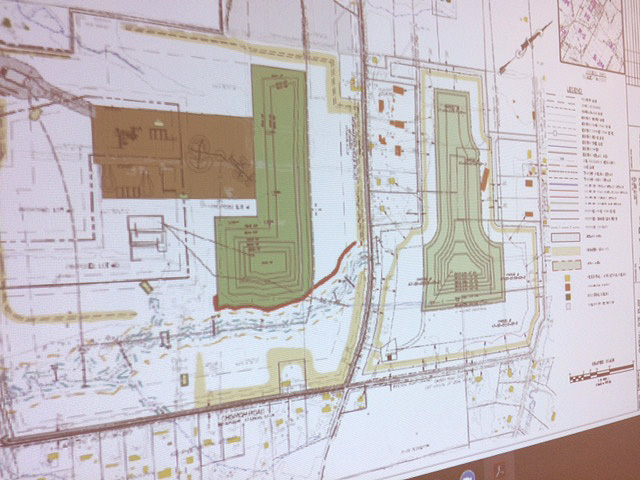
These maps show Hoffmansville Road running between the quarry pits.
In addition to the next requirement being to amend the quarry’s state mining permit to include the expansion, the quarry will also have to go through the land development process.

Earlier this week, Gibraltar submitted its final site plan for the original parcel south of Hoffmansville Road, known as GB-1, over which many legal battles and public hearings have been fought.

In 2007, the township’s zoning board of appeals granted the company permission to open the quarry on 163 acres bounded by Route 73, Hoffmansville Road and Church Road, but with a number of restrictions to which the company objected.

The company went to court, arguing among other things, the state’s non-coal mining law pre-empted the necessity of going through the township’s land development process, but lost that fight.

The preliminary site plan approval for the first quarry site dates back to 2015.

The quarry has a second digging site north of Hoffmansville Road and a tunnel will be dug beneath the road to move rock from this second site to the crushing machine on the first.

What the zoning hearing board approved Thursday is a third site, also north of Hoffmansville Road and adjacent to the second on one side, and to the former Good’s Oil property on the other.

It is located on 18 acres Gibraltar purchased for $800,000 in November, 2014 from a trust owned by the Good family.

New Hanover Zoning Hearing Board Chairman Mark Wylie
Next to it is the Good’s Oil site, where contamination from the former operation there infiltrated the groundwater, polluting numerous household wells and ultimately necessitating the installation of a $2 million public water system in 2013.

The affect the most recently approved operation will have on that contamination has been the focus of most of the hearings.

Wylie noted it will be approximately 15 years before the digging there is deep enough to reach groundwater and require the pumping some fear will alter the course of the pollution plume and release it into a tributary of Swamp Creek.

With 15 years of monitoring well data in hand before the problem emerges, Wylie said the township, the state and Gibraltar can be ready.

“Of course we don’t think that de-watering will draw in the pollution, but we’ve spent years asking ourselves ‘what if,’” Harris said, noting that treatment systems exist and would be implemented for whatever type of pollution, if any, ultimately appears.

Here are what few Tweets there were from the all-too-brief meeting.


Friday, August 4, 2017

Between a Rock and a Zoning Hearing Board Ruling


The relationship between the proposed expansion of the as-yet non-operational Gibraltar Rock Quarry and groundwater contamination at the neighboring property remained the central point around which all argument revolved Thursday night as the lawyers had their final say before the Zoning Hearing Board.

Now I could try to repeat everything they said, but most of it is contained in the Tweets below.

So let me sum up:

Gibraltar Rock Quarry Attorney Stephen Harris argued that even if the water pumping at the quarry pulls in contaminants form the former Good's Oil site off North Charlotte Street, it will be treated under the conditions of the permit, so everyone should be happy.

Rowan Keenan, attorney for the Paradise Watchdogs group, said even if the contaminants that reach the quarry pits are treated, the pumping will alter the flow of water underground and may contaminate nearby wells that will not be treated with the quarry water.

In a sadly comic passage, he also told the zoning hearing board that it is "alright to vote your conscience," whereas zoning board solicitor Ed Skypala said actually, that's not the case and the zoning board only has the authority to make decisions based on the facts in evidence.

And Bob Brant, attorney for the township, said he agreed with everything Keenan said and also pointed out that while Harris is trying to convince the zoning board that the first two parts of the quarry are going to begin operations, and they were approved by the zoning board, that Gibraltar has lost in court several times.

He pointed out that when the first two quarry segments were approved by the zoning board, no one knew about the groundwater contamination and the zoners should not feel obligated to follow suit on those first two decisions.

Brant and  Keenan both argued that testimony from township and Paradise Watchdog experts gave the zoning board adequate legal standing to deny the quarry request for the third expansion, which Harris said would take at least five years to get up and running.

The zoning board will issue its decision at the next meeting on Sept. 7 In the meantime, satisfy yourself with the Tweets!

Friday, April 7, 2017

A Chapter Closes on Quarry Zoning Hearings


Last night's zoning hearing meeting on the proposed expansion of the Gibraltar Rock Quarry is probably more significant for what it represents than what happened.

What happened is it's the last one. The zoning hearing board will issue its decision in August.

What it represents is the closing of a chapter in the quarry's ongoing saga in its attempt to win township approval and begin operations.

For most of the hearings that I have managed to attend, the primary question with which the zoning hearing board must wrestle is one of pollution, not its usual balliwick.

Small wonder, the expert paid by the quarry says there is no risk ("within reasonable scientific certainty") that the pumping of hundreds of thousands of gallons of water from the second quarry pit on the north side of Hoffmansville Road, adjacent to the Good Oil groundwater contamination site that the chemicals in question will be pumped into the quarry, and then into the tributary of Swamp Creek.

The experts paid by the township and the Paradise Watchdogs group put the potential risk much higher.

In the end, its the members of the zoning board who have to decide.

In the meantime, quarry attorney Stephen Harris said he believes the discharge permit for the original quarry, already approved by the zoning board, will be issued by the state in 30 to 60 days.

Then it's a question of how quickly the Pennsylvania Department of Environmental Protection's mining office in Pottsville issues a new mining permit that the digging can begin.

Here are the Tweets:

Friday, March 3, 2017

Zoning Hearing Digs Deeper into Quarry Issues

Photos by Evan Brandt
This map shows the first quarry proposal on the left, which has already received zoning approval, and the second, called GR-IV, on the right, which is the subject of the current zoning hearings in New Hanover. Hoffmansville Road splits the two sites. The road at the bottom of the maps is Church and Coleflesh Road is at the right.


The seemingly endless zoning hearings on the 18 acres that Gibraltar Rock would like to open as a second quarry site continued Thursday night with an expert paid by the quarry company disputing testimony from an expert paid by the township.

By strange coincidence, they disagree on several key points.

Currently at issue is the proximity of the site, called GR-IV, to the former Good's Oil site off Route 663, north north of Big Road, the source of significant groundwater contamination in the area.

For months, the two sides have been arguing about whether a quarry operation would have an effect on the contamination or not.
This map, created by the quarry company's consultant, 
EarthRes, shows the area of groundwater draw-down
for each 50-foot level quarry digs.

The quarry expert insists the flow of the contamination "plume" is flowing southwest, under Route 663.

The township expert says the action of pumping groundwater out of the deepening hole in the ground may well draw the chemical contamination into the pit and thus discharged into a tributary of Swamp Creek, which empties into Perkiomen Creek, a source of public drinking water.

Thursday night was scheduled for Lou Vittorio, the quarry's expert from the firm EarthRes, to rebut testimony from the township's witness, Toby Kessler, from Gilmore Associates.

At the next hearing, on April 6, at 6:30 p.m., Vittorio will be cross-examined by the township's special attorney on the case, Robert Brant.

Among the more notable things Vittorio said are that the state recently asked the company to update the chemicals it will test for in its monitoring wells around the proposed quarry site.

This request, which Vittorio said the company has agreed to, comes on the heels of the discovery in July of a concrete vault on the Good's Oil property containing many of the chemicals which polluted neighbors wells as well as some new ones -- primarily pesticides and petroleum products.

He also said that not only does the quarry's discharge permit from the
Gibraltar Rock witness Lou Vittorino, in the foreground,
testifies Thursday to the New Hanover Zoning Hearing Board.
Pennsylvania Department of Environmental Protection need to be renewed every five years -- when the state can make changes to the monitoring and treatment requirements with which the quarry must comply -- but also every time the quarry opens a new "lift," which is another 50 feet down.

His point is that "in the unlikely event" that contamination reaches the quarry pit, there are many opportunities for the state to react and impose new restrictions or a treatment regimen.

Kessler has already testified that the company's treatment regiment is inadequate for the chemicals in question, particularly a suspected carcinogen called 1,4 dioxane.

The hearing ended with Ross Snook, a relatively new arrival in the 17-year quarry saga, who was earlier this week appointed as chairman of the township's newly reinvigorated Environmental Advisory County.

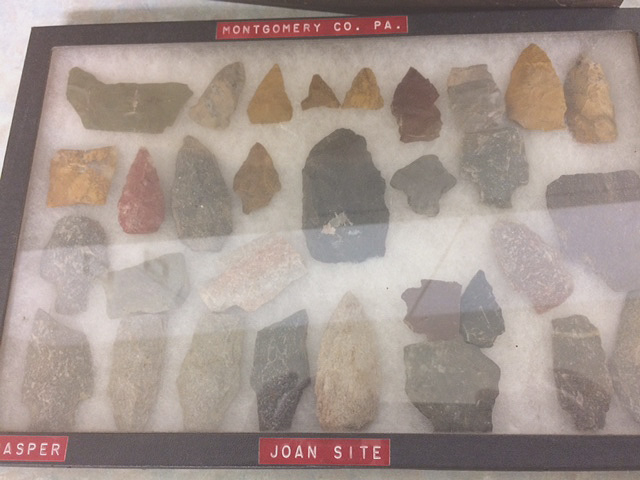
Some of Lee Hallman's samples.
He submitted evidence from the federal Agency for Toxic Substances Disease Registry which he was prevented from submitted two months ago on the grounds of a technicality.

The evidence had to do with the health effects of groundwater contamination at Camp Lejune, a Marine Corps base in North Carolina, and the health effects linked to that contamination. Snook's point is that the Lejune chemicals are similar to the chemicals at issue at the Good's Oil site, such as volatile organic compounds like TriChlorEthylene, or TCE.

He also brought along a man named Lee Hallman, who briefly outlined some of the pre-historic Native American artifacts found on the site of both the first and second quarry proposal sites.

He also brought along samples which he said could be as old as 9,000 years, adding "the site is crucial to Pennsylvania pre-history, which we know so little about."

However his testimony was undermined when he admitted he did not know that the Pennsylvania Historic and Museum Commission has already declared that the quarry operation will not cause any harm to the state's archaeological resources.

Friday, January 6, 2017

The People Get Their Say on Quarry Expansion

Photo by Evan Brandt
William 'Ross' Snook, newly appointed to New Hanover Township's Environmental Advisory Board, with some of the exhibits he was not allowed to present during Thursday's Zoning Hearing on the proposed expansion of the Gibraltar Rock Quarry.


If you're an aficionado of zoning hearing meetings, you know that is a realm of legalese, rules about when you can ask questions, and of whom, and when you can make a simple statement, and about what.

The year-plus long set of hearings regarding the proposed expansion of the Gibraltar Rock quarry to a site adjacent to the former Good's Oil Co. site, the source of groundwater contamination, has been no exception.

But Thursday night was that rare occasion when the people who have been suffering through these hearings for more than a year, got to offer (somewhat) unfettered comment on what they think of the whole idea of digging a hole and pumping hundreds of thousands of gallons of groundwater a day right next to a contamination site.

It would not be an understatement to say no one seemed to think its a good idea.

Most of those who spoke, asked the zoning hearing board to consider the health of residents, and argued it would be better (and safer) to wait until the site is cleaned, and declared clean, before allowing any blasting and pumping.

But don't let me give the impression that you could just get up there and say anything that came to mind.

For when Celeste Bish from the Ban the Quarry group tried to read the names of those people who have died in homes with contaminated wells since the contamination was first discovered, many of them of cancer, it was ruled either not relevant to the hearing or inadmissible because she didn't have personal knowledge of their death.

Of course, I would think an obituary in the newspaper is pretty certain evidence of death, but then I'm not a lawyer so I could be mistaken.

Nevertheless, when the chance finally came, 11 people who wanted to speak and were lucky enough to be there at the right time, had their say, which you can read about in the Tweets below.

But despite what you might think, we're not done. There is at least one more hearing, tentatively set for Feb. 2 with a possible postponement to March 2, at which Gibraltar attorney Stephen Harris will offer rebuttal witnesses from his expert.

And then the township's attorney, and Ban the Quarry's attorney, and so on and so on and .......

Anyway, here are the Tweets.

Friday, November 4, 2016

Town's Expert Cross Examined by Quarry Attorney

Image from last month's presentation by Toby Kessler on the potential for quarry operations at the Gibraltar Rock site to exacerbate the pollution at the adjacent Good's Oil Company site of Route 663.

The attorney for Gibraltar Rock had his turn Thursday night, using his cross-examination at a zoning hearing to try to poke holes in last month's testimony by an expert hired by New Hanover Township that operations from a proposed quarry expansion could exacerbate groundwater pollution there.

The attorney, Stephen Harris, was cross-examining Toby Kessler, a hydro-geologist with Gimore and Assoc., a firm the township hired to assess the threat of the contamination spreading.

Prior to Kessler's testimony, an expert from EarthRes, the firm hired by Gibraltar Rock to answer the same set of questions, testified that there was little chance the quarry expansion would affect the groundwater contamination.

The contamination in question came from the from the former Good's Oil Company site on Route 663. The contamination with TCE and 1,4 dioxane, two potential carcinogens, ruined several wells and required a $2 million extension of the public water system to provide safe drinking water to residents there.

Recently, the Pennsylvania Department of Environmental Protection reached an agreement with Ethan Good, who controls the trusts which own the property, to pay for the installation of the new water system and the clean-up costs.

Harris delivered news on that front as well.

He said the DEP has located the concrete pit in which the chemicals were stored and drained it. He said a public hearing to explain those action to the public will be held Dec. 6 at 7 p.m. at Boyertown Junior High West.

Harris also tried to use Kessler's previous testimony about the clean-up of the EPA Superfund site in which the former Bally Case & Cooler Co. polluted wells that supplied the borough of Bally's water supply.

He noted that the levels of 1,4 dioxane the EPA permits to be discharged into the West Branch of Perkiomen Creek, a stream classified as cleaner than Swamp Creek, is higher than the highest levels of contamination found at the Hoff site.

Harris also inferred that since the tributary of Swamp Creek into which the quarry expansion would discharge is not currently a source of public drinking water, a higher pollution clean-up standard might not be required.

The next zoning hearing on the subject was set for Jan. 5 at 6:30 p.m. in the township building, during which residents will be permitted to testify.