Showing posts with label DEP. Show all posts

Friday, March 3, 2017

Zoning Hearing Digs Deeper into Quarry Issues

Photos by Evan Brandt
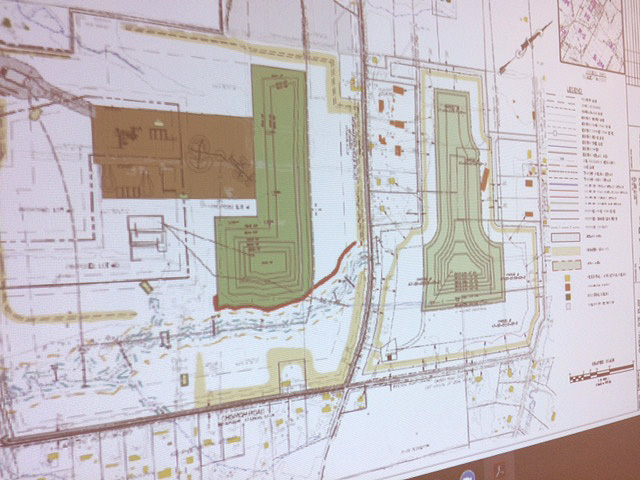
This map shows the first quarry proposal on the left, which has already received zoning approval, and the second, called GR-IV, on the right, which is the subject of the current zoning hearings in New Hanover. Hoffmansville Road splits the two sites. The road at the bottom of the maps is Church and Coleflesh Road is at the right.


The seemingly endless zoning hearings on the 18 acres that Gibraltar Rock would like to open as a second quarry site continued Thursday night with an expert paid by the quarry company disputing testimony from an expert paid by the township.

By strange coincidence, they disagree on several key points.

Currently at issue is the proximity of the site, called GR-IV, to the former Good's Oil site off Route 663, north north of Big Road, the source of significant groundwater contamination in the area.

For months, the two sides have been arguing about whether a quarry operation would have an effect on the contamination or not.
This map, created by the quarry company's consultant, 
EarthRes, shows the area of groundwater draw-down
for each 50-foot level quarry digs.

The quarry expert insists the flow of the contamination "plume" is flowing southwest, under Route 663.

The township expert says the action of pumping groundwater out of the deepening hole in the ground may well draw the chemical contamination into the pit and thus discharged into a tributary of Swamp Creek, which empties into Perkiomen Creek, a source of public drinking water.

Thursday night was scheduled for Lou Vittorio, the quarry's expert from the firm EarthRes, to rebut testimony from the township's witness, Toby Kessler, from Gilmore Associates.

At the next hearing, on April 6, at 6:30 p.m., Vittorio will be cross-examined by the township's special attorney on the case, Robert Brant.

Among the more notable things Vittorio said are that the state recently asked the company to update the chemicals it will test for in its monitoring wells around the proposed quarry site.

This request, which Vittorio said the company has agreed to, comes on the heels of the discovery in July of a concrete vault on the Good's Oil property containing many of the chemicals which polluted neighbors wells as well as some new ones -- primarily pesticides and petroleum products.

He also said that not only does the quarry's discharge permit from the
Gibraltar Rock witness Lou Vittorino, in the foreground,
testifies Thursday to the New Hanover Zoning Hearing Board.
Pennsylvania Department of Environmental Protection need to be renewed every five years -- when the state can make changes to the monitoring and treatment requirements with which the quarry must comply -- but also every time the quarry opens a new "lift," which is another 50 feet down.

His point is that "in the unlikely event" that contamination reaches the quarry pit, there are many opportunities for the state to react and impose new restrictions or a treatment regimen.

Kessler has already testified that the company's treatment regiment is inadequate for the chemicals in question, particularly a suspected carcinogen called 1,4 dioxane.

The hearing ended with Ross Snook, a relatively new arrival in the 17-year quarry saga, who was earlier this week appointed as chairman of the township's newly reinvigorated Environmental Advisory County.

Some of Lee Hallman's samples.
He submitted evidence from the federal Agency for Toxic Substances Disease Registry which he was prevented from submitted two months ago on the grounds of a technicality.

The evidence had to do with the health effects of groundwater contamination at Camp Lejune, a Marine Corps base in North Carolina, and the health effects linked to that contamination. Snook's point is that the Lejune chemicals are similar to the chemicals at issue at the Good's Oil site, such as volatile organic compounds like TriChlorEthylene, or TCE.

He also brought along a man named Lee Hallman, who briefly outlined some of the pre-historic Native American artifacts found on the site of both the first and second quarry proposal sites.

He also brought along samples which he said could be as old as 9,000 years, adding "the site is crucial to Pennsylvania pre-history, which we know so little about."

However his testimony was undermined when he admitted he did not know that the Pennsylvania Historic and Museum Commission has already declared that the quarry operation will not cause any harm to the state's archaeological resources.

Wednesday, March 16, 2016

Flow to Sewer Plant at Issue

Last night, the Pottstown Borough Authority board dealt with several issues, not the least of which was the capacity at the sewage treatment plant on Industrial Highway.

During a sudden and intense rainstorm three weeks ago, the plant received more stormwater mixed with sewage than it ever has in the past.

It resulted in an overflow and a notice of violation from the Pennsylvania Department of Environmental Protection, which was subsequently rescinded.

There was also discussion about whether the system can handle the potential sewage from the proposed Sanatoga Green development proposed for Evergreen road, opposite the Limerick Outlets.

The concern is that flow from both that project and the Spring Valley housing development would all come through the Porter Road pump station, which is already near capacity.

Read all about it in the Tweets and links below. More to follow in subsequent Mercury articles.

Wednesday, August 1, 2012

What's the Buzz?

Damned bugs!
They're heeeeerrrreeee:

As The Mercury reported Sunday, this is a banner year for mosquitoes and it has yielded a bumper crop of those testing positive for the West Nile Virus.

If everything went according to plan Monday, the Montgomery County Health Department sprayed in Pottstown's Riverfront Park and at the wastewater treatment plants in both Pottstown and Limerick.

Mosquito samples taken at those locations were found to be carrying the West Nile Virus.

Now came the news yesterday that the Pennsylvania Department of Environmental Protection will be spraying for mosquitoes in Wyomissing, Mohnton and West Reading boroughs and portions of Reading, Berks County.

According to DEP, Mosquito samples in 41 counties have been identified with the West Nile virus so far this year, although no human cases have been confirmed.

Have you seen this virus? Call the health department immediately
In late May, the Allentown Morning Call reported that the West Nile Mosquitoes had made "their earliest appearance ever in Pennsylvania.

The average date of first detection over the last decade is June 17.

A mild winter followed by an early, wet spring is the likely culprit, say experts.

Native to Africa, West Nile Virus has been present in the United States since 1999 when it was first detected in New York City. Transmitted by a particular family of mosquito, it has gradually spread to most of North America.


The virus causes a mild illness in most people. Symptoms include fever, headache, body aches, swollen glands and a skin rash. In some cases, about 1 in 50, it causes an inflammation of the brain called West Nile encephalitis, which can be serious, producing severe headaches, convulsions and even coma.

Last year, Pennsylvania confirmed seven human cases of West Nile infection, a far cry from the 236 cases detected in 2003 when the virus was a relatively new phenomenon. West Nile killed 43 people in the U.S. in 2011. While Pennsylvania reported five serious cases, none was fatal, according to the Centers for Disease Control.

There is some evidence that declining human infection rates are caused at least partly by less frequent testing for the virus by health care providers, said William Reisen, an expert on the disease at the University of California, Davis. There's also less federal funding available for surveillance.

"The requests of physicians for testing can in some ways drive the appearance of whether things are increasing or decreasing," Reisen said.

Hopefully, the cure for disease-laden mosquitoes
won't be worse than the disease.

Warmer temperatures typically lead to faster spread of the virus, Reisen said.
Did you see that? Warmer temperatures? One more thing brought to us all by global warming.

(I shared my thoughts on THAT subject in Sunday's post.)

Anyway, since I don't want any of my readers (both of you) to suffer headaches, fevers, sores, convulsions or comas, the research staff here at The Digital Notebook has put together this handy checklist of things you can do to fend off this threat.

(If it looks somewhat similar, or even identical, to a list from the Montgomery County Health Department offered in a recent Mercury story, I assure you that it is entirely coincidental.)

Don't help mosquitoes by leaving standing water un-emptied
  •   Identify and eliminate all sources of standing water that collect on your property. Mosquitoes will breed in any puddle that lasts for more than four days.
  •  Dispose of tin cans, plastic containers, ceramic pots, or similar water holding containers that have collected on your property. Do not overlook containers that have become overgrown by aquatic vegetation.
  •  Pay special attention to discarded tires that may have collected water on your property. They can serve as a breeding ground for mosquitoes.
  •  Drill holes in the bottom of recycling containers that are left out of doors. Drainage holes that are located on the container sides collect enough water for mosquitoes to breed in.
  •  Have clogged roof gutters cleaned on an annual basis, particularly if the leaves from surrounding trees have a tendency to block drains.
  •  Turn over plastic wading pools when not in use. A wading pool becomes a place for mosquitoes to breed if it is not used on a regular basis.
  •  Turn over wheelbarrows and do not allow water to stagnate in birdbaths.
  •  Aerate ornamental pools or stock them with fish. Water gardens are fashionable but become major mosquito breeding grounds if they are allowed to stagnate.
  •  Keep swimming pools clean and chlorinated. A swimming pool that is left untended becomes a source of mosquito breeding. Be aware that mosquitoes may even breed in the water that collects on swimming pool covers.
 Let's be safe out there people ...OUCH!