Once again, our eyes turn to the stars for our (mostly) weekly feature we like to call
This Saturday in Science
However, although our gaze is fixed skyward at a vastness too large to comprehend, we'll once again find the interconnectedness that affects us all, thus showing that the most vast and the most-micro are often one in the same.
 |
| Mount Sharp, on Mars, is where the rover Curiosity is headed. |
Let's begin by wishing the Mars rover Curiosity a happy birthday.
Although a year on Mars (if you define a year by how long it takes to orbit the sun) is shorter than an
earth year, we have enough confusion in our lives. So we're sticking with earth time for this one.
Not exactly a speed demon, Curiosity is mid-way through a journey to the 18,000-foot Mount Sharp, where it is hoped clues to the planet's early days can be found.
It's only 4.4 miles away, but with AAA service station thousands of miles away, the drivers of the rover are taking it super slow -- to the tune of 100 yards per day.
According to NASA, Curiosity has already traveled more than a mile, taken more than 36,700 images and fired 75,000 laser shots to analyze rocks and soil.
The New York Times tells us more from this Aug. 5 article:
The rover, roughly the size of a car, ended up right where it had been aimed — within Gale Crater, a 96-mile-wide scar from an asteroid impact at least 3.5 billion years ago. In that time layers of sediment filled much of the crater, which were then somehow carved away, leaving Mount Sharp at the center.
 |
| There was no room for a birthday cake on Curiosity... |
Observations from orbit pointed to the presence of clay minerals at the base of the mountain, named in honor of Robert P. Sharp, a prominent geologist and Mars expert. Because clays form in water that has a neutral pH, that made Gale Crater a promising place to look for signs that Mars could have once been hospitable for life.
Before it headed toward Mount Sharp, Dr. John P. Grotzinger’s team decided to send Curiosity on a detour to investigate terrain that looked to be an intriguing confluence of three different rock types. Along the way, Curiosity spotted what looked like an ancient streambed. At the site, in the first rock it drilled on Feb. 8 (Sol 182), it struck the jackpot — clays.
This rock in this part of Mars formed in watery conditions that were surprisingly Earthlike. “Unquestionably, Mars was a habitable planet in its ancient past,” Dr. Grotzinger said. Curiosity, however, does not have instruments that can directly search for life, past or present.You can track Curiosity's daily path by clicking here.
 |
| This is one asteroid capture method NASA is exploring... |
We first told you about it in this April 13 post.
When the agency asked for suggestions, America responded with more than 400 proposals from private companies, non-profit groups and international organizations.
The NASA asteroid retrieval mission aims to send a robotic spacecraft out to a near-Earth asteroid, snare it with a "space lasso" and tow it back to a parking orbit near the moon so it can be explored by astronauts.
The asteroid mission is NASA's way of pursuing the goal set by President Barack Obama that called on NASA to send a manned mission to a near-Earth asteroid by 2025, and then aim for a Mars flight in the 2030s.
On June 18, NASA also unveiled its Asteroid Grand Challenge, an effort to find and identify all of the asteroids that could pose a threat to Earth, as well as develop ideas to defend the planet against potential impacts. The effort is one of several national "grand challenges" announced by the Obama Administration and other government agencies in recent weeks to spur scientific progress and innovation.And of course you can't talk about asteroids without thinking of the big one that crashed into earth and wiped out the dinosaurs.
 |
| That was one big boom |
In this July 26 article from Yahoo News, we discover that because the fresh-water species were used to a freezing-thawing cycle, they were better able to adapt to the premature winter that arrived when a cloud of dust from the impact cut off sunlight for a very long time.
The disaster, which killed off at least 75 percent of all species on Earth, including all dinosaurs except for birds, was apparently triggered by a cosmic impact that occurred in what is now Mexico about 65 million years ago.
Water would have helped shelter life in rivers and lakes, as well as the seas and oceans, from the initial blast of heat from the cosmic impact. However, the giant extraterrestrial collision set fire to Earth's surface, darkening the sky with dust and ash that cooled the planet.
The resulting "impact winter" and its lack of sunlight would have crippled both freshwater and marine food chains by killing off microscopic photosynthetic organisms known as phytoplankton that are at the base of the marine and freshwater food chains.
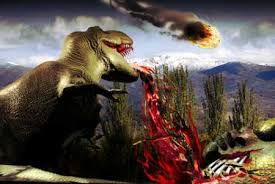 |
| Many a dinosaur dinner was interrupted on that fateful day.... |
Intriguingly, while marine communities were devastated by the mass extinction, losing 50 percent of their species, geophysicist Douglas Robertson at the University of Colorado at Boulder and his colleagues looked at a database of western North America fossils and discovered freshwater ones there survived relatively unscathed, losing only about 10 percent of their species.
The researchers note that freshwater organisms, unlike marine life, are used to annual freezes that ice over inland waters, severely limiting their oxygen supplies. As such, freshwater communities might have better endured the low oxygen levels in the wake of the death of photosynthetic life following an impact winter.Speaking of the questions of life, it is often amazing how answers to really big questions are found in tiny places.
Conversely, answers to questions about really small things, we're talking sub-atomic here, are sometimes found in the vastness of space.
Consider this July 30 article from National Public Radio which reports on how the apparent
 |
| Black holes and quantum entanglement, we're all connected, big and small. |
The first concept to wrap your head around is something called "quantum entanglement," which, by the way, would be a great name for a rock band.
NPR's Adam Frank explained it like this:
One of the deepest mysteries of quantum physics, however, is called entanglement — the ability of two widely separated quantum systems to instantaneously affect each other. Make a measurement on one member of an "entangled" pair of electrons and its twin, stationed, perhaps, at the other side of Universe will instantly be forced to change its own behavior.So, Star Trek aficionados are already saying to themselves "I know where this is going" -- and they're right.
Physicist Mark Van Raamsdook has recently argued that entanglement wasn't just another wacky, unexplained, throw-your-hands-in-air quantum effect, but a clue to the fundamental structure of space and time.
How a pair of black holes could be created with a wormhole strung between them. For those of you not watching too many science fiction movies, a wormhole is a kind of tunnel in space-time that can quickly connect two widely separated regions of the Universe (they are formally called Einstein-Rosen bridges).
That expression "widely separated regions of the Universe" is the key, since it also appeared in the explanation a few paragraphs ago of entanglement. What Maldacena and Susskind showed was that their black holes + wormhole system was also an entangled quantum system of space-time.Cool huh?
The study's authors thought so too.
Maybe that's why they titled it: "Cool Horizons for Entangled Black Holes."
Well that's it for this week folks.
Remember to watch this blog for more science.


