Showing posts with label re-districting. Show all posts

Wednesday, May 15, 2019

Boyertown Board Votes to Begin Closing Pine Forge

Photos by Evan Brandt
A panoramic view of the crowd at the start of the May 14 Boyertown School Board meeting.


With a 5-4 vote, the Boyertown Area School Board Tuesday night kicked off the process for closing Pine Forge Elementary School.

Voting just one week before the primary election, the members voting in favor of the closure were David Lewis, Donna Usavage, Jill Dennin, Rodney Boyer and School Board President Steve Elsier.

Voting in opposition were Ruth Dierolf, Clay Breece, School Board Vice President Brandon Foose
With enrollment of about 242 in December, Pine Forge is one of
Boyertown's smallest school buildings.
and Christine Neiman.

As solicitor Jeff Sultanik explained in some detail, Tuesday's vote is not a final decision, but only begins the process for gathering more information for a full public hearing required by the state; as well as approvals by the Berks County Planning Commission and Douglass (Berks) Township Planning Commission.

But at least four speakers Tuesday night did not need a formal public hearing to explain their thoughts on the subject.

"Closing Pine forge will create student over-crowding which will become a district-wide issue, not just an isolated issue in one or two schools." said Jen Irey. She said it will lead to larger class sizes, which will lead to less individualized attention for the students.

Here is some video of her comments:


"What is disheartening to me, is that after sitting through all these meetings, I still have not heard any of the long-term plans laid out," said Krista Gross, a parent of three children in the district.

"I would like to know what the district plans to do if their assumptions are wrong; what their back-up plan is if the district grows faster than they anticipate" said Gross. "Will our children end up in modular classrooms again?"

Here is more video of her comments:


Ellen Martignetti said some of the Pine Forge staff is already moving on to other jobs, "instead of waiting to be re-assigned by the district. Came you blame them? Isn't that what all of you would do?"

"Imagine what that looks like to a child. It looks frightening." Martignetti said. "Imagine a building full of unfamiliar faces."

Here is video of more of her comments:


Resident Jon Emeigh said his comments would not be popular.

"I don't know if everyone realizes how dire our financial situation is. It's really bad," said Jon Emeigh. "And we have only a choice of bad decisions"

"If we vote to keep Pine Forge open, it's going to cost about $8 million, spread out. Over the course of 30 years, it will cost about $16 million," Emeigh said.

"So the trade off for you keeping your school, is probably not being able to spend more on counselors; potentially not upgrading other schools and potentially threatening programs."

Nevertheless, he said, he would not support closing the school without more details on what would happen next.

Here is more video of Emeigh's comments:


But Boyertown Superintendent Dana Bedden said that if the administration went to the extra step of putting together those plans, the public would argue that the board's mind was already made up before the vote.

"Tonight's decision is not a closing decision," said Sultanik, noting state law requires a public hearing with full details a full three months before the final vote is taken.

In fact, two of the "yes" votes, Boyer and Dennin, said they voted yes in part to move the process forward so that those very questions can be answered.
Supporters of keeping Pine Forge open, wore red.

"If the data changes, I'm willing to change my mind," said Dennin.

But Neiman doubted that. "Once we start having hearings, it's going to be a done deal," she said.

She said Pine Forge students will most likely be sent to Earl, Boyertown and Colebrookdale elementary schools and will be "on the bus for an hour."

Dierolf agreed that the school district "is in financial crisis, but we're building a new stadium."

Lewis said closing the school will save the district $4 to $5 million, but Dierolf said she does not see those savings being realized.

"Cosing a school to close a budget shortfall is wrong," said Breece. "This will not raise academic outcomes for our kids," said Breece. He also predicted that in a few years, it will be decided that a new elementary school is needed "five or six miles to the east."

Pine Forge Elementary School was first constructed in 1928 as
Douglass Township Grade School. It was upgraded in 1957 and 1987
and is located on eight acres.
He was perhaps referring to the fact that enrollment growth driving re-districting is coming primarily from the Montgomery County side of the 100-square-mile district, in Douglass (Mont.) and New Hanover townships, where hundreds of new housing units are planned or already approved.

But Bedden insisted the one thing "not on the table is a new elementary school. That will cost as much as $26 million, and that is money we don't have," he said.

According to the district study, last year it costs $2.7 million to operate Pine Forge Elementary.  It would cost between $1.8 to $4 million to upgrade the building to be compatible with the other elementary schools.

Pine Forge has about 17 teachers and 18 other staff. The administration does not call for any lay-offs as a result of closing the school. Personnel savings would come from attrition, retirements and resignations.

Donna Usavage said the studies have shown there is enough room in the other school buildings and closing Pine Forge "is in the best interests of the entire school district."
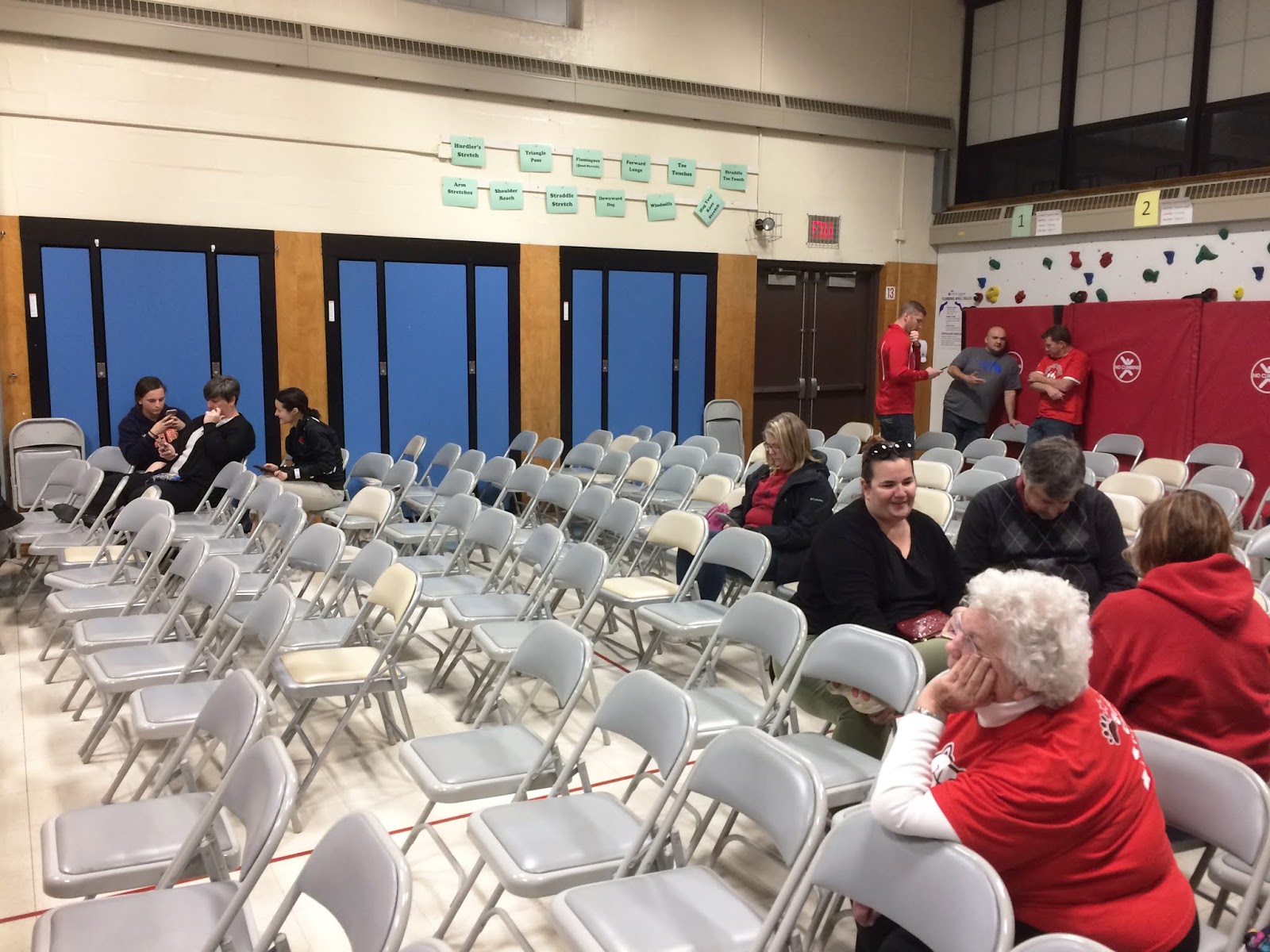
After voting, the school board went into a executive session, closed
to the public, for more than an hour, which did a good job of 
clearing out the audience from the meeting.

But the question of whether there is enough room in Boyertown's school buildings is exactly what is driving the re-districting plan which was adopted unanimously prior to the Pine Forge vote.

In the first vote, the board voted unanimously to begin the process of re-districting, which will change which school hundreds of students attend among Boyertown's seven elementary schools and two middle schools.

After the meeting Elsier explained that the re-districitng plan, or "rightsizing" as Bedden has labeled it, can be found on the district website and affects all school buildings but the high school.

According to that information, last updated on May 5, Boyertown's school buildings have the following capacities and enrollments as of December:

  • Boyertown Elementary: Capacity of 700 with 445 students, or 64 percent of capacity.
  • Colebrookdale Elementary: Capacity of 350 with 291 students, or 83 percent of capacity.
  • Earl Elementary: Capacity of 350 with 246 students, or 70 percent capacity.
  • Gilbertsville Elementary: Capacity of 700 with 689 students, or 98 percent of capacity.
  • New Hanover/Upper Frederick Elementary: Capacity of 700 with 675 students, or 96 percent of capacity.
  • Pine Forge Elementary: Capacity of 350 with 242 students, or 69 percent of capacity.
  • Washington Elementary: Capacity of 700 with 483 students, or 69 percent of capacity.
  • Middle School East: Capacity of 1,050 with 895 students, or 85 percent of capacity.
  • Middle School West: Capacity of 860 with 782 students, or 91 percent of capacity.

Elsier conceded that should the board ultimately vote to close Pine Forge Elementary, that the plan will have to be adjusted to put those 242 students in other buildings.

In other news, after coming out of an hour-long executive session, from which the public was excluded, the school board voted 7-2 to adopt a $121 million preliminary budget that, if unchanged by June, will raise taxes by 3.6 percent.

Now, here are the Tweets from the meeting:

Friday, September 27, 2013

Welcome to Pottstown Senator

Photo by John Armato
State Sen. Robert Mensch, left, meets with Steel River Playhouse director Marta Kiesling and PAID director Steve Bamford during his recent tour of Pottstown.


The new 24th State Senatorial District will soon include Pottstown.
When Pennsylvania's long-delayed legislative re-districting finally falls into place in the beginning of
the year, Pottstown will not only have a new, additional representative in the House of Representatives, but a new state senator as well.

The boundaries of the 44th District, currently represented by John Rafferty, will shift south and the 24th senatorial district, will slide south to encompass Pottstown, as well as West Pottsgrove and Upper Pottsgrove.

The 24th district seat is currently held by Republican Robert Mensch.

Photo by John Armato
Mensch tours the Sly Fox Brewery
In an effort to get out in front of the change, Pottstown officials last week invited Mensch for a day-long visit to the borough to help him re-familiarize himself with town and to be sure Pottstown's issues are front and center.

Schools Superintendent Jeff Sparagana spear-headed the effort and reported on the results to the school board Monday night.

It began with a walking tour of the downtown area.

"To start, we visited VideoRay, ArtFusion, Steel River Playhouse and Weitzenkorn's, which Senator Mensch remembers because his father used to work at OxyChem and that's where he bought his suits," Sparagana said.

The group included Borough Manager Mark Flanders, PAID Executive Director Steve Bamford,
Photo by John Armato
Mensch meets with ArtFusion 19464 director 
Erika Hornburg-Cooper.

TriCounty Chamber of Commerce Executive Director Eileen Dautrich, Hill School Headmaster Zach Lehman, PMMC CEO Sharif Omar, PDIDA Executive Director Sheila Dugan and Myra Forrest, executive director of the Foundation for Pottstown Education.

From downtown, the group boarded a trolley and visited the Pottstown campus of Montgomery County Community College, the Schuylkill River Heritage Area headquarters, The Hill School campus and the community gardens on Chestnut Street.

From there, the group went to Pottstown High School where the culinary arts class prepared lunch
Photo by John Armato
Mensch meets with Weitzenkorn's proprietor Marc Weitzenkorn.
and, in the process, "really went above and beyond," Sparagana said.

Afterwards, Sparagana said the group visited Pottstown Municipal Airport and the Sly Fox Brewery on the Circle of Progress.

"Senator Mensch told us he never expected to have the type of day he had and he was pleased and impressed by all the collaboration he saw taking place in Pottstown," Sparagana said.

"It was a good opportunity to demonstrate what happens here as this community comes together as one," Sparagana said.


Thursday, February 21, 2013

Check out the new elementary attendance maps

This is an overview of the Pottstown School District’s four new elementary school attendance zones that will be presented at tonight’s meeting.


POTTSTOWN — In advance of tonight’s school board meeting, at which the proposed four new elementary school attendance zones will be discussed, Superintendent Jeff Sparagana has agreed to The Mercury’s request to make them public for inspection.

The meeting will be held in the Pottstown High School cafeteria and begins at 7:30 p.m.

Sparagana said the information was released to give parents and residents an opportunity to look at and digest some of the information prior to tonight’s presentation.

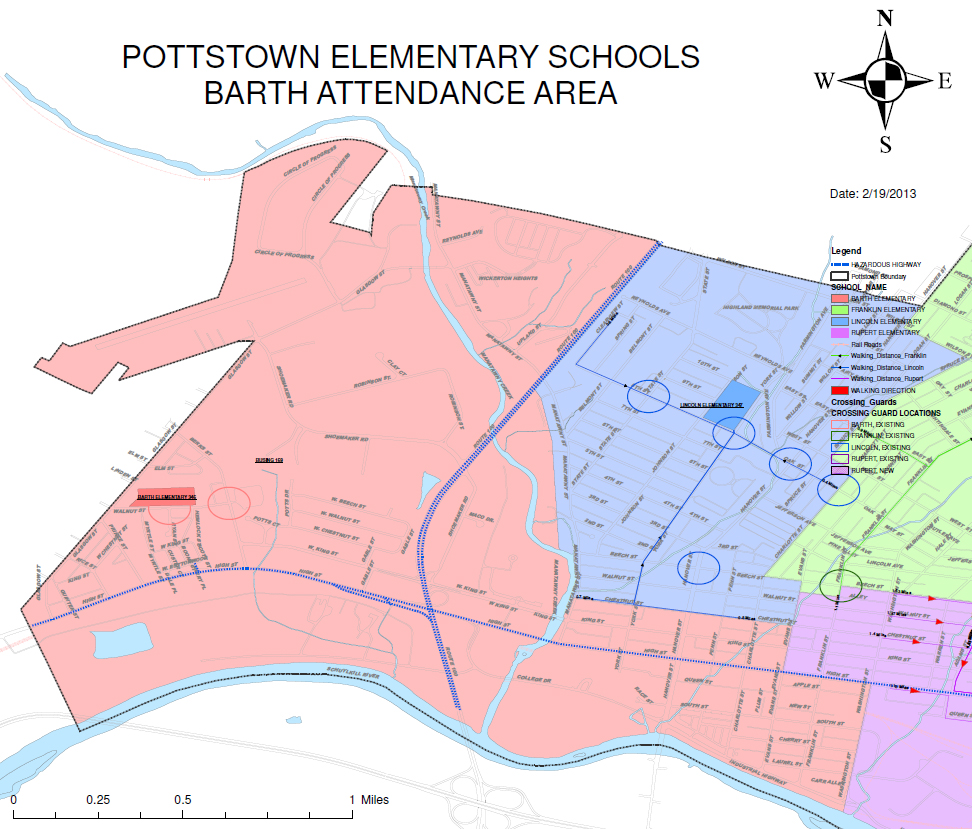
Attached to this article, readers should find a map of the current five-school configuration, a map showing the borders of the four new attendance areas, as well as close-up maps of all four attendance areas.
This map shows the current attendance zones for the 
five elementary schools.

(The four attendance area maps are posted below as large as this format allows.)

The open circles on the maps show established crossing guard locations. The circles that are filled in with color show proposed new crossing guard locations.

The district also released four lists of addresses for each of the four new attendance areas.

We are unable to post those lists on our web site on short notice, however anyone who sends an e-mailed request to Reporter Evan Brandt at ebrandt@pottsmerc.com, will receive a return e-mail to which the attendance areas list requested will be attached.

The re-districting is part of the district’s overall elementary project, which also includes moving all fifth grade students to the middle school and expanding Franklin, Lincoln and Rupert elementary schools as well as renovating all three.

Barth Elementary School is currently under renovation, but is not being expanded.

The attendance areas had to be re-drawn as a result of the decision to close Edgewood Elementary School.

However the Edgewood building will be used in the coming school year because the renovations and expansion plans at Rupert are so extensive.

All three projects will begin this summer, but the work at Lincoln and Franklin will continue into the school year, as is now being done for the Barth project.

Follow Evan Brandt on Twitter @PottstownNews
The proposed new Franklin Elementary School attendance area
This is a close-up of the proposed new attendance area for Lincoln Elementary School that will be presented at tonight’s meeting.
This is a close-up of the proposed new attendance area for Rupert Elementary School that will be presented at tonight’s meeting.


This is a close-up of the proposed new attendance area for Barth Elementary School that will be presented at tonight’s meeting.


Tuesday, February 19, 2013

What School Will Your Child Attend?

Photo by Evan Brandt
According to this map, the red areas of town will send students to Barth, the blue to Lincoln, the green to Franklin and the purple to Rupert.
Perhaps those who don't send their children to Rupert or Edgewood elementary schools might think the decision to close Edgewood Elementary School does not affect them.

But if you have elementary school-age children in the Pottstown school system, just about everyone will be affected.

Because, as Robert Stevens, assistant to the superintendent, explained to the finance committee last week, when you go from five schools to four, all the attendance lines have to shift.

Stevens gave an overview of those changes during the Feb. 14 committee meeting, but emphasized nothing is set in stone -- at least not yet.

As a result of re-drawing the lines, done with what school officials called the invaluable help of Public Works Director Doug Yerger, each school will hold about 350 students, Stevens said.

Dr. Robert Stevens explains the proposed elementary re-districting
to the Pottstown School Board's finance committee Feb. 14.
Of course that won't be until the renovation and expansion projects at Barth, Lincoln, Franklin and Rupert are completed.

The Barth project is underway now, and the three remaining projects are set to bid shortly and work is set to begin as soon as school lets out.

Because the Rupert project is so much more extensive, school officials decided to move all students and staff from Rupert to Edgewood for the coming school year, to give the contractors more elbow room at Rupert.

All fifth graders will be moved to Pottstown Middle School as part of this plan.

In addition to balancing out school populations, another result of re-districting elementary attendance areas is "we cut our busing costs significantly," Stevens said.

However, in order for those costs to be cut, that means that students attending Rupert will have to cross High Street.

As a result, the district has applied to PennDOT to have High Street removed from PennDOT's list of hazardous streets.

That will allow walking students to cross, with the help of crossing guards, Stevens said.

The district also plans to adopt a policy of re-districting the elementary attendance areas every 10 years in order to keep the populations at each school balanced.

The proposal will be formally presented to the school board at this Thursday's school board meeting and Superintendent Jeff Sparagana said the district intends to put the maps up on the district web site subsequently so the public can become familiar with the proposal.


Wednesday, August 29, 2012

Texas and Pennsylvania: Separated at Birth?

Ooops. Texas Voter ID Law tossed by federal court. (Oops belongs to
Reuters, which reported the above in error.)

UPDATE AND CORRECTION:
It turns out I'm not the only one who makes mistakes. 

Apparently Reuters reported the striking down of the voter ID law in Texas in error

So that kind of makes half my point in this blog based on an error. So feel free to ignore the first three paragraphs below and find what meaning you can from what remains.

This just in from Reuters:

They could be electoral twins!
"Federal court ruled on Tuesday that a controversial Texas voter identification law discriminates against black and Hispanic voters, effectively killing the law before it could take effect for the Nov. 6 presidential election.

The U.S. District Court for the District of Columbia issued the ruling.

The state law, passed by the Republican-dominated Texas Legislature in 2011, required voters to present one of six forms of photo identification before casting ballots.

In March, the Obama administration blocked the requirement using the 1965 Voting Rights Act, a federal law designed to protect the voting rights of minorities, primarily blacks in Southern states."
Maybe the Pennsylvania Supreme Court will recognize this as a precedent and also throw out our new voter ID law.

Then again, maybe pigs will fly.

The same day Reuters reported the demise of the Texas voter ID law, Associated Press reported that a federal court found that the new legislative districts drawn up by the same legislature had the same problem -- discriminating against minorities.

A few excerpts:

In some cases, black congressional members in Texas had economic drivers such as sporting arenas freshly carved out of their districts, though "no such surgery" was performed on any belonging to white incumbents, according to the U.S. District Court for the District of Columbia.
 "Anglo district boundaries were redrawn to include particular country clubs and, in one case, the school belonging to the incumbent's grandchildren," said U.S. Circuit Judge Thomas Griffith, writing the 154-page opinion for the three-judge panel.
Known as seeking "preclearance," Texas and eight other, predominantly southern, states with a history of racial bias must submit their political maps to the U.S. Justice Department for compliance. State prosecutors, however, sought preclearance through the federal court in Washington rather than through the Justice Department.

Luis Vera
Opponents said the state's strategy of skirting the Justice Department backfired. Luis Vera, an attorney for the League of United Latin American Citizens, said the ruling was "better late than never" and an unequivocal win for his and other minority rights groups that sued the state.

How Texas redrew its political boundaries was watched particularly closely after the state was awarded four additional U.S. House seats because of its booming population. The surge has been driven almost entirely by minorities, who account for more than 87 percent of the population growth in Texas over the last 10 years.
So I don't know about you, but a population surge driven almost entirely by minorities should probably not end up short-changing the very people who gave you four more Congressional seats.

Here's my favorite part, the defense Texas chose was this: "We're not discriminating against minorities, we're just trying to get some partisan advantage for the majority party."

This is how AP put it:

The state's lawyers said the map crafted by the Legislature reflected a GOP majority seeking to squeeze a partisan advantage out of the once-a-decade redistricting process, not a willful disregard for the Voting Rights Act. The state also maintained that lawmakers kept a cool distance from the process, leaving much of the work of drawing districts to legislative staff.

The judges were a wee bit dubious.
The state also argued it was only a "coincidence" that district offices and economic drivers were removed from minority districts and not those belonging to white incumbents, according to the court opinion.

"But if this was coincidence, it was a striking one indeed," the ruling said. "It is difficult to believe that pure chance would lead to such results."
So does any of this sound disturbingly familiar?

Photo voter ID laws, insane legislative districts? Heck, Texas could be Pennsylvania.

As I wrote about back in January, the Congressional districts created by the Republican majority somehow passed muster while equally ludicrous state legislative districts -- including one that split Pottstown among three representatives -- was rejected by the courts.

It's a shame, sadly, that making crazy districts, including one that looks like Bullwinkle J. Moose, is legal as long as its only for unfair political advantage.

But maybe, it we keep along the same path, Pennsylvania can soon also be under the eye of the U.S. Justice Dept. as we develop a "history of racial bias."

Won't that be a proud moment for the Keystone state?