Showing posts with label Independence Day. Show all posts

Monday, July 1, 2019

Hopewell Offers an Historic Independence Day

Blogger's Note: The following was provided by Hopewell Furnace National Historic Site:

If, for some reason, you want something a little more historic for your Independence Day celebration than parades and cookouts, Hopewell Furnace National Historic Site has just the celebration for you.

The way it might have been celebrated in the 18th and 19th centuries, when the furnace was a bustling industrial center.

Various activities and demonstrations will be offered throughout the day. 

At 2 p.m., the Friends of Hopewell Furnace present our annual commemoration of the Declaration of Independence.
  • Blacksmith demonstrations will be offered in the Blacksmith Shop from 10 a.m. to 4 p.m. 
  • Quilting demonstrations will be offered in the historic Boarding House from 10 a.m. to 4 p.m. 
  • Moulding and Casting demonstration will be offered in the Cast House at 11 a.m., 12:45 p.m. and 3:15 p.m. 
  • The Independence Day commemoration will be at 2 p.m, presented from the front porch of the Ironmaster’s Mansion. 
  • Finally, the Village Store will be open 10 a.m. to 4 p.m.
Hopewell Furnace National Historic Site preserves and interprets an early American industrial landscape and community. 

Showcasing an iron making community and its surrounding countryside, Hopewell Furnace was active from 1771 to 1883. The park’s facilities are currently open daily, 9 a.m. to 5 p.m. and is closed Thanksgiving, Christmas, and New Year’s Day. 

Hopewell Furnace is located five miles south of Birdsboro, PA, off of Route 345. 

Admission to the park is free. For more information, stop by the park's visitor center, call 610-582-8773, or visit the park's web site at www.nps.gov/hofu

Tuesday, July 4, 2017

Will the Real Americans Please Stand Up (Or Kneel)

Real Americans are all shapes, sizes, religions and beliefs, as symbolized during this citizenship ceremony at Pottsgrove High School last year.

What does it mean to be an American?

The nation's birthday seems like as good a time as any to explore this question.

I'll begin by telling you outright I don't think there is just one answer.

The problem is, a lot of us think there is.

To some, an "American," is an English-speaking person born in this country.

But last October, I watched 54 people born in a different countries, take an oath at Pottsgrove High School that made them citizens of the United States of America.

Are they any less "American" than those of us who were born here?

I would argue that getting to this country from another, sometimes under difficult circumstances, in some cases learning a new language and learning the history and structure of your adopted nation makes them more of an American than those of us whose only qualify characteristic is being born.

These folks had to work for it.

Chin Su Kim of South Korea received his US Citizenship papers
last year in a ceremony at Pottsgrove High School.
They had to want it.

If the only real American is someone born here, one could argue that the only real Americans are the descendants of those who were here before Columbus; before Ponce de Leon; before the Mayflower blundered its way into Massachusetts Bay.

Frankly, Native Americans have a pretty solid claim, and the only practical way to dispute it is to put a pin in the timeline of the continent's history and say only those born after 1776 (or 1789) and their descendants are real Americans.

But that seems a bit capricious in the broader scheme of history.

In truth, all Americans are from somewhere else. Its just a matter of how far back you go.

And lately, we have been going way back.

It has never been easier -- or more lucrative for the Internet companies doing the searching -- to trace our descendants back through the generations to Ireland, or Italy or Slovenia and, if the commercials are to be believed, millions of us are delighted to be doing so every day.


To celebrate our non-American origins and, in the same breath, refuse to confer the status of "American" on those who came a decade or two later is beyond ironic.

It's moronic and it borders on the kind of willful and belligerent ignorance in which, sadly, we have begun to specialize in recent years.

Perhaps being a real American has less to do with where we're born and more to do with what we believe.

And no, I don't mean belief in God or being a Christian nation. We are, rather, a nation that was founded by Christians (many of them "diests," who believed in God but not religion).

The Christians who founded this nation knew their history, they knew the centuries of blood spilled in Europe in wars over who was the right kind of Christian.

This nation was founded by Christians who specifically wanted to keep Christianity out of government; to make worship a matter of personal belief and not one of government mandate.

When I say maybe a real American is defined by her belief, I mean someone who believes in the ideals of America; our right to pursue life, liberty and happiness; our right to be free to speak our minds; to worship as we wish.

Perhaps a real American is someone who understands and exercises the rights that are due every American thanks to our Constitution and its predecessor which we celebrate so noisily on this day every year with fireworks (or in Pottstown's case, lasers.)

Consider the curious case of Colin Kaepernick, the San Francisco 49ers quarterback who refused to stand for the National Anthem because of what he saw as unfair treatment of non-white Americans.

Many viewed this choice as "un-American."

I say what could be more American than to peacefully protest what you see as the unfair treatment of a minority?

When you can be pulled over for "driving while black," or a jury decides that a police officer did not commit murder when he shot a black driver because he is justified to be "in fear for his life" because of the color of the driver's skin, something has gone wrong. That is a violation of America's highest ideals.

Is it not the finest American tradition to stand up, or in Kaepernick's case, kneel down, for what you believe to be un-American? Let's not forget the "all men are created equal" part of the document we are celebrating today folks.

To argue that all men are being treated as equals in America today is to deny the evidence of your own eyes.

To argue that all men (and women) are provided with the same opportunities in today's public school systems is to deny the facts.

To argue that protesting such unfair treatment, sometimes peacefully, sometimes in more riotous fashion causing property damage, is un-American is to deny our own history.

After all, what was the Boston Tea Party we so venerate but a bunch of costumed hooligans destroying private property in protest over how the majority in England was treating the minority -- the colonists?

In truth, I believe this argument over "real Americans" -- most recently crystalized in a new NRA advertisements pasted below in which the word "they" is featured prominently -- is really about the dry science of demographics.


The U.S. Census predicts that in a few years, white Americans will become a minority in this country.

Its hard to win elections that way, which is why for years, Jeb Bush was trying unsuccessfully to rouse his party to this reality with the phrase "demographics is destiny" and urging the GOP to be more welcoming to Hispanics.

But instead of embracing this new majority and winning them over in the marketplace of ideas, the multi-pronged methodology now underway is to subvert that looming majority to maintain control of the country for as long as possible -- a desperate strategy to hold on to what is believed to belong only to the "real Americans."

It's pretty simple stuff when you take a step back and look at the big picture.

First, you make it harder for "them" to vote.

Purging voter rolls, requiring photo IDs and a national investigation of non-existent voter fraud as an excuse to collect state voter data is a good way to start.

Another necessity is to undermine public education.

Citizens who are taught to think for themselves are hard to fool and even harder to rule, particularly when there are a lot of them. So rather than recognize that different people learn in different ways and devote our efforts to educating each student in the best way we can, we have standardized education; using standardized tests which discriminate against non-traditional learners and, by what I'm sure is pure coincidence, non-whites and those raised in poverty.

If you don't fit the mold, you don't move ahead through the system. How did we come to this in a country where we celebrate the idea of independence every year?

We've punished and demeaned teachers for so long now, that the number of people willing to undertake this most vital and, more recently, thankless job, is dwindling to the crisis point.

But rest assured that school districts in wealthy white suburbs -- the beneficiaries of Pennsylvania's lopsided and racist education funding system -- will still be able to afford the higher salaries necessary to attract those still willing to teach.

And of course, trust in the media must be undermined as well.

You can't have those who may point out inconsistencies and outright lies; those charged with speaking truth to power and holding it to account; those who so often remind us how alike we all truly are and how much we actually have in common; running around unimpeded when you are so desperately working to instill fear with an "us" and "them" narrative.

Fearful people are easy to manipulate, particularly when you claim to have an easy solution that we can understand. Never mind that it doesn't work. What's important is that its comforting and that it reaffirms what we've always believed about who truly deserves the rewards of being a real American.

Certainly, it's not "them."

As for me, I plan to celebrate July 4th by celebrating the idea that real Americans fight for what's fair, what's right, because it makes us a better country. It brings us closer to being the country we say we aspire to be.

I plan to celebrate July 4th by celebrating the idea that the best American is an American educated enough to make decisions based more on facts than feelings, to know her rights and to exercise them with vigor, who knows that oppression of any of us is oppression of all of us.

I plan to celebrate the birth of America by celebrating an idea best articulated by a fictional Englishman, that we have come to a time in our history when we will all have to make a choice -- between what is right, and what is easy.

But that's just me.

And I'm only one American.

Thursday, June 9, 2016

July 4th Events Canceled and Other Business


What much of the Pottstown area feared came to pass Wednesday night; official word that there will be no parade, no fireworks and no Independence Day festivities in Pottstown this year.

Marcia Levengood, co-chair of Independence Day Ltd., the non-profit organization which has struggled to field events for the last three years, said almost no contributions were received as a result of fundraising efforts.

Borough Council President Dan Weand reiterated that the borough never has, and has no intention to start now, of funding the event with taxpayer dollars.

And council member Dennis Arms wondered why council is complacent enough to allow Borough Manager Mark Flanders to spend $2,500 to hire a consultant to find a replacement for the departing Assistant Borough Manager Eric Batdorf, when the borough "has an HR department charged with hiring and recruiting," but won't spend money on a July 4th parade.

And so it went. You can read and watch more about that in the Tweets below.

On to the "other business."

First of all, Vice President Sheryl Miller sketched out a way that the Pottstown Human Relations Commission could be put back up and running. Significant among the changes sought are appointment of commissioners by borough council and not the mayor, as happens now.

The PART bus system, whose $2.3 million budget will likely be approved at Monday's meeting, will have a fare increase starting July 1 after a public hearing at which no one spoke.

The LERTA tax break, or as the Digital Notebook staff calls it -- "The Never-Ending Story" -- may finally be adopted at the joint council school board meeting on June 21

And what we all hope will be the final version of plans for the land on the former Mrs. Smith's Pies site at south Hanover and Industrial Drive -- now called Hanover Square -- will be voted on Monday.

That should be enough to keep me on my toes for a couple days.

Here are the Tweets 'N More:


Saturday, July 5, 2014

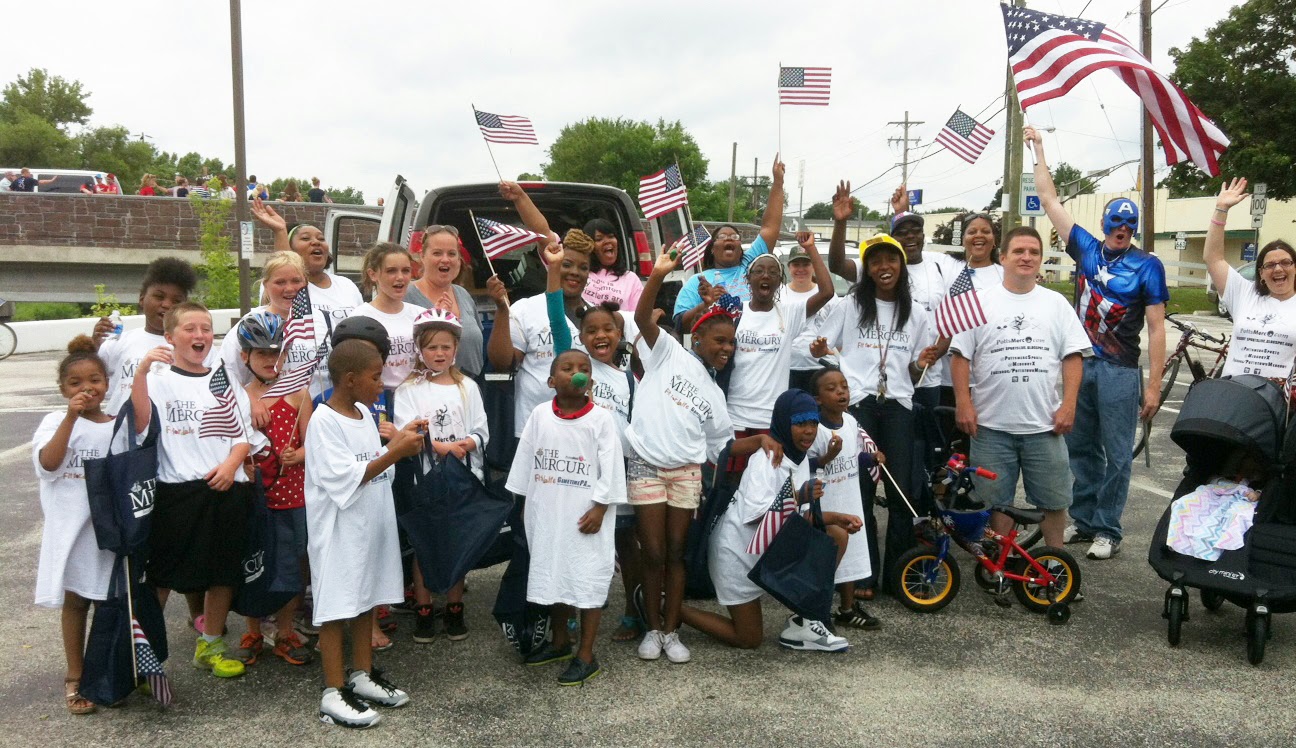
A Very Pottstown Fourth

Surprisingly good photo by Evan Brandt
The Mercury/#StoptheViolence/MercuryMile/BikePottstown crew celebrate the completion of the Fourth of July Parade.
Folks from The Mercury were awfully busy for a holiday on Thursday, not only covering Pottstown's signature Fourth of July Parade, but participating in it!

Here are some Tweets, Touts, videos and links from the day.

(As always, click the blue "Read Next Page" bar at the bottom to make sure you don't miss anything!)

Friday, July 4, 2014

Without Public Education, There is No Republic

"A republic madam, if you can keep it."

That is what Benjamin Franklin famously said to a passerby when she asked him what the Constitutional Convention of 1787 had given the country.

I know this is the day that we celebrate the signing of the Declaration of Independence, but in many ways, the document that followed 11 years later is the more important of the two.

The Declaration declared what we were not -- subjects of a king -- and described our aspirations.

The Constitution declares what kind of nation we are, and how we intend to go about building it -- and continues to do so.

It is, however, an imperfect document by design.

For example: The reason the Constitution did not free the slaves is that do have done so then would have meant the dissolution of the nation.

Politics, even then, is the art of the possible.

So the founders wisely left some things for us to take care of later.

We are not doing a very good job.

And the place where we're really falling down is education.

The founders worried that democracy would fail if attempted on such a large scale. It had never been done before and the only successful democracies, which had not lasted, were rarely practiced in a place much larger than a city state, Athens being the most obvious example.

They reasoned the only things that could overcome the problems of an uninformed set of voters spread out and isolated over a broad area being given the power of the vote were:

1) the ability to communicate on a nationwide basis, and
2) an education system that ensured those voters could understand and interpret for themselves what was being communicated.

This is the part of the blog where I provide some quotes from the founders to shore up my case:
  • "I consider knowledge to be the soul of the republic, and, as the weak and wicked are generally in alliance, as much care should be taken to diminish the number of the former as of the later. Education is the way to do this, and nothing should be left undone to afford all ranks of people the means of obtaining a proper degree of it at a cheap and easy rate." -- John Jay
  • "Learned institutions ought to be the favorite objects with every free people. They throw that light over the public mind which is the best security against crafty and dangerous encroachments of the public liberty." -- James Madison
  • "Educate and inform the whole mass of the people ... they are the only sure reliance of the preservation of our liberty." -- Thomas Jefferson
  • "A Bible and a newspaper in every house, a good school in every district -- all studied and appreciated as they merit -- are the principal support of virtue, morality, and civil liberty." -- Ben Franklin
  • "The best means of forming a manly, virtuous and happy people will be found in the right education of youth. Without this foundation, every other means, in my opinion, must fail." -- George Washington
So now that you're convinced the founders considered education important -- I mean Thomas Jefferson not only instituted public schools in Virginia, he founded the University of Virginia and considered it his greatest achievement -- ask yourself, how are we doing in that department?

To say that public education is in crisis in America and right here in Pennsylvania is an understatement.

At the root of the debate is an understandable desire to measure what our taxes are paying for, butting up against the belief that the value of a good education (and by extension, a good teacher) is incalculable.

One side of the debate demands tests scores and, more recently, teacher and school evaluation matrices to try to get some kind of accountability built into the system.

This is an understandable impulse and not to be dismissed out of hand. After all, if the value of a good teacher is incalculable, so is the damage a bad one can inflict.

Less understandable is the tendency to cleave to the idea that private industry can do a better job at teaching children than the local school district, simply because its private industry.

If you can do it better, prove it.

So far, particularly with cyber charter schools, the proof remains elusive.

One of the largest is K12 Inc., which, in Pennsylvania, runs Agora Cyber Charter.

For those interested in accountability, Agora  has never. Once. Met any measure of adequacy set by those who clamor for more accountability.

Yet, it continues to draw tax money unmolested in the same way those "failing" public schools we love to label do, schools whose students perform far better than those taught by Agora.

Happily for the executives of Agora, they continue to collect $2,000 per student in salary which, with with 75,000 students, means $21 million of taxpayer in the pockets of eight executives who run a school that fails children they are paid to help.

Certainly, not all charter schools are failures, and we should learn and adopt the best of those that succeed, but where is the outrage over THESE failing schools?

As any scientist will tell you (you learn this in school by the way) you cannot start an experiment with the conclusion, only a hypothesis.

This experiment with "school choice" has run its course and the conclusion is, some charter schools work better than public schools, some don't. But almost zero cyber-charters perform better than public schools.

There have been some successes, and they should be allowed to continue, but its time to put the focus back on the schools the founders knew were this democracy's only hope.

Lord knows, no public school is perfect and I have had my differences with how the Pottstown School District is educating my son.

But this is part of the process of raising children and my wife and I have done what we can to try to make those schools better, not abandon them.

But making them better has now given way to fighting to keep them from getting worse.

And the voters are starting to notice.

For the first time, registered Pennsylvania voters polled by Franklin and Marshall have listed education as their top concern in the coming gubernatorial election.

I confess, I don't know as much about Tom Wolf's education plans as I should, and I intend to remedy that.

But I know, and I think the majority of voters in Pennsylvania know, what Tom Corbett's record on funding education is.

We live in a capitalist society and in a capitalist society, money matters.

No, before you say it, I am not advocating "throwing money" at the problems in our schools, but
starving them of the funding they need to provide even the most basic education isn't doing our children any favors.

After all, as Ben Franklin once said (sorry, couldn't resist one more): ""Genius without education is like silver in the mine."

We are headed into extraordinarily difficult times; climate change, economic upheaval, a world-wide terrorist threat.

I'll be blunt.

Stupid, uneducated children will become stupid, uneducated adults who will make stupid decisions and make things worse.

We are going to need as many geniuses as we can muster to understand the nuances of an increasingly complex world.

Starving our public schools is not doing our democracy or our future any favors.

And that's worth considering on the day we celebrate the birth of that democracy.

Sunday, October 13, 2013

Strange Brew

"Brew Dog" hosts Martin Dickie, left, and James Watt


OK, so it's no secret that I like beer.

 A lot.

But that is NOT the reason I so enjoyed Tuesday's episode of "Brew Dogs," a new program on a new television network, the Esquire network.

I enjoyed it because a portion of the episode was filmed on a float, in the middle of Pottstown's Fourth of July parade.


(Here is a link to my Tweets and Touts during the parade)

When I arrived in Pottstown in 1997 to take a job at The Mercury, I could not understand what was holding Pottstown back.

The Brew Dogs float passes The Brick House
I've since come to realize its the people who live here and their inability (or in some cases unwillingness) to get behind efforts to improve conditions, jealously carping about any partial success by one group and grasping to snatch that group's resources away for their own pet project -- for which they have been unable to build either support or resources.

Watching Tuesday's episode of Beer Dogs, reminded me of how Pottstown can look to outsiders, who, I sometimes think, are the only people who will ever save this town.

If you have Comcast you can see the episode for free through their "On-Demand" function, or just click here and sign in through your Comcast (Xfinity) account.

Or you can see a portion of the program on Esquire's web site by clicking here.

I can't resist mentioning here that the show also includes a visit from NBC TV News reporter Doug Shimell, who (after reading about it in The Mercury no doubt) rushed up to Pottstown to cover the Brew Dogs float after Philadelphia turned them down.

At the end of the report, he says "reporting from Bucks County, this is Doug Shimell."

Really Doug? You thought you were in Bucks County?

TV news.
They did leave the beer unguarded
for a moment. Not to worry,
I kept an eye on it
.

What are you gonna do?

Anyway, back to my rant.

So in addition to enjoying witty banter with a Scottish accent; in addition to watching Martin Dickie and James Watt undertake the outlandish pursuit of "the most American beer ever brewed;" with Declaration of Independence-encoded DNA mixed with the brew; you get to see Pottstown through the eyes of people who have never been here before.

And frankly, it looks pretty good.

As Dickie and Watt ride down High Street on their float, there
are no derisive comments about who is on the street, no commentary about the condition or occupants of the buildings, or the politics of this ridiculously political small town.

Instead they talk about beer, including favorable reviews of Pottstown's own Sly Fox brewery and Downingtown's Victory Brewery.

It should make us recognize the assets we have in town, and how to make the most of them, instead of crying over lost assets, or assets we wish we had.

For example, Dickie and Watt have an interlude with Pottstown's own Roller Derby Rockstars.

Now how many towns can say they have their own Roller Derby team?


We should all learn to relax a little and stop taking ourselves so seriously and pull in the same direction for a while.

Maybe we should start drinking more beer....

After all, as Ben Franklin is said to have said: "Beer is proof that God loves us."

The Sly Fox beer tent at the Pottstown Volleyball Rumble
Is on of the things that has helped make it a success.


Friday, July 5, 2013

Telling the Storify of Pottstown's Fourth of July Parade

Even though I wasn't supposed to be working, I could not resist Tweeting, Touting and Texting video, photos and witty remarks from the sideline during yesterday's Fourth of July parade down High Street. Here, if I have been successful, is a "Storified" collection of some of those.


Marcia Levengood: TV Star
Now, since it would appear that the links to the "tout" videos are not live here in a storify format (sometimes, I think we don't even speak English anymore) I will post a link to my Tout channel here, so you can watch those videos too. Some of them are quite cute, if I do say so myself.

Finally, as the dying battery on my iPhone, which I foolishly forgot to charge the night before, gave up the ghost, I quickly grabbed the phone of a perfect stranger (to whom I happen to be married) to get this photo of Fourth of July Committee Co-Chairperson Marcia Levengood being interviewed in Smith Family Plaza by the film crew from the "Brew Dogs" TV show.

If, like faithful Mercury subscriber Levi Wolf, you just happened to have missed the wonderful story I wrote for Sunday's Mercury explaining what exactly the Brew Dogs float and TV show were all about, shame on you.

Here's a link to the story explaining it all.

Here is a link to one video I sent out through Twitter, for which the Storify links may not work. Be warned, the hill these marchers had to climb was very steep (almost 90 degrees, and that ain't farenheit!).

(Keep your eyes peeled for a guest appearance by frequent Digital Notebook contributor John Armato!)

To all those who joined me along High Street, here's hoping you enjoyed the parade as much as I did.

To all those who weren't there, you missed a good parade.

Happy Day-After-Independence-Day everyone.

Thursday, July 4, 2013

Founding a Friendship Over the Fourth


Today is the day the nation celebrates the signing of Declaration of Independence.

(It was actually approved by a vote on July 2, which was the day John Adams always thought would be the one celebrated, but I digress.)

But it is also the day we should celebrate two men, without whom the Declaration would never have been written or adopted, and who poetically died 50 years after its adoption, within hours of each other.

It would be hard to find two men more different in character than John Adams and Thomas Jefferson.

Adams: irascible, brilliant and often over-compensating for his inexplicable self-confidence problem.

Jefferson: urbane, equally brilliant and with the unusual capability of believing two opposing things at the same time without being destroyed by the conflict between them.

The two men shared two things -- a common belief in the need for independence, and a common experience both in Philadelphia and Paris.
John Adams

For most friendships, this is an either/or situation, but Adams and Jefferson had both, this despite having personalities which did not exactly mesh.

In political circles at least, Jefferson almost exclusively acted through others, most famously James Madison, his chief political operative, and James Callender, the scurrilous scribe who turned on Jefferson and alerted the world to his affair with slave Sally Hemmings after Jefferson refused to get him out of jail.

Adams, on the other hand, was more hands-on and addressed political matters in a head-on manner, often a bull-headed, head-on manner.

As Benjamin Franklin, who had the work of the American delegation in Paris in common with both, once said of  Adams: "always an honest man, often a wise one, but sometimes and in some things, absolutely out of his senses."

Perhaps not surprisingly, it was not the drive for independence, nor the conduct of the war to ensure it, that drove a wedge between the two presidents.

It was the more difficult problem of how the country should be governed, and by whom.

And isn't that always the way?

It's easy enough to rally around an idea, but much harder to find constant agreement over how that idea should be implemented, particularly if it has never been done before.

After the apex of their friendship -- their time together in Paris as emissaries working to get French troops and money to the fledgling United States -- came the nadir, the inexorable growth of political parties.
Thomas Jefferson

Both said they hated what they called "factions," but both ended up as the leaders of one; Adams the aristocratic Federalists, whose avatar was Alexander Hamilton, a man Adams did not trust; and Jefferson the Republicans.

Both men were, arguably better patriots then they were presidents, although each managed to make a major contribution to the young nation while in office.

Adams had the unenviable task of following in George Washington's footsteps and, unsure of the protocol of doing so, made the mistake of keeping much of Washington's cabinet, men kept in check largely by their loyalty to Washington, a feeling they did not extend to Adams.

But that did not excuse his approval of the Alien and Sedition Act against his better judgement, which outlawed speech against the government and which is what put Callender in jail, who had all the time been doing Jefferson's bidding.

It occurred during a panic when most of the country was convinced we were about to be invaded by France, but principles ignored during times of stress are not principles at all.

However, Adams refusal to succumb to popular opinion, a trait often on display with Adams, resulted in his skillful handling of the XYZ Affair and an agreement that kept the young nation out of a war with France.

Jefferson's election in 1800 essentially spelled the end of the Federalists' time in power and, never one to pass up an opportunity to coin a phrase, Jefferson insisted on calling it America's second revolution.

Unfortunately for the American economy, Jefferson believed that diplomacy and national interests could be conducted economically rather than militarily.

So his 1807 trade embargo with Britain, America's primary trading partner, nearly crippled the economy, particularly New England where manufacturing was beginning to take hold.

And of course the primary contradiction within Jefferson, a freedom fighter who held slaves, also manifested itself with his temporary dissatisfaction with the Constitution, written while he was serving in France, which evaporated when as president he realized that its three-fifths clause gave disproportionate power to the south.

As outlined in Garry Wills' convincing treatise, "Negro President: Jefferson and the Slave Power," it resulted in seven of the first 10 presidents and 14 of the first 25 Speakers of the House being from the south; this despite significantly smaller populations of eligible voters.

But of course, without Jefferson, we would not have expanded as we did through the Louisiana Purchase, a move Jefferson himself thought to be outside of his Constitutional authority. Like Adams, his principles could be flexible depending on circumstances.

By the time both had left office, they were bitter enemies, each having committed crimes against the other that each considered unforgivable.
Benjamin Rush

It was Philadelphia physician Benjamin Rush, also a signatory to the Declaration, who finally cajoled the two of them to begin corresponding again.

Adams went first, sending Jefferson a letter on New Year's Day, 1812, wishing him many happy new years to come -- a wish which was fulfilled -- and Jefferson wrote back recalling them being soldiers in a common cause.

What resulted was just one more gift to the nation from these two remarkable men -- 14 years of correspondence by two people who really knew how to do it.

Subjects ranged from the current governments, to old friends, to philosophy, religion and science.

I came to my fascination with this period and these people through the David McCullough biography of Adams which was the basis for the excellent HBO series.

At the same time, my father was editing a book on Jefferson's letters and diary writings while serving in Paris called "Travels."

We discovered that each was an advocate for our chosen subject.

While my father admired Jefferson's facility of intellect, his love of books and his nearly universal array of interests; I admired the constant self-examination of motives and methods to which Adams subjected himself and the self-awareness it brought. He was a flawed human being, he knew it, but achieved greatness anyway.

We exchanged several months of e-mails in mock debate and I've been hooked ever since.

(As a bow to Adams willingness to examine all sides of an argument, I allowed my father to recommend several books on Jefferson, including his own of course, through which I began to see some of Jefferson's admirable qualities.)

As everyone knows, in a mythic coincidence which cemented their legend in American history, the two men died within hours of each other, each in his beloved home, on the Fourth of July at the 50th Anniversary of the Declaration's release upon the world.

Adams was 90. Jefferson was 82.

And so when I watch the parade go down High Street today, I will be thinking not only of the Declaration of Independence, that singular product of Enlightenment thinking, but also of two men whose deep, unexpected friendship was nearly broken by running the nation they had helped to found.