Saturday, July 7, 2018

These Colors DO Run, For Clean Water in Kenya

Photos by John J. Armato
Trojan runners brave a spray of colored powder as they cross the finish line of the All For Kenya 5-K in Riverfront Park.
Blogger's Note: The following was provided by the Pottstown School District.

Thanks to Pottstown High School teacher Dave Woodley, Rupert teacher Treena Ferguson and Team Trojan Man, the people of the Pikot Village in Kenya are one step closer to having a well to supply clean drinking water. 
Treena Ferguson and her daughter.

All ran in the recent All For Kenya 5-K Color Run in Riverfront Park. 

Money raised at the event went towards drilling a well that will supply the Pikot Village with clean water. 

The 5-K distance was selected because that is how far students in the Pikot Village walk to school and how far they walk for clean drinking water on a daily basis. 

Running through clouds of colored powder just added to the fun of the event. 

Woodley, Ferguson, along with Trojan Men Jorge Mundo, Jon Jon Ositer and Zack Griffin were all place winners. 

PHS grad, class of 2002, Jared Remigio joined Team Trojan Man to support the World Hope event. 
BEFORE: From left, Zack Griffin, Jorge Mundo as Trojan Man, Jon Oister and Dave Woodley were all clean and cool BEFORE the All for Kenya 5-K.

AFTER: Ummmm, not so clean or cool, but what they did certainly was.
Mundo said "I am not much of a runner but was proud to be part of Team Trojan Man and know that we are helping people thousands of miles away improve their living conditions." 
Trojan Man always finishes what he starts.

Woodley, who is the acknowledged leader of The Trojan Nation said "I am so very proud of these young men to come out on a very hot Saturday morning to run 3.1 miles and have colored powder thrown on them so that they could help people that they will never see, is reason to say Proud to be from Pottstown."

Friday, July 6, 2018

Pottstown Names Markovich Interim Police Chief

Photos by Evan Brandt
Retiring Pottstown Police Chief Rick Drumheller, left, and Mayor Stephanie Henrick congratulate Michael Markovich after being appointed to the post of interim police chief Thursday night.


Pottstown lost a police chief Thursday night, and gained a new interim chief.

Working on the second to last day of his 30 years of service to the borough, Police Chief F. Richard Drumheller received, with good grace, the praise of borough, state and even religious leaders.

Chief since 2013, Drumheller was told by Mayor Stephanie Henrick that "it's well deserved and I will miss you terribly."

Perhaps what I will miss most is your expert guidance, and the ability to help those around you," said Interim Borough Manager Justin Keller, who informed Drumheller that a brick with his name on it would be placed on the walkway in Riverfront Park.

Drumheller was also honored by a triumvirate of state representatives -- Tom Quigley, Tim Hennessey and David Maloney -- all of whom praised his effectiveness and work ethic and who presented him with a resolution passed by the Pennsylvania House of Representatives recognizing his service.

Quigley said he first met Drumheller in 2002 when he was mayor of Royersford and Drumheller was
From left State Rep. Tim Hennessey, Chief Rick Drumheller,
State Rep. Davids Maloney and State Rep. Tom Quigley.
in charge of a regional DUI enforcement detail that Royersford had just joined for the first time.

"The thing that struck me about the chief then, he was coordinating the whole thing, was his calm demeanor, his sense of purpose, and that really impressed me," said Quigley.

Hennessey said Drumheller had delivered the assurance for the people of Pottstown that, as is necessary in these times, that police authority was being administered properly

Maloney said he went to high school with Drumheller, and his record "speaks volumes to what public service is and what it means to our communities."

Bishop Everett Debnam speaks at last night's council meeting.
Later in the evening Bishop Everett Debnam of Invictus Ministries, who is also the police department's chaplain, thanked Drumheller for his service, and for becoming his friend.

Debnam also reminded council that "you get what you pay for" in terms of the next chief of police.

After he spoke, council adjourned into a 25-minute executive session closed to the public to discuss "personnel."

When they emerged, they voted unanimously (council members Rita Paez and Carol Kulp were absent) to appoint Markovich Interim Police Chief at a salary of $110,000 per year. There was no time frame set for how long this appointment will last.
From left, Councilman Joe Kirkland, Mayor Stephanie Henrick
and newly sworn-in Coucilwoman Trenita Lindsay.

My prediction: Look to see them string him along until October, then decide to put his salary in the budget.

Also last night, new Fourth Ward Councilwoman, who was chosen last month to replace Dennis Arms, was sworn in by Mayor Henrick and took her seat on council.

Council also seems inclined to renew the 15-year-old lease with Trilogy Park to run the BMX track in Memorial Park, which will host a Gold Cup national race this weekend, with opening ceremonies at 11 a.m. Saturday.

Mayor Henrick said she will poll the community on her Facebook page about whether they would like to see meetings held in each ward to improve communication. As former councilman Arms reminded us on Twitter, "It's been tried. Every council person I talked to- said it's a waste of time because no one shows up."

And Keller told council that, as instructed, he sent a letter to Digital First Media urging them to re-consider the closure of The Mercury building and moving the newspaper's operations to Exton.

If not successful in changing their minds (he won't be. We're already out.) he said he and Peggy Lee-Clark, director of PAID, will mount "an aggressive campaign to attract high-quality re-development to- this architecturally significant building."

And with that, here are the Tweets:

Thursday, July 5, 2018

Hopewell to Host Talk on Audubon's Mill Grove

Mill Grove
Blogger's Note: The following was provided by Friends of Hopewell Furnace

On Sunday, July 8, Audubon Center Director Jean Bochnowski will present an overview of John James Audubon’s Mill Grove, the home of the famous naturalist, ornithologist and painter and the namesake of the Audubon Society. 

Sponsored by the Friends of Hopewell Furnace, the free program will begin at 2 p.m. in the Hopewell Furnace Conference Room.
John J. Audubon

Located in Audubon, PA, Mill Grove was home to John James Audubon from 1803-1808. Here he achieved the first bird-banding experiment in America; invented a method of wiring dead birds in order to paint them in a naturalist manner; and married Lucy Bakewell in 1808 who supported and promoted his work during his lifetime. 

 Today the property is owned by Montgomery County and managed by the Audubon Society.

Jean Bochnowski was hired as Center Director for the Mill Grove Audubon Center in October 2003. She served six years as the Executive Vice President/Chief Administrative Officer of Zoo New England. 

During her tenure, Boston’s Franklin Park and Stone Zoos achieved an unprecedented eighty percent increase in attendance, a 241 percent increase in guest revenue, and a 400 percent increase in fundraising. 

She is credited with building from the ground up programs in marketing, development, information services, education, guest amenities, and human resources. Ms. Bochnowski has a BS in Mass
Audubon's style is instantly recognizable.
Communication and an MS in Administration. 

Prior to joining Audubon, she served as the Executive Director of the Rainbow Endowment, a national grant making foundation established by tennis legend Martina Navratilova.

Established in 1994, the Friends of Hopewell Furnace is the official non-profit fundraising arm of Hopewell Furnace National Historic Site. A 501(c)3 citizen organization, its mission is to support the preservation, maintenance and programs of Hopewell Furnace National Historic Site. Donations to the Friends may be tax deductible according to the rules set by the Internal Revenue Service.

Hopewell Furnace National Historic Site is located in the Hay Creek- French Creek Forest Block Important Bird Area designated by the Audubon Society in the 1990s. Visitors are encouraged to explore the natural landscape, go into the village, tour the buildings, and learn about iron making and why Hopewell Furnace is important to our nation’s history. Open 9 a.m. to 5 p.m.; Wednesday thru Sunday, the park is located five miles south of Birdsboro, PA, off Route 345. For more information visit www.friendsofhopewellfurn.org.

Wednesday, July 4, 2018

Limerick Residents Oppose Plan for Truck Facility

Slightly fuzzy photos by Evan Brandt
Most of the people who turned out for Tuesday night's Limerick Supervisors meeting were drawn there out of concern for a proposal to develop 181 Limerick Center Road.


Facing a group of angry residents concerned about a proposal by Tom Perkins to develop 10 acres of land at 181 Limerick Center Road into a truck servicing business similar to the one he runs on Ridge Pike, township supervisors punted on making a decision Tuesday night.

The design for the 10-acre parcel that was presented to Supervisors.
Instead they voted on a confusing motion to consider the facts and opinions brought out during the nearly three-hour meeting and decide at the next meeting, in two weeks, whether to move the proposal forward.

The property, and proposals for it, have a complicated history. For many years, the township's zoning map indicated the parcel was split, with one part residential and the other office and light industrial.

But as it turns out, the map was wrong because township officials could find no record of a vote by an elected body that change part of the parcel over to residential.

Tom Perkins listens to neighbors of his property voice their
concerns about his plans at Tuesday night's meeting. He had little to
say during the meeting.


Tom Perkins, owner of TP Trailers and Truck Equipment, owns the parcel with his sister and has variously tried to develop it with 50 townhomes, which was rejected by the township, as well as a business exactly like the one on Ridge Pike, which was also rejected, according to Supervisor Ken Sperring Jr.

The reason for the second rejection was that Limerick Center Road is not certified for enough traffic to accommodate sales of vehicles, explained Mark Kaplin, the lawyer representing Perkins.

This latest proposal is identical to the first, except that vehicle sales are no longer proposed, thus removing the snag that sank the last one.

But his proposal, to build a 35,000 square-foot office/warehouse/five-bay shop will still generate more heavy truck traffic than Limerick Center Road can handle, said the nine speakers whose homes border on the property.
Samuel Barilla speaks during Tuesday's Limerick Supervisors meeting.

Samuel F. Barilla, who emphasized that he was speaking as a resident and not a member of the township's planning commission, said the increased truck traffic just blocks from Limerick Elementary School, will create a safety hazard for children.

He also was the first of several to raise concerns about the potential for stacking of shipping containers, as high as 30 feet, on the portion of the property which borders the residential area.

Another speaker, Darren Thompson, said he was concerned about air quality with so many large trucks running and being worked on at the site.

Bella Rosa Court resident Amy Walker said when she and her husband bought their house, they were
Amy Walker speaks to the Limerick supervisors Tuesday.
assured the neighboring property was zoned for residential use.

Given that the shop will be doing truck inspections increases the likelihood of trucks with bad brakes driving past Limerick Elementary School, said Walker. She warned the supervisors that if they approve the project, she and her neighbors will take legal action.

Kaplin said repeatedly that his clients had done everything the township had asked and that the business, when open, will follow whatever rules and ordinances apply.

He also announced that Perkins has agreed to fence the entire property to address concerns raised about safety.

Supervisors Chairwoman Elaine DeWan told the crowd several times that if a proposal meets the rules and regulations of zoning and land use, the supervisors have very little ground to deny a proposal simply of the grounds of objections by the neighbors.

"If we reject an 'as-of-right' plan, they can come after our personal assets," Sperring told the crowd.

The plan has already been cleared by the zoning board and has gone through the first round with the planning commission and was before the board seeking preliminary site plan approval.

Instead, the board delayed taking the next step, which would be to authorize Solicitor John Iannozzi to draft a resolution granting preliminary site plan approval, with whatever conditions the supervisors choose to attach.

Consideration of that step will come at the next meeting, scheduled for July 17. Should that action be taken, the board would vote at the first meeting in August. Presuming preliminary site plan approval was granted, Perkins and his plan would go back to the planning commission in pursuit of final site plan approval, which would also need to be granted by the board of supervisors.

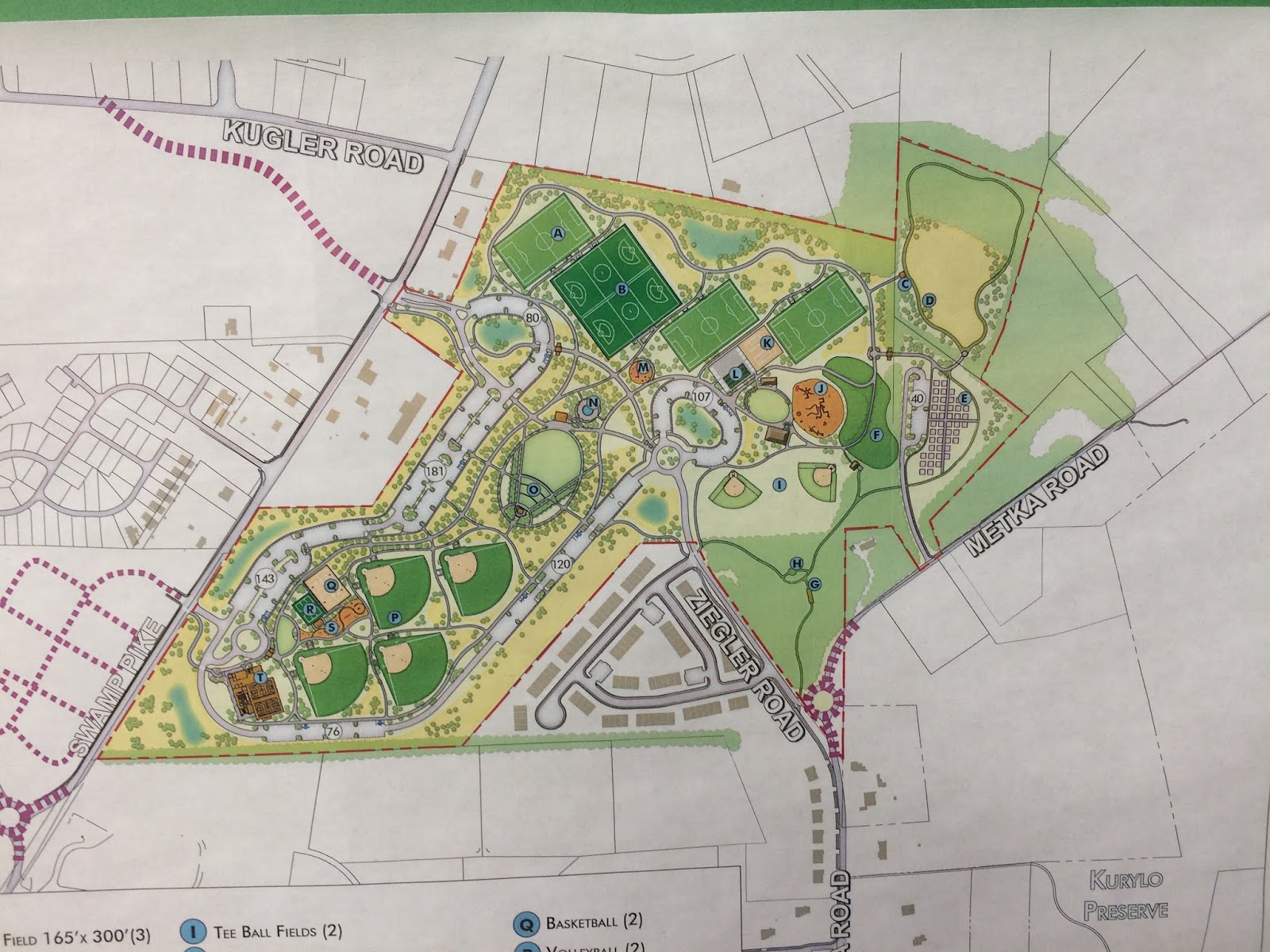
The Master Plan for Limerick Community Park.
In other news of import, the supervisors granted final approval to the $13 million master plan for the development of Limerick Community Park.

The concept is for the development of the park to proceed in five phases, said Township Manager Dan Kerr.

Also, the board decided to bear the costs of a federally-funded program to rehabilitate homes in the township, meaning it voted to accept $200,000 in community Development Block Grant funding for that purpose.

(Read more about that by clicking here.)

With State Rep. Tom Quigley, R-6th Dist., in the audience, DeWan took the opportunity to put him on the spot and outline the ways the red tape is killing a program that has benefited many Limerick residents over the years -- things like requiring prevailing wage for small projects and rules which require an entire home be brought up to code rather than just fix the problem.

He promised to look into it.

The program is a hold over from many years ago and had the supervisors declined to take the money, it would have effectively ended the program, said Kerr. Escalating administrative costs are causing the township to spend its own money to meet the demands of the red tape.

He told the supervisors that it was staff's recommendation to withdraw from the program and township residents could participate in a similar program operated by Montgomery County.

"Let's give it another year and take a look at it again," said Sperring, which became a motion that was unanimously approved by the supervisors.

And with that, here are the Tweets from the meeting:

Tuesday, July 3, 2018

Rupert Road Bridge to Close for Replacement July 23

Photo by Evan Brandt

The Rupert Road bridge in Lower Pottsgrove, built in 1921, is seriously deteriorating and will be removed and replaced starting on July 23.


The Rupert Road bridge along the eastern border of Lower Pottsgrove Township, will be closed for 120 days starting July 23, according to a pending announcement from township officials.

Built in 1921, the crumbling concrete structure has been on the township's list for replacement for years and will finally be removed.

The township had hoped to get started on the project as soon as school let out "but there were some delays due to the county having trouble getting easement rights on some of the property," said Chad Camburn, township engineer.

"As a result, some of the detour is going to bleed into the school year," he said, a situation officials had hoped to avoid.

Camburn said hopefully the bridge will be finished by October, "but we told the school district not until Thanksgiving just in case we have any problems," he said.

For cars, the detour will have drivers using Pleasantview Road to Pruss Hill Road to get around the bridge.

But trucks and "anything over five tons will have to use Fruitville Road over in Limerick because of all the weight-restricted bridges we have around there," Camburn said.

The final cost will be between $800,000 and $900,000 said Township Engineer Ed Wagner, and the township's share of that cost will be $325,000.

Camburn said some of the township's share was donated by the developer of the Raven's Claw housing project, most of which is in Limerick, but a small portion of which is in Lower Pottsgrove.
Site of the planned Spring Valley Farms clubhouse.

In other news from the commissioners meeting last night, Camburn said after a long absence, the developers from the Sanatoga Green project were back before the planning commission on June 7 and are moving forward with plans, starting with the completion of the sewer plans, called a module, which must be publicly available for review for at least 30 days.

The other major housing project in town, Spring Valley Farms off Bliem Road, will seek a special exception for the construction of a club house for residents of the Spring Valley Farms project, targeted at residents over age 50.

That project is expected to be built in at least three phases.

Commissioners also about the expiration of the "circuit rider" program, which most of us know as the regional recreation coordinator, a post now held by Michael Lane. The program officially expires in August of 2019 and in anticipation of that, township officials throughout the eight-municipality planning area can expect to begin seeing presentations about re-authorizing.

Due to the $162,000 no longer being provided by the state Department of Conservation and Natural Resources, the price is expected to rise from about $5,000 a year now to around $8,000 per year for the next term, which ends in 2024.

The Pottstown Area Health and Wellness Foundation is putting up 50 percent of the money to keep the program going, and the Schuylkill River Greenway has agreed to continue providing office space, and personnel resources for Lane.

So far, the program has obtained $1.6 million of the $1.9 million in grants it has sought for the six towns that participate, and for Lower Pottsgrove that includes a $362,000 grant for improvements to Gerald Richards Park, said Lane.

That sounds like a pretty good return on investment to me.

Here are the Tweets from the meeting

Monday, July 2, 2018

Death in the Family

The front page of the Annapolis Capital-Gazette on the day after a shooting in that paper's newsroom killed five. Despite the tragedy, they "put out out a damn paper" the next day. It's what we do. 
So at this point, I would imagine that some of you are getting tired of all the goings on about journalists and community newspapers on this blog.

But you must admit, it hasn't been a banner week around here or in my business.

Although, and apparently I can't repeat this enough, the Pottstown Mercury may have re-located out of Pottstown, it will continue to publish. I'll be working out of my nifty little home office right here in Pottstown, which I spent the hot part of the weekend setting up.

Still I will miss the company of my co-workers, dwindling though their number may be.

But my loss is nothing compared to that experienced in Annapolis. As I said, not a banner week for newspaper newsrooms.

One of my former co-workers, Michelle Karas, sent me a column by Miami Herald and Pulitzer Prize winning humor columnist Dave Barry on the subject of that shooting.

You can read it by clicking here.

I've been a huge fan of Barry for a long time, particularly when I used to read his columns to my wife while she was pregnant. Then I found out he graduated from my high school, Pleasantville High School, the year after I was born and his first job was at the Daily Local News in West Chester, where he was paid $93 a week. (I'm not sure the pay has increased much since then....)

Anyway, my attachment grew, the fewer our degrees of separation became.

There was a line in his column that caught in my throat when I read it to my wife Sunday night.
Since that first job, "most of my friends have been newspaper people. No offense to any other profession, but these are, pound for pound, the smartest, funniest, most interested and most interesting people there are. They love what they do, and most of them do it for lousy pay, at a time when the economic situation of newspapers is precarious, and layoffs are common."
And I began to think about what a small extended family we newspaper people are and getting smaller all the time.

Michelle is working for The Gazette in Colorado Springs now, and Chris Six, whose column you hopefully read yesterday in this space, is now running two weeklies in Virginia. Caroline Sweeney is out in Kansas now as a TV reporter and the irrepressible Brandie Kessler is still at the York Daily Record.

Dan Robrish is running the Elizabethtown Advocate and Joe Zlomek, the former publisher of The Mercury, is running his growing empire of digital Post publications, which began with The Sanatoga Post -- this despite the fact that the guy already has a full-time job.

Michelle didn't know this when she sent Barry's column, but I applied for a job at The Capital many years ago.

Shortly after The Mercury was purchased by the then-dreaded-now-long-gone Journal-Register Co., once known as the champion of cost-cutting until the current owner, the rapacious Alden Global Capital, showed us all how it's really done, the late Walt Herring, the departing editor, advised me to find another job.

"Don't dawdle here," he said.

This was before Pottstown fully had its hooks in me and it seemed like good advice, so I snagged an interview at The Capital. No job offer came and the rest is history, well, at least family history anyway.

But it did get me thinking this weekend about "what if?" Had I gotten a job there, would I be among the dead? Would I have been like crime and courts reporter Phillip Davis, live-Tweeting from under his desk that his newsroom was under attack? (That's where my wife put her money.)

Would I have been one of the many who came back to the office to do what they always do, gather the facts and share them? I like to think so.

Journalism is certainly under attack these days, from economic forces, political forces and, as seems to have been the case in Annapolis, by people who have a grudge they want to settle with a gun.

But despite the glamour of being occasionally threatened, or being called "an enemy of the people," it gets harder and harder to make a living, raise a family and pay a mortgage working in a newsroom these days.

Many, like Frank Otto, Rosemarie Ross, Eileen Faust, Cheryl Thornburg, Eric Devlin, Chuck Pitchford, Pat Sommers, Kim Toth, Kaitlyn Foti -- the three horsemen of the photographic apocalypse, John Strickler, Kevin Hoffman and Dan Creighton -- and particularly my boss of nearly 20 years Nancy March, have left the business, mostly for aforesaid economic reasons.

I heard from many of them Friday on the last day in the newsroom at The Mercury building before it was shuttered, sharing memories and regrets. Tom Hylton, former editorial writer and one of our two Pulitzer Prize winners, came in to have a last look around.

All because while some of them may have left the business, the business has left its mark on them.

By way of example, some of you may know March still does some part-time paginating work for us but is primarily focused on her new passion, "Pottstown Works." 

But I ran into her after the chamber of commerce luncheon last week and she remarked on the presentation made by Peggy Lee-Clark about all the new businesses opening in Pottstown.

Nancy was particularly interested in Cedarville Engineering, which moved here from Chester County and is taking over the upper floors of the bank building at High and Hanover streets.

"We've got to get them into the paper" she said to me intently, completely forgetting that she no longer decides who gets into "the paper." This was not hubris, it was habit.

I just smiled, and agreed. She read my face, grimaced, and told me to shut up.

It is like any other family of un-related people who all love the same thing, don't always love each other, but always drop what they're doing to make deadline.

We don't do it for the money and fame, although some of us do it a little bit for the adrenaline (I'm looking at you Frank and Brandie). Barry had it right again when he wrote:
"The news people I know are still passionate about what they do, and they do it remarkably well. And here's the corny-but-true part: They do it for you. Every time they write a story, they're hoping you'll read it, maybe learn something new, maybe smile, maybe get mad and want to do something."
And so although I didn't know any of them, I'll risk an accusation of presumption and say it's not hard to imagine that I knew something about what those killed in Annapolis were like; what they thought was important and the passion they had for the vocation, because it is so, so much more than a job.

And I know I know why those who survived, those 10 bylines that appear on the next day's front page of The Capital, did what they did in the immediate aftermath.

They "put out a damn paper."

Because that's what we do.

Sunday, July 1, 2018

Guest Column: Former Mercury Writer Reflects on Community Journalism, "A Tale of Two Newspapers'


As some of you might imagine, Friday, the last day I wrote for The Mercury inside the building where I have worked for 20-plus years, was a day that will stand out in my memory for a long time.

And what with the newsroom killings at The Capital-Gazette in Maryland the day before, you might understand feeling a bit beleaguered.

But given that the Capital-Gazette newsroom still put out a paper after being shot up and five of their co-workers killed, I don't see how I can justifiably say that I'm too wiped out to offer any  more insights into the closing of The Mercury building, even though I am.

So as a compromise, I'm going to offer somebody else's insights.

Chris Six worked at The Mercury as a graphics editor for several years, then at Stars & Stripes for many more and now runs two up-and-coming weeklies in Virginia, the Fauquier Times and the Prince William Times. He and I have remained friends throughout the years.

On June 12, he published a column about his time here, the closing of The Mercury building and the role of community journalism that was so good, it seems a shame not to share it with you here.

So I am.

Without further adieu, I give you:

"Community journalism: A tale of two newspapers"

By Christopher Six

For as long as I can remember, they’ve been telling me newspapers were in trouble. But of my former employers, only the small daily where I started my career in Coatesville, Pennsylvania, no longer exists.

The circulation was 6,000. I was the “full-time,” 30-hour-a-week sportswriter. That meant they could work you 38 and not pay benefits. If I didn’t live with my parents, I couldn’t have made a living. When it rained, water came pouring through the ceiling of the “sports annex” into an industrial-sized Rubbermaid next to my desk.

I loved it. So much so that I changed my college major from broadcast to print. Why? Because community journalism matters.

But this column isn’t about that newspaper.

It’s about where I’m at now, almost 30 years later: The Fauquier Times. And it’s about a daily that still holds an important place in my heart: The Mercury, in Pottstown, Pennsylvania.

The Mercury was facing the same difficulties every newspaper faced when I arrived in 1998: shrinking ad revenue, shrinking circulation, what to do with the internet. But good journalism was still happening. And boy, did we have fun. In many ways, I think it was the last of the good old days.

Christopher Six
Three photographers, a half a dozen reporters, two copy editors, a five-person sports crew. Multiple editors. From 4 in the afternoon until midnight, it’s where the action was.

These were people who cared about the community they served. Working all hours. After deadline, going for burgers and beers together. We loved what we did, who we did it with and the community we were doing it for. I look back on those days and curse the foolishness of youth that led me to chase dreams elsewhere.

A handful of those good journalists remain, as recent coverage of the YMCA’s attempt to leave Pottstown proves. But as a friend who continues to fight the good fight assured me, I would have been axed years ago. You see, the newspaper’s parent company, Digital First Media, is owned by Alden Global Capital, a hedge fund that has very different goals for its properties.

You might have heard of Alden and Digital First. They have been in the news lately:

Niemanlab.org: “Newsonomics: Alden Global Capital is making so much money wrecking local journalism it might not want to stop anytime soon.”

• Bloomberg: “Imagine If Gordon Gekko Bought News Empires. The reality is even worse: This raider sinks decimated newsrooms’ revenue into bad investments.”

• Philadelphia Inquirer: “Philly’s Digital First papers face harsh cuts, potential ‘lights-out scenario’”

• Denver Post editorial: “As vultures circle, The Denver Post must be saved”

• MPR News’ NewsCut: “Newspaper employees wonder who will cover their plight”

Digital First recently made news by purchasing the Boston Herald.

• Boston Business Journal: “Digital First lays off Boston Herald managers, workers”

And this is just the tip of the iceberg. Alden has done something besides strike a blow to community journalism: They’ve profited from it. For years, we have heard journalism is not profitable. It seems we have been proven wrong.

Quoting the NiemanLab story:
“Today we can reveal some key financial numbers from the very private company that shows just how successful Alden and DFM have been at milking profit out of the newspapers it is slashing to the bone. DFM reported a 17-percent operating margin — well above those of its peers — in its 2017 fiscal year, along with profits of almost $160 million. That’s the fruit of the repeated cutbacks that have left its own shrinking newsrooms in a state of rebellion.”
News came Friday that The Mercury is being kicked out of its historic home. This isn’t a surprise; the building should probably be condemned. I understand parts of it have been left to rot to a point that it is uninhabitable. Workers have been told they can work remotely or at the centralized plant in Exton. Unfortunately, that’s 30 minutes away, not in Pottstown.

The newspaper is being physically removed from its community. Now, good reporters will still be present, but think about it for a minute. Think about access this community enjoys to its local newspaper. Think about stopping by to subscribe, pick up a copy, drop off a letter to the editor, plan an ad or talk to a reporter or editor. Imagine that gone.

The Fauquier Times offers something different than disinterested corporate entities or hedge funds: local ownership comprised of investors who want to be proud of their newspaper. Who thought so much of that cause, they went and bought it.

I saw a lot of promise in that. It’s what drew me here from a relatively stable job at Stars and Stripes. I saw possibilities for the future of community newspapers, and a model for how it could work that others could follow. I wanted to be a part of that.

It hasn’t been easy. There have been challenges along the way. But exciting things are happening. We’ve redesigned. Added section fronts. Expanded coverage. Branched out into new mediums. We are learning and we are growing. The possibilities are endless.

To me, community journalism is a sacred trust. We are uniquely positioned to tell the stories of this community in ways no other organization can. We believe in this community: its people, its businesses, its causes. That means sharing the good things that are happening, as well as serving as the community’s watchdog.

I’ve shown you how easily that trust can be betrayed. You and I each have an investment in this cause. By buying a newspaper in print or online, or subscribing, you invest in our future. And through our work and dedication, we invest in our community. It’s a symbiotic relationship. All of us. Together.

Chris Six is the Editor-in-Chief of the Times. Email him at csix@fauquier.com. Follow him on Twitter @christophersix1