Showing posts with label callery pear. Show all posts

Wednesday, October 10, 2012

Council Vote Puts the Ax to Second Street Pear Tree

Photo by Evan Brandt
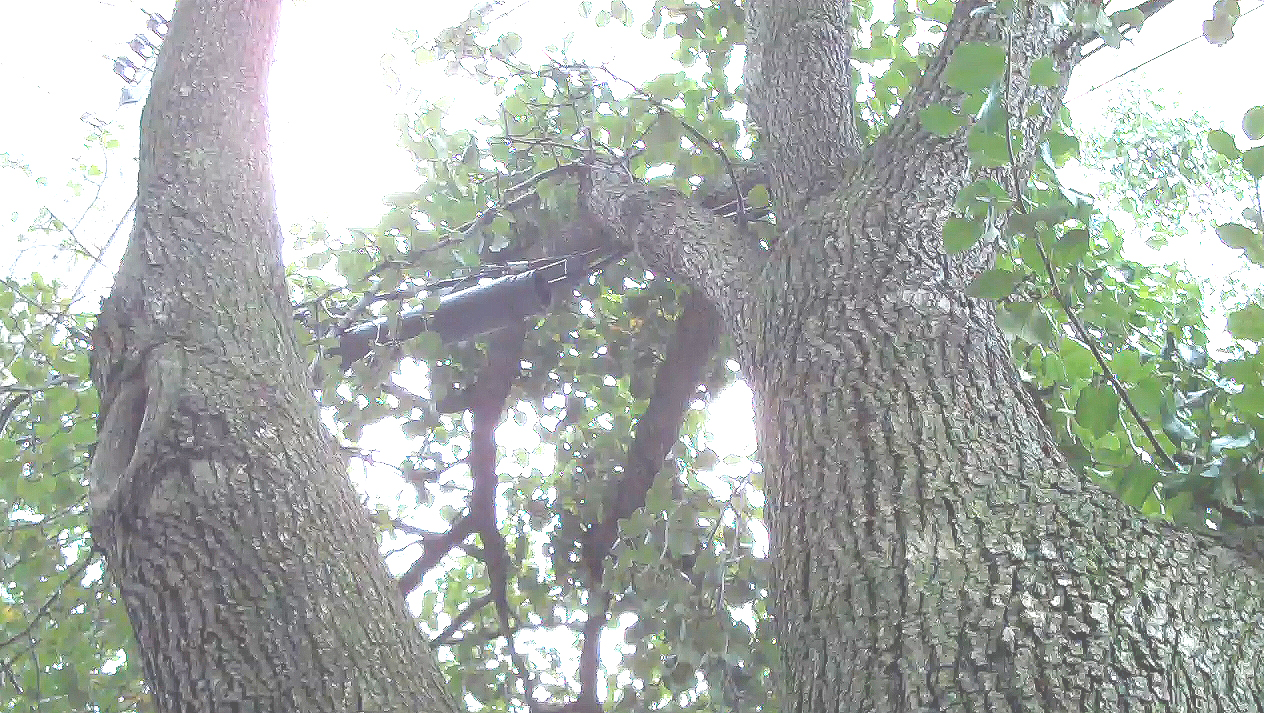
Say good bye to this callery pear tree. With a 5-2 vote Tuesday night, borough council approved its removal.

Borough Council voted 5-2 Tuesday night to allow a callery pear tree at the corner of Second and Johnson streets to be removed and for another tree to be planted in its place.

The vote came at the request of Janice Monger, the neighbor of 3 W. Second St., who last week appealed the denial of permission to remove the tree to council on behalf of her neighbor.

Photo by Evan Brandt
This tree, across the street from the one council has allowed to be
cut down, lost a branch which hit an occupied vehicle. Luckily,
no one was hurt.
She told council the Bradford pear tree, a species of callery pear, in front of her neighbor's house is considered dangerous by some and that, combined with the branch that fell off a similar tree across the street, was reason enough to allow its removal.

Since council disbanded the shade tree commission, appeals for tree permits now come to them.

Tuesday night's vote came despite points raised by former shade tree commission chairman Tom Hylton that allowing this tree to be taken down because council considers it a dangerous species could lead to a domino effect.

He pointed to a letter from Bran Gunther, the man in the New York City Parks Department in charge of street trees, that indicated a 2005 census showed the city, the largest urban forest on the east coast had planted 65,000 callery pear trees, the fourth most popular.

(Full disclosure, Bram Gunther is this blogger's brother-in-law.)
Photo by Evan Brandt
Although this tree has not been trimmed to reduce the threat of
a branch cracking and falling, PECO has trimmed the top to try to
keep the power lines clear.

If the tree in front of 3 W. Second St. is allowed to be take down simply because of what species it is, "then what do you do about the other six trees on that street? What do you do about the other 400 pear trees on the streets of Pottstown," Hylton asked.

"If you declare them dangerous, then it becomes incumbent upon you to do something about it," he said.

Even more dangerous, said Hylton, are the 10 "very dead" street trees in town. "Dead trees are far more dangerous."

Further, he said, with the coming arrival of the invasive emerald ash borer, Pottstown's 150 street trees that are ash trees will soon be dead as well unless expensive treatments are given to them.

Since 2007 -- when the borough ceased making contributions to Trees Inc., the non-profit organization with which Hylton is affiliated -- which once maintained street trees at no cost to the property owner, no maintenance has been done on the street trees.

Pottstown spent $60,000 since 2005 to maintain its existing trees when Phoenixville, by contrast, spent $415,000, "and we have one-third more than Phoenixville does," Hylton said.

"If you assume that shade trees add 3 percent of the value to property in Pottstown, and that's very conservative, that means they are responsible for $30 million worth of our property value," he said.

"When you look at the cost/benefit, clearly street trees pay for themselves," said Hylton.

Photo by Evan Brandt
One of the benefits of the callery pear trees in town, is how they make Beech Street look in the spring.
He also noted that PennVest, the state's infrastructure loan program, has spent $6 billion in the past 30 years for water and sewer treatment plants, but in recent years have begun to pay municipalities to plant trees as one of the most efficient means of stormwater control -- to the tune of $6.8 million to day.

Council Vice President Jeff Chomnuk, who represents the ward where the tree is located and who, along with Council President Stephen Toroney provided the "no" votes, reminded council and the public that in addition to removing the tree, the property owner is responsible for stump removal and sidewalk remediation.

Councilman Joseph Kirkland worried about "how we stop this decision from having a domino effect on the street."

Borough Solicitor Charles  D. Garner Jr. noted that the ordinance allows for council to take each appeal "on a case by case basis and how the evidence of the appeal is presented. It does not require you to agree to remove a tree unless you are convinced by the evidence."

However, he noted, this decision will not go unnoticed.

"Don't be fooled, you may have other appeals that will refer to this decision," Garner said.

Before voting, Toroney noted that an assessment of the tree from Todd's Tree Service repeated the information about the tendency of callery pear branches to crack as the trees get older, but noted "he didn't say that the tree should come down or is a danger."


Sunday, October 7, 2012

Pottstown's New Shade Tree Procedure Gets its First Test

Photo by Evan Brandt
A West Second Street resident told borough council Wednesday this Bradford pear tree is dangerous and she should be 
allowed to cut it down. The borough initially denied the request twice.

For the first time since it dissolved the Shade Tree Commission, Pottstown Borough Council is faced with an appeal by a resident who was denied a permit to take down a tree she considers dangerous.

Janice Monger of 5 W. Second St. made her case on behalf of her neighbor at 3 W. Second St., who has actual legal responsibility for the pear tree in front of her property. It is located at the northwest corner of the intersection with Johnston Street.

Monger applied for a permit to take the tree down and was denied. She appealed and was again denied by the body set up to hear such appeals -- the borough manager, public works director and councilman who represents the ward in which the tree is located.

(She complained to council that the meeting at which she was supposed to make her case was cancelled, but her appeal was denied anyway.)

The pear tree on the south side of Second Street lost a
branch that hit a vehicle with people inside, Monger said.
Under the new ordinance, her final appeal goes to a full meeting of borough council, which occurred during Wednesday's work session.

Monger told council that a similar tree across the street lost a branch that fell on a pick-up truck occupied by a man and his infant son. Luckily, neither was hurt although there was damage to the truck.

But it has made Monger fearful of what the tree in front of her neighbor's house might do.

"My neighbors and I live in fear," she said. "I have to tell my family not to park in front of our house. I like trees, but humans are more important than trees," Monger told council.

Monger said her neighbor cannot afford the cost of taking the tree down so Monger offered to undertake the job for her.

But when she applied for the permit, it was denied by Public Works Director Doug Yerger.

Yerger told council it is a healthy tree and has caused no damage to the sidewalk and, under the terms of the ordinance, the tree does not meet the conditions which allow for it to be taken down.

But Monger, a 38-year resident of Pottstown, said the species itself is inherently dangerous. "I did some research on the Internet," she said. "And I found these trees have a very short lifespan of 25 years and these trees are at least 30 years old."

Furthermore, she said, "after 15 years they start to crack and the branches get large and heavy. There are two that are cracked on Second Street."

She said Penn State arborists do not recommend the species as a street tree.

The tree in front of Monger's house has grown up into the power lines,
despite trimming by PECO.
Allentown and Emmaus have both removed all their Bradford pears for that reason, Monger said, adding that this particular tree has also grown up into the power lines in front of her house.

But while Allentown and Emmaus may have eliminated their pear trees, New York City, which has the East Coast's largest urban forest, has continued to plant them.

A 2005 survey of that city's trees showed that of the 93,000 street trees planted in the previous 10 years, callery pear's were the fourth most numerous.

But given the choice to do it over again, Yerger said he would probably not plant pear trees in Pottstown.

"There's no question it's a problem tree and we have a lot of them," Yerger said.

Council Vice President Jeff Chomnuk, who represents the ward where the tree in question is located, is opposed to its removal.

"I travel that street every day, and I know that tree pretty well," Chomnuk said.

He suggested that Monger's concerns could be address by trimming the tree, "which would be half the cost and could eliminate the branch you're worried about."

"I'm not trying to minimize your concern, but it's a healthy tree," Chomnuk said.

Council President Stephen Toroney said he wanted an expert opinion before making a decision. "None of us up here are experts and we're not in the business of taking trees down."

He suggested that Monger get the contractor she intended to hire to take the tree down to give an opinion on the tree's stability.

However Mayor Bonnie Heath noted that given the contractor's interest in making more money by advising that the tree come down, that opinion should be considered carefully.

Toroney also indicated said he might be more inclined to allow the removal if a new tree would be planted to replaced it.

However, Yerger said the tree's proximity to a newly installed handicapped sidewalk ramp makes re-planting problematic under the new planting guidelines, which call for a certain distance from such ramps, as well as water and sewer lines.

Councilmen Mark Gibson, Joe Kirkland, Dan Weand and Travis Gery, all seemed convinced by Monger's argument.

Gibson expressed concerns about the borough's liability, although Borough Solicitor Charles D. Garner Jr. advised that "negligence" on the borough's part would have to be proven for that to be a problem.

Kirkland, Weand and Gery all agreed that since Monger had produced information indicating pear trees of that age are prone to cracking and losing branches, that it is enough to allow the tree's removal under the provision of the ordinance that allows the removal of trees the borough finds to be "dangerous."

"I don't believe our ordinance makes it necessary to wait until it falls on somebody to be considered dangerous," Gery said.

Garner conceded that because the ordinance does not specifically define "dangerous," that the only definition that applies "is the one in the dictionary."

"We're looking at a responsible property owner," said Weand. "And we have a similar tree that failed across the street and we have residents who feel endangered by the preservation of that tree."

However Heath warned that setting a precedent of allowing tree removal permits based solely on a tree's species "would have other people being allowed to cut down trees all over town willy nilly."

"Those trees," she said, "were put in to provide shade and to beautify our town. Have you ever seen a street where all the trees have been removed? It's not a pretty sight."

Council has scheduled a vote on the matter for its meeting Tuesday night.

Wednesday, March 21, 2012

Spring Springs Ahead on Beech Street

Callery pear trees in bloom looking east along Beech Street.
I've always been partial to that saying: "Spring ahead, Fall behind," and not just because it helps remind me what to do with my clocks.

As a reader who equally loves science fiction and history, I have always been torn between looking forward and looking back.

With not immutable rules of reality to constrain it, a broader variety of issues can be explored in science fiction because no one throws down the book in frustration and says "that could never happen!" 

Hey, it's science fiction, anything can happen.

But as I get older, and read more history, I find myself leaning more toward the known facts of the past, then the tantalizing but intangible "what if's" of the future.

Sadly, the more and deeper into history I read, the more I realize how much of it we are doomed to keep repeating. Besides, whatever happened to the flying car and personalized jet pack I was promised as a kid?

All of which is a long-winded introduction to saying I'm someone who usually likes Autumn more than Spring.

But if you'll pardon me the pun, one of the things I look forward to happening every spring is driving down Beech Street.

Because at some point in the season (ever-earlier if today's science is to be believed) the callery pear trees which line this sometimes forlorn street explode with starbursts of white color.

This winter will go down as the warmest on record so welcoming spring seem a bit redundant, but the fact is this sight never fails to make me smile.

As I pulled on to Beech Street, one of my favorite passages of Holst's "The Planets" was playing in the CD player and I resolved, as I rushed to my appointment, that it being the first day of spring and all, I would re-create the experience with my handy video camera for, well, someone.

The video is posted on The Mercury web site, but I know it will attract few eyeballs, amid the clamor of burning cars, burning houses and videos of accused recalcitrants of Montgomery County.

So I've also posted it here.

Recognizing that even the advanced sensibilities of Digital Notebook readers have their limits, I realized that too much video of me driving down the road might prove tiresome, so I overlaid some spring-themed photos as well as information about the Pottstown Garden Club's floral photo contest.

(Click here for a link to more information about that.)

So here it is, enjoy it for what it is, a welcome to spring that "an autumn" like me rarely gives.