Showing posts with label Alden Global Capital. Show all posts

Sunday, April 12, 2020

Saving Local News in the Time of Coronavirus

Many local newspapers, including The Mercury, have been reduced

to a skeleton staff.
It should come as no surprise to any regular readers of this blog that, like other local businesses, local news is struggling to make it during this pandemic.

When you consider how many businesses have had to shut their doors, take the next step and ask yourself how many of them are advertising in the local paper?

Add to this, the fact that The Mercury and other papers in this chain have done the right thing and made our coverage of coronavirus free of charge.

That doesn't mean the print edition is free.

It means you can read about the information that may help save your life, or your flagging spirits, on our website without having to subscribe.

Needless to say, the combination of decreased advertising and "free-of-charge" is not having a positive effect on our bottom line.

It has accelerated an existing and increasingly desperate trend.

Just ask Ken Doctor. He is the "Newsonomics" columnist for Harvard's Neiman Journalism Lab and his predictions about the state of the local newspaper industry have been spot-on for the past two years. And his diagnosis is not good.

His March 31 column did not offer much hope for recovery.

Newspaper executives are "finding themselves careening right now into a future they’d thought was still several years away."
Ask an American newspaper exec a few weeks ago what they thought 2025 would look like, and they’d tell it you it would be much more digital, far less print, and more dependent on reader revenue than advertising. Some of them would have told you they think they had a plan to get there. Others, if they were being candid, would have said they didn’t see the route yet, but they hoped to find one in time.
The COVID-19 crisis has clearly accelerated that timeline — and may have ripped it to shreds altogether, depending on how long the shutdown lasts and how deep the resulting recession gets.
Make no mistake, though: Many of the decisions being made right now and in the next few weeks will be permanent ones. No newspaper that drops print days of publication will ever add them back. Humpty Dumpty won’t put the 20th-century newspaper back together again. There can be no return to status quo ante; the ante was already vanishing.
Can you guess what comes next?

You guessed right, lay-offs.

By serendipity and good negotiating, those of us who work at the papers in Alden Global Capital's Philadelphia Cluster that are lucky enough to be in The Newspaper Guild, signed a two-year labor contract in February that limits lay-offs in the contract's first year. That includes The Mercury.

That did not stop the company from asking for "voluntary separations," or from laying-off workers at non-union papers.

The latest reports indicate 19 lay-offs at The Reading Eagle, which Alden bought last spring, and ten of those are in the newsroom. That is on top of the 81 lay-offs that occurred right after the purchase.

My heart goes out to those staffers. I hate to see any local journalist lose their job at a time when we need them more than ever.

That the economic situation is exacerbating the peril facing local news is an inescapable fact.

But, as I wrote about in November, an already crumbling business model is being eroded at hyper speed due to the wealth-extracting business practices of private equity, better known as hedge funds.

Alden Global Capital, the company that owns The Mercury, is one of those hedge funds. Here is a primer on the company, put together by investigative reporter Julie Reynolds, who works for The Newspaper Guild's parent union, Communication Workers of America, and has plumbed the depths of this company like no other.

Having already strip-mined the local papers it owns of their assets, like the real estate, earning double digit profits and re-investing none of it back into the business that generated it, Alden left its papers particularly vulnerable to this latest economic shock.

Small wonder that its attempt to gain control of Tribune Company, which runs some of the nation's most revered papers like The Chicago Tribune and, more locally, The Morning Call in Allentown, has sent waves of fear through its newsrooms. So much so that in January, two Chicago Tribune reporters wrote an Op-Ed in The New York Times, pleading for a local buyer to take control.

Me visiting Heath Freeman's Montauk manse
before the security fence was installed.
True to form, Alden has responded to this reduction in revenue in the same way it sought to increase its revenue, lay-offs across the country, in California, Denver, and Boston, not just in Reading.

Perhaps most galling is the March 27 letter Alden CEO Heath Freeman -- who has since put up a security fence around his $4.8 million, five-bedroom, five-bath summer house overlooking Lake Montauk at the tip of Long Island since I dropped by unannounced two years ago to chat -- sent a letter March 27 to Illinois senators Tammy Duckworth and Dick Durbin.

In it, he claimed that rather than pillaging newspapers, he is saving them. This is hogwash, as Vanity Fair reported in February.

(You can read his full leaked confidential letter here.)

In part, Freeman wrote:
Too often, MNG is the buyer rescuing newspapers like The Reading Eagle, The Greeley Tribune, The Boston Herald or The Orange County Register from bankruptcy or liquidation or perilously close to that fate. Indeed, failing to equip local newspapers so they can adapt to the economic realities of the newspaper business in the 21st century would most certainly lead to more newspapers going out of business in your state and across the country.
I wonder if the 19 Reading Eagle employees laid off this week feel "rescued."

He goes on to note, accurately, that:
Heath Freeman
The digital transformation of the U.S. newspaper industry is in its early stages. And if local newspapers do not reset to these economic challenges they may cease to exist.
As you may be aware, a 2018 study from the University of North Carolina found that the U.S. has lost nearly 1,800 local newspapers since 2004, or approximately one in five. Clearly, if local newspapers fail to adapt to the economic realities they will continue to close.
We could not agree more. What Freeman's letter fails to indicate, because he can't, is what Alden has done with the profits it reaped from local papers to reinvest and adapt to those economic realities.

The answer, of course, is nothing.

My work laptop runs on Windows 7, which Microsoft stopped supporting on Jan. 14. The plan for upgrades, or new equipment? There isn't one.

That's because Freeman and his corporate cronies took the profits we were making and invested them in unrelated businesses like Fred's Pharmacy and Payless Shoes, both of which are now in bankruptcy putting more people out of work.

Perhaps most egregious of the letter's passages is when Freeman writes: "MNG’s goal is to operate newspapers in a sustainable and responsible way (emphasis mine) so that they will continue to exist successfully for the benefit of their local communities and shareholders over the long term."

This is more hogwash. There is no plan for sustainability. None.

There is only a plan for profitability, for as long as it lasts.

Freeman wrote to those senators at a time when many of them are not only questioning the questionable role hedge funds play in undermining local news, but also considering making the support of local papers part of the next stimulus to combat the economic devastation wrought by the coronavirus.

U.S. Sen. Bob Casey, right, visited the YWCA Tri-County Area

in Pottstown last year. With him at Montgomery County
Commissioners Chair Val Arkoosh, left, and YWCA's
Executive Director Stacey Woodland.
Pennsylvania's senior senator, Democrat Bob Casey, is among them, joining 19 others in signing a letter to other senators urging support for the move.
"The current public health crisis has made the already vital role of local news even more critical," the senators wrote in the letter. "Some of the most important guidance for families and businesses during this crisis has been highly localized.
"Local journalism has been providing communities answers to critical questions, including information on where to get locally tested, hospital capacity, road closures, essential business hours of operation and shelter-in-place orders," the letter says.
The senators said any future stimulus package must contain funding to support this important industry at such a critical time. They suggested the legislation include a provision that is tailored to benefit aid recipients who make a long-term commitment to high quality local news.

There are other suggestions for the legislation as well, coming from those of us who know the business well, and know how sudden influxes of cash can sometimes find their way into the wrong wallets if further protections are not put in place.

On Thursday, NewsGuild President Jon Schleuss wrote a letter to House Speaker Nancy Pelosi, House Minority Leader Kevin McCarthy, Senate Majority Leader Mitch McConnell, and Senate Minority Leader Chuck Schumer.

He had some pretty relevant suggestions:
News Guild President Jon Schleuss helped guide

the fledgling chapter at the Los Angeles Times
to its first-ever union contract.
  • A publicly financed fund to support newsrooms and media workers to prevent layoffs furloughs and pay cuts;
  • Requirements that news outlets receiving aid remain independent from partisan influence, demonstrate a need for the assistance, report on how funds have been spent and be prohibited from engaging in mergers and acquisitions resulting in job losses, leveraged buyouts and anti-union activity, and from using funds for executive bonuses, stock buybacks or dividends (emphasis mine);
  • A prohibition on job cuts by participating companies;
  • Requirements that recipient companies provide ongoing information on staff diversity;
  • Ensuring that one-quarter of seats on boards of directors be held by non-management employees at recipient publications;
  • A separate mechanism to establish a Small Business Administration program of no-interest loans for the creation of news start-ups, including nonprofits and employee-owned co-ops;
  • Tax deductibility for the cost of subscriptions to any news product;
  • Incentives for local ownership to encourage chains to sell to local owners and community interests;
  • A nationwide federal advertising program to promote public health, participation in the federal census and other topics of national interest.
"Continuing news coverage through this pandemic must be a priority in the next stimulus package. Many publications have lowered digital paywalls to provide COVID-19 coverage for free," Schleuss wrote.

"At the same time, the news industry is seeing plummeting ad revenue created by business closures. At this moment when Americans need reliable, community-focused coverage, we risk losing it all," he wrote. "More Americans will die if they cannot access this critical information."

There's also something you can do, and it doesn't even cost any money.

Sure, you can subscribe to The Mercury or the local paper near you. I can guarantee you its struggling.

But you can also lend your John Hancock to a petition supporting Schleuss's suggestions.


I guarantee it will make you feel good inside. And it might just save your life or the life of someone you love.

Sunday, February 2, 2020

The Things We Leave Behind

Photo by Evan Brandt
Front pages and special sections I rescued in my last visit to The Mercury building.
These things always seem to come in threes.

First was the news that management at The Mercury had left behind personnel files of current and former employees, complete with Social Security numbers, birthdays, addresses and even bank account numbers, when it abandoned our landmark building in June of 2018.

This has of course left all of us vulnerable to identity thieves, but in many ways, those of us who are left and who identify themselves as journalists first and foremost, have been experiencing a slow identity theft for years as profits and resources have been siphoned away from The Mercury by the New York hedge fund that owns us, Alden Global Capital.

Among those resources was the landmark Mercury building which, like the other properties it obtained when it purchased the majority of shares in what was once known as Digital First Media, it has sold off for cash that was not put to any use for the newspaper itself, but rather to fund Alden's other business ventures.

The building was sold on Oct. 22 for $440,000 to a company controlled by April Barkasi, the woman who founded and is the CEO of Cedarville Engineering Group, LLC.

She also purchased the bank building across the street at the northwest corner of High and North Hanover streets.

By all reports, she intends to turn it into a "boutique hotel" with a whiskey bar and cigar lounge in the basement where the newspaper's "vault" of old papers used to be housed.

When the Alden shell company 24 North Hanover St. LLC bought the building in 2013, it paid nearly  $1.2 million, according to Montgomery County property records.

I'm pleased to see this grand old building will get a new life and contribute to the ongoing revitalization of downtown Pottstown. (And let's face it, I never met a whiskey bar I didn't like.)

But before that happens, there is quite a bit of cleaning up to do.

Photo by Kevin Hoffman
You see, it wasn't just a few missed boxes of personnel records that were left behind,, a truly symbolic indication of the disregard the company had for the building and those who worked there.

They left everything. File cabinets, desks, old computers, furniture.

Those who have been in the building have marveled at the ghostly nature of how everything looks.

Desks with papers, chairs and staplers; used computers in a storeroom; someone even joked that there was a half-filled cup of coffee sitting on a desk.

It was as if everyone was coming back to work the next day.

Photo by Kevin Hoffman
Computer and office equipment abandoned by the management
of The Mercury in our old building at King and Hanover streets.
But of course, that's not going to happen, not here and not at dozens of local newspapers across the country, where the crisis in local news is being accelerated by private equity firms, like the one that owns The Mercury and the other local papers in Southeast Pennsylvania.

Which brings us to the second of the three.

News that Warren Buffet, who had once seemed like one of the billionaires who might save some of the nation's local newspapers, gave up and sold his chain of papers.

As Julie Reynolds, the remarkable investigative reporter for The Newspaper Guild reported, Warren Buffett’s sold his BH Media newspapers to Lee Enterprises for $140 million. That deal is expected to close in mid-March.

Alden CEO Heath Freeman
Like a shark drawn to blood in the water, "Alden Global Capital, the New York vulture hedge fund gutting Digital First Media newspapers (and owner of The Mercury), has acquired a $9.2 million stake in Lee Enterprises, siphoning money from Alden’s highly profitable and understaffed papers to finance the stock purchase," Reynolds reported.

The purchase was made through one of Alden's shell companies, some of which, Reynolds has discovered, are incorporated in secrecy-friendly Delaware and the Cayman Islands. The methodology hasn't changed and neither will the outcome.

Alden CEO Heath Freeman, Reynold's reported, “intends to engage in discussions” with Lee’s management and/or board of directors about “certain operational and strategic matters, including, but not limited to the recently announced acquisition of Berkshire Hathaway’s newspaper operations and matters pertaining to (Lee’s) 2020 Annual Meeting.”

In other words, like it did when it bought stock in Gannett after it merged with Gateway; and when it purchased Michael Ferro's Tribune Publishing stock after he was forced out, it wants to feed on the corpse.

There is no thought to investing in these papers to make them sustainable and thus sustain the crucial work of local journalism, keeping the powerful accountable. 

The only motive is greed, which is a sad but all-too-familiar mindset in these times. 

Gone is any sense of corporate responsibility to the community its newspapers serve.


Mercury clip files have been abandoned by Mercury management.
Below, former Mercury Editor Nancy March looks through the
clip files for things worth saving.
Which brings us to instance number three, which is likely my final visit to the inside of The Mercury building before renovations begin.

I accepted an invitation to join former Mercury Editor Nancy March to drop in Friday morning.

Like so many others, I went to the desk where I had worked for decades, and found a few things I should not have left behind. 

But taking the seven drawers of files I had accumulated over the years was impractical. And frankly, I ceased to make much use of them even when I was still in
the office.

A greater loss is The Mercury clip files. Back when we had a staff, we had employees who would clip every story in every day's paper. 

Whenever a reporter was assigned a story, the first step was to go to the clip file to get background on the subject.

At least the "bound volumes," physical copies of each edition of the paper found into annual books, have been moved to the company offices at the printing plant in Exton and are being preserved.

But that preservation is only a sliver of the region's history The Mercury has recorded.

As I walked through the newsrooms (we had two locations during my tenure there) and advertising rooms, the publisher's office, the composing room, I could not escape thinking about what is being lost; not only the history of the community, but the history of The Mercury's involvement in that community.

Photo by Kevin Hoffman
Nancy March's old office looked out onto King Street. It can't
have been easy for her to say goodbye one last time.
After the visit, I was covering a visit by Pennsylvania Department of Human Services Teresa Miller to Montgomery County Community College. It began in the North Hall which, I could not resist telling Miller, had once been the Kiwi Shoe Polish factory and was later known as the Nittany Warehouse.

That warehouse was storing dangerous chemicals, and doing it so badly, that former Fire Chief Rich Lengel had told me if it caught fire, he would not allow any firefighters inside because it was too dangerous.

Kevin Hoffman and I climbed up onto the railroad tracks and he took photos through the windows of chemicals leaking out of bins and unclosed containers and that lead to coverage that got the attention of the EPA, who shut the place down.

Now, it's a unique part of the community college and an asset instead of a liability. 

Sure enough, as I looked through the piles of old Mercury editions strewn about the office, I found one of those front pages from 2000 when we helped to expose that danger and get it taken care of, making Pottstown a safer and more vibrant community.

This is the kind of value local journalism brings to a community, the kind that doesn't show up on a quarterly report, the kind Mr. Freeman does not seem to consider as being worth saving.

So as I left the building where I had worked for more than 20 years, and housed the people who chronicled the life of the greater Pottstown area for nearly 90 years, I reflected on the fact that its not just desks, clip files and memories that are being left behind.
 
Also being left behind is the value we place on community, nationally and locally; on having a common set of facts, a common starting point for discussions about what's best for the future, where we go from here.

That is the true loss, one that is only now just being recognized, perhaps too late.

I will be sure to toast its memory in the whiskey bar that replaces it.

Sunday, November 24, 2019

Losing the News: The National Crisis in Local News

Photo courtesy of Todd Bainbridge
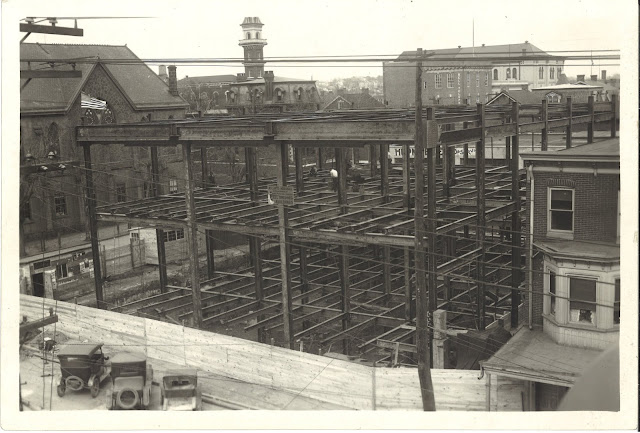
Do you recognize this building being built? It only took me about 30 seconds.

As a history buff, I often find myself looking backward for clarity and similarities during times of extreme change in this country.

History can also be a source of comfort by reminding us that things have been this bad before, and we survived.

Trying to get a handle on impeachment? Look at what happened last time we went through this.

What are the consequences of the concentration of extreme wealth? Read up on "the gilded age."

So there was a certain amount of synchronicity at work this week, during a time of extreme upheaval in the local news landscape, that brought Todd Bainbridge's photo to one of my favorite non-political Facebook pages.

There, on "Good Old Days of Pottstown," where folks mostly post old photos and "does anyone remember?" questions, was a photo of steel framework of a building being erected in 1925.

Recognizing the since-shortened watchtower at the Phillies Fire Company, where wet hoses were hung to dry; and the Trinity Reformed United Church of Christ I walked past for more than 20 years on the way to work, I realized it was The Mercury building at High and Hanover streets being constructed.

The Mercury building as it appears today.
It did not become The Mercury until 1937.

That's when William Heister and the paper's legendary first editor, Shandy Hill, moved the paper they had founded six years earlier, into the building.

But for all intents and purposes, everyone knows it as The Mercury building.

The sign remains on the corner one year after I wrote the obituary for news operations there.

In it's first issue, Hill wrote The Mercury would be “frank and fearless in all matters, especially in which Pottstown has a vital interest.”

In terms of the mission of local news, that remains as true today as it was in 1931. What is not the same, is our ability to continue to do so.

What's happened?


Margaret Sullivan, the media columnist for The Washington Post provided probably the most succinct round-up of last week's local news shockwaves:
Gannett and GateHouse, two major newspaper chains, finished their planned merger, and the combined company intends to cut the combined budget by at least $300 million. That will come on top of unending job losses over the past decade in the affected newsrooms of more than 500 papers.

The McClatchy newspaper group — parent of the Herald and Charlotte Observer — is so weighed down by debt and pension obligations that analysts think it is teetering on bankruptcy.

And the storied Chicago Tribune on Tuesday fell under the influence of Alden Global Capital, a hedge fund that has strip-mined the other important papers it owns, including the Denver Post and the Mercury News in San Jose.
Regular readers of this blog know that Alden also owns, and has gutted not only The Mercury, but the other papers it owns in its "Philadelphia Cluster" -- The Times-Herald in Norristown, The Daily
Space for rent in The Reading Eagle building.
Local News in West Chester, The Reporter in Lansdale, the Delaware County Daily Times, The Trentonian and its most recent addition, The Reading Eagle.

In addition to the relentless drumbeat of staff cuts, the most visible example of the strip-mining of local newspaper assets is off-loading the real estate.

In addition to selling The Mercury building, Alden has also sold or is actively marketing the Norristown, West Chester and Delaware County buildings and recently announced on The Reading Eagle's front page that there is "space for rent" inside.

Because irony never takes a holiday, I hasten to point out that this same cluster of papers provided Alden Global Capital, and its top man Heath Freeman, with a $18 million profit in 2017, as reported last May by the undisputed chronicler of these sad times, Ken Doctor and his Newsenomics column in Harvard University's Neiman Foundation for Journalism.

SOURCE: Ken Doctor
While not the highest dollar profit for the papers owned by Alden, at 30 percent, it was the highest percentage in the company.

"DFM reported a 17 percent operating margin — well above those of its peers — in its 2017 fiscal year, along with profits of almost $160 million. That’s the fruit of the repeated cutbacks," Doctor wrote, noting that none of that profit, none of it, was reinvested in the business.

Instead it was spirited away to invest in controlling stakes of distressed companies like Fred's Pharamacy and Payless Shoes, both of which almost immediately dove into bankruptcy under the leaden management of Alden and the "management" fees it extracts.

In the combined Fred’s and Payless store closures this year, roughly 22,000 people have lost their jobs.

Some of those workers stood with News Guild investigative reporter Julie Reynolds and myself in Washington, D.C. this summer when several Congress people and senators (and presidential candidates) announced a bill to try to regulate the wanton greed of hedge funds and private equity.

Alden's business practices are so shady, it is under investigation by the U.S. Labor Department for using employee pension funds as a piggy bank to prop up its bad investments.

And, as Reynolds reported last month, "A federal bankruptcy
Heath Freeman
judge on Oct. 16 ordered Alden to turn over requested documents to (Fred's Pharmacy) creditors and will allow them to question Alden president Heath Freeman under oath."

The creditors have claimed Alden's purchase of Fred's was "shrouded in suspicion" and the creditors told the court that Alden “funneled $158 million from a floundering newspaper business in order to purchase (Fred’s) stock—stock which has since that time lost 97% of its value.”

All of this to say that the employees of Tribune newspapers -- which include The Morning Call in Allentown, and the Chicago Tribune, The Baltimore Sun, The Hartford Courant, the New York Daily News and The Virginian-Pilot -- are truly anxious about Alden's majority shares in Tribune.

"We're deeply concerned that Alden Global Capital has purchased a majority share in Tribune Publishing. Alden has hurt journalism and journalists," The Chicago Tribune Guild Tweeted as soon as the news of the sale of stocks to Alden made headlines.

The guilds of all Tribune's newspapers, including The Morning Call, immediately issued (and Tweeted) a statement that read, in part: 
Alden is not a company that invests in newspapers so they succeed. They buy into newspaper businesses with the express purpose of harvesting out huge profits -- well above industry standards -- and slashing staff and burning resources.
We know we are looking at the real threat that Alden is looking to bleed its next chain of newspapers dry.  
Adding insult to injury, Tribune announced just prior to the Alden stock purchase that it would issue a quarterly dividend to stockholders next month worth $36 million "despite the company being in the red by $9.1 million for the first three quarters of 2019," according to Doctor.

All this while telling the News Guild negotiators at the bargaining table for Chicago, Virginia, Hartford and Allentown that there is no money for raises and they have to eat a 6.4 percent hike in their health care costs.

Added to this Alden-apocalypse is the Gannett-Gatehouse merger which is also financed by private equity hedge funds, Fortress Investments and Apollo Global Management, which will harvest a whopping 11.5 percent interest rate on its loan, requiring savings of $400 million to make the payments.

Image filched from Ken Doctor's column
Some of those savings will come from cuts, particularly in markets where Gatehouse and Gannett both have papers. That means job cuts at the combined company of one in eight employees which, Doctor reported on Nov. 14, "would add up to 3,450 of the combined companies’ 27,600 jobs."

And at McClatchy, now the nation's second largest newspaper chain, a Bloomberg News headline indicating the company may be near bankruptcy due to its efforts to get out of its pension fund obligations, sent the company's shares tumbling 82 percent on the market across five trading days, according to Doctor.

With $700 million in debt, down from the $5 billion it took on in 2006 when it acquired Knight-Ridder, former owner of The Philadelphia Inquirer, McClatchy owns 29 newspapers with a combined circulation of three million, including The Kansas City Star, The Miami Herald, The Charlotte Observer, The Sacramento Bee (California), and the Star-Telegram (Fort Worth, Texas).

If McClatchy gets reorganized through bankruptcy, another hedge fund, Chatham Asset Management, "the company’s biggest lender and shareholder, is in the driver’s seat," wrote Doctor.

And, Doctor is reporting there are rumors of a merger between Tribune and McClatchy which would once again put money in Alden's pocket. Similarly, Alden tried to scotch the Gannett-Gatehouse merger by making its own bid. When that failed, it bought stock in Gannett and supported the sale.

What does the threat of losing local news mean?


As Doctor wrote in his Nov. 20 analysis: "The impact is obvious. As America has moved from jokey indulgences in truthiness to a point where fact fights for its very life, it’s the bankers who are deciding what will be defined as news, and who and how many will people will be employed to report it."

Which is where I return to my refuge in history which, in this case, provides more warning than comfort.

We must use our time machine to go back to Medieval times to find the example of life without a free press. To be allowed to publish in Elizabethan England, for example, one needed to be in a guild (no relations to today's union other than the work done by both) which had permission from the crown.

And if you published without permission, or something the crown did not like, you were punished, sometimes with jail.
Martin Luther's 95 theses, a free press in action.

You suffered worse during the religious wars in Europe if, for example, you were in possession of a protestant Bible in a Catholic nation, or a Catholic Bible in a protestant one.

What were Martin Luther's 95 theses about the church other than an early example of the free press, the free expression of ideas presented to as broad an audience as possible?

There is no better indication of the importance of the role played by a free press in this country's founding than its presence in the very first of the Amendments made to the Constitution.

And while the First Amendments means the government can make no law abridging the freedom of the press, it is silent on whether the press can be abridged by other increasingly powereful interests in our society, like Wall Street's single-minded pursuit of profit over purpose.

That is the danger posed by monied ownership of newspapers and, perhaps, by the death of the traditional, long-standing but crumbling model of local news ownership.

As I said at that Washington news conference this summer:
"Wall Street exists to pursue profit. That’s its purpose.
 But maybe it’s time to recognize that some institutions in America are more important than profit; that these institutions should be in the hands of those dedicated to their preservation, not to those who willfully plunder them for a 16th mansion in Miami Beach or to put another addition to their Montauk beach house."
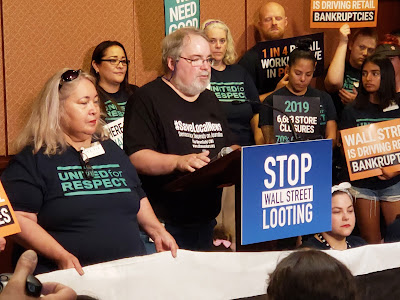
Yours truly speaks truth to power in Washington.
It's about more than my job, and the jobs of journalists across the country. It's the function those jobs perform that matters.

I've lost track of the number of studies I've referenced that show people's taxes go up without a local news source, largely because those same Wall Street firms that are breaking the back of newspapers to make more money, charge higher interest rates on bonds taken out by local governments that are not curbed by the watchdog oversight of a local news source.

Pretty nice deal. Wall Street makes more money on both ends of that equation. Yay vulture capitalism.

Other studies show without local people become less engaged in their communities, more polarized, vote less and fewer people run for office.

Thankfully Joshua Benton did it for me when he wrote the following in April for Neiman Lab:
What do strong local newspapers do? Well, past research has shown they increase voter turnout, reduce government corruption, make cities financially healthier, make citizens more knowledgable about politics and more likely to engage with local government, force local TV to raise its game, encourage split-ticket (and thus less uniformly partisan) voting, make elected officials more responsive and efficient, and bake the most delicious apple pies. Okay, not that last one.
Local newspapers are basically little machines that spit out healthier democracies. And the best part is that you get to reap the benefits of all those positive outcomes even if you don’t read them yourself. (On behalf of newspaper readers everywhere: You’re welcome.)
Without local news, or with newspapers that are a shadow of their former healthy selves, a gap opens.

"With fewer resources, though, reporters are more likely to report on an issue only when it reaches a public state of prominence — by which time the city’s plans may have already been shaped without much public input," Benton wrote Friday, undermining the "early warning system" that more robust local news coverage traditionally provided.

"As newspapers cut back on coverage — just as when they cut back on distribution — the first things to go are the farthest away from headquarters," he wrote.

Look no further than the Mercury for an example of that. I can't remember the last time I was able to get to a meeting of the Upper Perkiomen School Board, North Coventry Supervisors or Trappe Borough Council.

With meetings occurring the same night, I have to make my best guess and as a result, I miss things. 

For a perfect example, look no further than the Phoenixville School Board. 

Attending Thursday's public hearing on the purchase of a 30-acre East Pikeland property for a new school, I suddenly became aware that Superintendent Alan Fegley had a new four-year contract.

More significantly, I checked the minutes of previous meetings and was dismayed to discover it was adopted in September, several months before the current contract expires and ahead of the installation of a new majority on the incoming school board.

Phoenixville readers got no early warning from The Mercury on that development, despite the fact that it played out over several meetings and happened at about the same time an investigation into the mishandling of funds by the district's chief financial officer had begun.

Fake local news?


Sometimes, citizens fill that gap left by the loss of local news with more national news which is becoming more partisan and more fractious.

Many local journalists then find themselves painted with the same brush.

As Benson wrote: "as media consumption becomes more nationalized, the yelling and spinning on cable news colors how people think about their hometown daily."

He was citing a second research paper by Cleveland State’s Meghan Rubado and the University of Texas’ Jay Jennings titled “Newspaper Decline and the Effect on Local Government Coverage,” that interviewed local journalists.

One reporter was quoted in the report as follows:
One reporter said these resident attitudes were further tainted by negative attitudes about national mainstream media outlets. “You know, we’re not CNN; we’re not Fox News; we’re not MSNBC…we’re your neighbors. We want to do good by you, but we can’t do that if you hate us or you think that we’re out to get you or you think that we’re out there with an agenda. We’re not and I don’t — sometimes I just don’t know how to get that across to people who vehemently believe otherwise.”
Look no further than The Mercury's Facebook page to see claims of "fake news" being thrown at stories and opinion columns with which some readers take issue.

And sometimes, the gap is filled with actual fake news, and I'm not talking about actual news that Donald Trump doesn't like.

On Tuesday, The Guardian newspaper, which has an online U.S. edition, published a troubling story about "Locality Labs, a shadowy, controversial company that purports to be a local news organization, but is facing increasing criticism as being part of a nationwide rightwing lobbying effort masquerading as journalism."

It offered the example of an Illinois school referendum into which a Locality Labs inserted itself.
Hinsdale School News, a print newspaper that was distributed around Hinsdale voters. The paper had the Hinsdale high school district logo, and the look of a journalistic organization. But, as the Hinsdalean reported, the “newspaper” was stuffed full of articles, mostly byline-free, which had a distinct anti-referendum skew.
“The depths of what they went to were pretty egregious,” said Joan Brandeis, who was part of the Vote Yes Campaign.
“This was purposely done to mislead people into thinking that was a publication from the district.”
Apparently, it's not the first time. Here is the gist of the scheme as reported by Adam Gabbat:
Locality Labs operates scores of sites across Illinois, Michigan, Maryland and Wisconsin, often sharing content. In Michigan alone, the Lansing State Journal reported, almost 40 sites opened in one fell swoop this fall.
“It is always a bit troubling in the current environment when websites don’t really indicate what they’re all about, and sort of hide who is behind them, and I think that’s clearly the case here,” said Matt Gertz, a senior fellow at the not-for-profit press watchdog Media Matters.
“In the fractured media environment that we’re operating in now, if you’re just scrolling through your Facebook feed or your Twitter feed and you see an article, you click on it and you might take in the information from there without really ever wondering what the source actually is.”
The CEO of Locality Labs is Brian Timpone, an ex-journalist with a track record of operating dubious news organizations. Timpone’s predecessor to Locality Labs was a company called Journatic, which saw a licensing contract with the Chicago Tribune torn up after it published plagiarized articles and made up quotes and fake names for its writers. Locality Labs did not respond to a request for comment.
Locality Labs’ sites are almost identical in layout. The Great Lakes Wire is similar to the Ann Arbor Times, which bears a striking resemblance to the DuPage Policy Journal and the Prairie State Wire.
There's more:
What the sites all have in common is praising Republican politicians, and denigrating Democratic ones.
Last week Illinois sites – including the West Cook News, Grundy Reporter, South Central Reporter and Illinois Valley Times – each ran a story about a thinktank criticizing JB Pritzker, the state’s Democratic governor.
The stories were all written by Glenn Minnis – whose byline was also listed in the Hinsdale School News. None of the articles mentioned that the thinktank in question was a rightwing, anti-tax lobbying organization.
And the kicker that makes this all relevant to this column:
Opinion as news is nothing new. But the appearance of the rightwing-skewed Locality Labs sites, presented as merely local news, has been aided by the demise of the local news industry in America as real local newspapers have shut down in droves, sometimes leading to “news deserts.”
About 1,800 newspapers closed between 2004 and 2018, while a University of North Carolina study last year found that 1,300 US communities have completely lost news coverage.
... Gertz said people still tend to have more faith in local news than in national outlets.
“And so there’s an idea here that you can move in and take advantage of that, of both the lack of local news options and the fact that people are inclined to trust local news by creating these hyperlocal news sites and provide no little bit of conservative propaganda.”
As Doctor warned us, “the old world is over, and the new one — one of ghost newspapers, news deserts, and underinformed communities — is headed straight for us.”

What can be done?


Photo shamelessly stolen from The Colorado Independent.
Uncharacteristically, I will end this screed on a positive note.

There are success stories out there.
It is now in its second year and attracting more readers.
  • Also in Denver, "where two major papers once thrived, a host of locally run, community-focused outlets are proliferating. One such outlet, Chalkbeat, is reporting from public schools and school board meetings, covering education, one of the biggest casualties of the attrition in local news—and successfully scaling to other states. Nationwide, over 6,500 philanthropic foundations, as well as tech giants, are now financing media initiatives," wrote Pulitzer Prize-winning playwright Ayad Akhtar.
They have visited and profiled operations in Mississippi, Maine, Massachusetts, southern California and the Bay Area and Houston.

In his latest installment, on Oct. 27, visiting the Shawangunk Journal in New York's Hudson Valley, Fallows wrote:
A theme that runs through nearly all of these reports is the importance of ownership structure.
Times are tough for little newspapers everywhere, but the papers least likely to survive are those that have fallen under the control of hedge-fund and private-equity chains, which are starving them into short-term profitability and longer-term demise. The successful counterexamples are mainly family-owned, community-owned, or in some other way bolstered against the pressure to cut the publication into insignificance.
Founded in 2006, The Shawangunk Journal is a print publication, now with a paid circulation of about 2,000.

What I found most interesting about it is its "subscription-and-micropayments business model. As you’ll see if you register (for free) on the paper’s site, NewsAtomic, after an introductory-offer period, articles from the paper for non-subscribers cost 25 cents apiece."

The paper is also recruiting future readers, and training future journalists, by partnering with the local high school newspaper.
"More civic-info coverage replaced restaurant closures and car crashes, and the Post has now grown to 2,650 fully paying subscribers. That’s an annual run rate of nearly $190,000," Schmidt wrote.

“We started to look at what was converting people who just visited the page to people who wanted to pay us,” Jay Senter who founded the site with his wife Julia Westhoff, told Schmidt.

“The accountability journalism, the Civics 101 content we put out there — that was the kind of stuff that seemed to get people over the hump and giving us money every month…Things that were on the fires-and-car-accident side of things would get a lot of pageviews, but didn’t seem to have lasting impact on the way that people live their lives around here.”
  • Or you can try the non-profit model.
This is something I've been musing about for several years, creating a non-profit community foundation that owns and operates a local paper, print or otherwise, and can accept donations and contributions which are tax deductible.

Salt Lake Tribune building.
It keeps the site accountable, and owned, by the community it serves.

The Salt Lake City Tribune, is the second to do it on a larger scale, having obtained non-profit status from the Internal Revenue Service.

Closer to home, our own Philadelphia Inquirer/Daily News operation went non-profit in 2016 under the Lenfest Institute for Journalism.

But it is not a panacea.

As Schmidt wrote in April, "unresolved financial issues, a new round of buyouts, less-than-stellar staff morale, and a leadership vision some consider hazy on specifics remind the Inquirer that it’s not safe yet."

As negotiations with the News Guild of Greater Philadelphia, of which I am a proud member, continue, the Twitter account there notes workers have gone more than 3,700 days without a raise.

On a smaller scale, Schmidt writes in a Nov. 20 article for Neiman, "alt weeklies," those often free publications you see in honor boxes in most major cities, are experimenting with this approach.

Last week a new report was issued (I told you it was a crazy busy week in local news) by PEN America, a non-profit founded in 1922 by such luminaries as Willa Cather, Eugene O’Neill, Robert Frost and others "to ensure that people everywhere have the freedom to create literature, to convey information and ideas, to express their views, and to access the views, ideas, and literatures of others."

Titled "Losing the News," it covers all the concerns mentioned above, what one local official once described to me as "worshiping the problem," but also highlights some success stories includes some potential solutions.

Among the recommendations are

News organizations should:
  • Collaborating with other local news sources on broader, enterprise coverage of major issues:
  • "Investment in revenue-generating staff, such as subscription, membership, sponsorship, and development teams."
Non-profit news sites should:
  • Build diversified revenue streams, including subscriptions, membership, events, sponsorships, and other channels to lessen reliance on grant funding.
  • Implement and defend safeguards to ensure editorial independence from funders, adapting existing newsroom traditions, norms, and rules and enacting news ones for noncommercial models.
  • Invest in systems and hiring in the areas of nonprofit management and revenue development, including teams to seek, manage, and report on grant funding
  • Commit greater resources to preserving public service journalism that is local, rather than national, and that meets the critical information needs of communities
Tech companies should:
  • Negotiate with news outlets to develop new, robust, equitable licensing and ad-revenue-sharing agreements. These agreements should incorporate the explicit aim of supporting the financial viability of local news outlets that produce online content. Negotiations for such agreements must include substantive participation from news outlets—including small and midsize ones and those that serve under-represented communities.
The federal and state governments should:
  • Restore pre-2017 regulations governing the ownership of TV stations, radio stations, and newspapers to prevent further consolidation and homogenization in local news media.
  • Explore legislation and policy to reduce roadblocks for media outlets aiming to innovate or adapt to new market realities.
  • Recognize the civic and democratic necessity of strong local news ecosystems and approach the industry as a “public good” rather than a “market good.” 
  • Increase financial support for local news to approach the levels of support in other democratic, high-income countries
News consumers should:
  • Subscribe to and join membership programs for local news outlets.
  • Donate to local news outlets (such as public media and nonprofit outlets).
  • Speak or write to elected and appointed officials about the importance of local news and the need for more public funding and send comments to the FCC about their deregulation efforts.
  • Inform news outlets of local stories that need to be told.
As Schmidt wrote: "The voices of the future of local news are yet to be determined; but the more creative the thinking, the better."

Because if we don't, as a nation, we're history.

Monday, September 2, 2019

Labor Day, Capitalism and a Failure of Newspapers

I read an interesting article yesterday.

It was timed no doubt, as is this one, to coincide with Labor Day.

It's an old newspaper trope, tying an article to the calendar to increase it's relevance. Usually it works, that's why we do it.

This article was published by the Neiman Foundation at Harvard, which tracks trends in journalism, and it was adapted  from Christopher R. Martin’s 2019 book, “No Longer Newsworthy: How the Mainstream Media Abandoned the Working Class," published by Cornell University Press.

The gist of it is that in the 1960s and 1970s, newspapers abandoned the idea of a mass audience and, driven by a desire to capture an audience most attractive to advertisers, began to target their content toward those more affluent audiences.

As a result, "newspapers pursued more upscale readers with workplace 'lifestyle' columns featuring the lives of young professionals and their concerns about office gossip, job interview strategy, expense accounts, and office party etiquette. Personal finance news also began its ascendancy in the 1970s. The focus was on individualism: people had to take care of themselves. Time Inc.’s launch of the magazine Money in 1972 helped to kick off a boom in personal finance stories, which assumed that every upscale reader had an investment portfolio," Martin wrote.

This trend away from covering the concerns of the working class also can be measured, in part, by the loss of reporters covering the "labor beat."

"Today there are just six full-time labor reporters in the top 25 newspapers across the U.S., none in network or cable news, none at NPR or PBS, and just a few at digital news organizations and magazines," according to Martin.

This new business trajectory  which changed the target news audience from mass to upscale, "altered the actual news narratives about the working class in US journalism," according to Martin.

Martin tells us, "the upscale focus of the news upset the status of labor unions and upended politics through the last third of the twentieth century and beyond. The mainstream news media’s write-off of the working class set the conditions for the decline of labor and working class news and the rise of a deeply partisan conservative media that hailed the abandoned white, working-class audience. (Working-class women and people of color had no similar emergent news media platform to pursue them as an audience.) The right wing then attacked the upscale-focused mainstream news media as 'elite' and ultimately as 'the enemy of the people.' Given this politicized media infrastructure, the 'surprise' of a Donald Trump presidency seems much less of one."

I think Martin is spot on.
Mercury file photo
Pottstown was once a town where work equaled wealth.

It's not much different than how the increased concentration of national media on the coasts creates what some  call "parachute coverage" of the "fly-over states" -- a New York Times or CNN reporter parachutes into St. Louis to report on unrest there using the same tone and methodology that they would to cover unrest in Kosovo -- and then beats a hasty retreat back to New York with a report on "what's happening over there."

There is little attempt to get a deeper understanding of the situation, get some context, understand the why; just report the what and get the hell out of Dodge.

Sunday's front page
Similarly, says Martin, the news media now "usually look at the working class only through the lens of a political news story, not through the lens of a labor or workplace story. Second, the news media typically consider the 'working class' not in its entirety, but just in the stereotypical white male form, which nicely serves the purposes of divisive politicians who seek to exploit this image and divide working-class people on every other dimension: race, gender, sexual orientation, disability, and citizenship."

I often write in this space about the public service aspect of journalism, particularly the only kind I have ever practiced, local journalism.

But this pursuit of an "upscale" audience belies that claim.

You are not serving all the people, or even most of the people, if you are tailoring your coverage to appeal primarily to the wealthier segment of the country, the people with more money to spend on your advertisers' products.

But this was done because at the time, journalism was also a viable business and the decision to pursue a wealthy audience was a business decision, not a decision to practice better journalism.

To be sure, there are plenty of other factors contributing to the decline of newspapers.

Fat and complacent for decades, newspaper managers and publishers failed to see the threat, and potential promise, of the Internet and repeatedly failed to adapt to the assaults on longtime revenue sources, like classified ads. As Google and Facebook scooped up the lion's share of online advertising, there was little left to support the traditional newspaper business model.

But I'm left to ask if local newspapers might not have had more resilience, more time to adapt to those changes, had we continually sought to remain relevant to all the people, not just the ones with disposable income.

The business side of the business, the capitalists, not the journalists, made a business decision.

And, as it turns out, it was a pretty short-sighted one.

Perhaps that's because the late 60 and early 70s was also when local newspapers started getting bought up by chains, when Wall Street got involved.

Wall Street has ever been focused on the next quarter, not the next quarter century.

That's when making payroll, covering costs and serving your community was replaced with meeting profit projections, cutting costs and serving your shareholders.

We are now in the final, late-stage consequence of this choice.

Having abandoned the working class, they, quite understandably, have abandoned us.

And, ironically, that fickle up-scale audience we chased has as well.

They're all now getting their news digitally without realizing (or caring) that much of the digital news they read  is the re-written work product of a newspaper reporter. Or, if not, that it has not been verified for accuracy or made much of an attempt at fairness.

All too often its primary characteristic is what faux conservative talk show host Stephen Colbert comedically, but prophetically, coined as "truthiness."

Dictionary.com formally defines truthiness as: "the quality of seeming to be true according to one's intuition, opinion, or perception without regard to logic, factual evidence, or the like."

Further, the increasingly fractured news audience remain largely united in one aspect, they are outraged at the idea that they should be asked to pay for news "when it's free on the Internet."

What should we expect from an audience that has never purchased a newspaper?

The bottom line here is when you let the money men make the decisions, they make decisions about money, not journalism, and certainly not community.
Hedge funds and technology have brought us from full newsrooms,
at left in the good old days, to no newsrooms and reporters who work
at home. No, my view is not nearly so dramatic.

And when the money dries up because of the decisions they've made, or failed to make, they take their stock options and put the business up for a fire sale.

And that's when the parasites show up.

Just like in the natural world, the financial world has bottom feeders, those who take what is left, what is perceived to have little value -- financial value at least -- and strip it for parts to extract what' profit they can, a process made infinitely easier if you have no intention of making that businesses sustainable for the long haul.

They sell the real estate to a shell company, and charge the company rent to occupy a building it once owned. Eventually, they put the building up for sale too, particularly if the rent payments have covered the original purchase price.

They cut staff and run articles from other newspapers they own in the area, filling the pages with less relevant content than readers used to enjoy; thus giving readers less reason to buy that newspaper again.
The Aug. 6 edition of The Vindicator, almost its last,
comes off the press.

The practice has become so common it even has a name: "ghost newspapers."

And Youngstown, Ohio is about to- find out what that's like.

When Youngstown's newspaper, The Vindicator, failed to find a buyer, a neighboring company bought the name, the masthead and the subscription list after it went under.
The Vindicator's final edition.

They certainly won't employ any of the journalists who know the town best.

Instead, they will continue to publish a "Vindicator" that is filled with stories about other towns, not Youngstown.

Yesterday, the day after the final Vindicator was published, the Tribune Chronicle took over publishing The Vindicator in Mahoning County.

“It’s going to be The Vindicator edition of the Tribune Chronicle,” Charles Jarvin, publisher of the Trib told WKBN News. “It will have The Vindicator masthead on it. It will be of the style of the Tribune Chronicle, however, as we go forward but it will be the Vindicator edition of the Tribune Chronicle.”

For a time, The Mercury was somewhat insulated from this trend.
The front page of the Aug. 13, 1948 edition.

Pottstown was always a working town.

Whether it was Bethlehem Steel, Firestone, Flagg Brass, Doehler-Jarvis, Gudebrod, Dana or Mrs. Smith's Pies, the business of Pottstown required labor.

Lots of it.

So covering Pottstown meant covering the lives of the people who worked at those plants.

When I arrived here from New York in 1997, I was amazed at how much Pottstown still resembled a community from the 50s or the 60s.

And like those communities, the local newspaper was still a vital part of life here.

But about a year after I arrived, word came that Mrs. Smith's Pies had been sold. It was only the latest in a long string of closures.

The Bethlehem Steel plant had been closed for years and the Doehler-Jarvis, Stanley Flagg Brass  and Gudebrod plants soon followed suit.

As the paying jobs fled for lower-paying shores, local businesses fell one by one to the national chains who could sell it for less. Never mind that the money spent there did not re-circulate in the community like with a locally owned business.
The Mercury building at 24 N. Hanover St., Pottstown

It was only a matter of time before Pottstown's local newspaper got caught up in what is happening all across the country.

According to Montgomery County property records, Goodson Holding Company sold The Mercury building at 24 N. Hanover St. on April 2, 2013 for $1.2 million.

The buyer was a company called 24 N. Hanover St. LLC whose address is 885 Third Ave. in Manhattan.

By no small coincidence, that is the address of Alden Global Capital, the hedge fund that owns MediaNews Group, which owns The Mercury and all the other newspapers in the 50-mile radius.

So the company that bought the newspaper, purchased the newspaper building through a shell company with the same address, and extracted the value of the real estate by charging itself rent which, as many know, did not go into maintaining or repairing the venerable, but leaky old building.

The building has been on the market for more than a year, although several local sources have told me it has been sold. The transaction has not yet appeared in the county's property records so the final entry in that particular account book remains blank.

What should we do?

It would be nice to suggest that this Labor Day we newspaper people re-dedicate ourselves to covering all of our communities, not just our advertisers' customers, but I think it is already too late for that.

No one likes being taken for granted.

It is also probably too late for the wave of unionization that is sweeping those decimated newsrooms that remain as we try desperately to hold our ground against the final parasitical flood of hedge funds, mergers and buy-outs.

When Hurricane Agnes struck in 1972, we were there to tell the story.
I remain a proud member of the Newspaper Guild. I know I would not have earned a living wage all these years without them, and that allowed me to raise my son, buy a home for him to live in, send him to college and become a stakeholder in the community I cover. 

And I believe that unionizing will provide some protection to those newsroom employees who remain.

But unless there is a major shift in the local news business (should it even be a business?) and a sustainable model for paying us a living wage can be found, it won't be nearly enough.

The writing's on the wall. And then who will tell Pottstown's story?

-- 30 --