In many cases, it makes people (like me) think of "English as a Second Language."
But, as I learned from a trusted source, it is so much more.
"So how long have you been teaching English as a second language?" I asked.
"Everybody always makes that mistake," said my sister with a sigh deeply familiar to any younger brother.
A 20-year veteran of the City University of New York system, my sister has been involved with teacher and designing adult basic education for decades.
So of course, she is the perfect person to interview this month, while we're supporting the YWCA's Adult Literacy Program.
But before we get to that, it's time for...: SHAMELESS PLUG ALERT!
In case you don't know, myself and my fellow bloggers at The Mercury's Town Square blogging center are working hard this month to convince you, gentle reader, to sign your name in support of the YWCA's Adult Literacy program and, like magic, generate contributions to the program.
Each name and valid e-mail address nets the program $1.
I've made it simple. The form is embedded below. Just enter your name and e-mail address and money will be contributed to the program. It's that simple.
Anyway, now that you've done that, let's get back to teaching people to read.
My sister who, for a variety of reasons asked me not to use her name, told me one of the most frustrating things about adult literacy education is also the most rewarding -- the challenge most adult students face acquiring this essential skill.
"Most students I teach have very difficult lives and it's hard for them to stick with it," she said.
"They have jobs, they have babysitting issues, they get sick, so they have much less time than a regular school student."
"Students in school are in class 30 hours a week, but our students are in class for about six hours a week, and yet we are expected to make the same progress over the same time period as a teacher who has their students for five times longer," she said.
As I said, challenges.
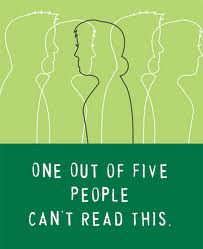
Consider the challenge of conquering these basic necessities when you cannot read:
- Reading a medicine label
- Reading a nutritional label on a food product
- Balancing a checkbook
- Filling out a job application
- Reading and responding to correspondence in the workplace
- Filling out a home loan application
- Reading a bank statement
- Comparing the cost of two items to work out which one offers the best value
- Working out the correct change at a supermarket.
According to an April, 2012 report by the World Literacy Foundation:
"Illiterate people earn 30 to 42 percent less than their literate counterparts and do not have the literacy skills required to undertake further vocational education or training to improve their earning capacity.
"One study shows the income of a person with poor literacy stays about the same throughout their working life. However, individuals with good literacy and numeracy skills can expect their incomes to increase at least two to three times what they were earning at the beginning of their careers."Most of my sister's students arrive with a basic understanding of English, but need a General Equivalency Diploma, or its equivalent, to get a job or be promoted at work, she said.
(Sure, it's no high tech fighter plane, but these days, every little billion helps.)
Ironically, according to my sister, in many ways it's easier to teach someone who is literate in another language how to read, write and speak English than it is to teach those who already speak English.
That's because those literate in other languages already know the benefits, and how a written language works generally. To them, it's not a change in thinking or philosophy, it's just vocabulary and a new set of rules.

Most of the native English speakers my sister gets in her classroom read at about a fifth grade level but "they don't have the habit of reading," she explained.
"They don't go to the library, they don't buy books, they don't read magazines," she said.
They say nothing succeeds like success and, apparently, this is true of literacy as well.
As it turns out, the more you read, not only do you get better at it (duh), it also means you can read less.
Whaaaaaa?
The example she gave me -- of course a newspaper example -- made it clear to me. (Good teachers know their audience!)
"When Osama bin Laden was killed, The New York Post had a headline that just said 'Got Him!' Now, if you read a lot, you know the context of that and it makes sense to you. You don't have to read the story. Well the same is true for general reading, the more you read, the more you know, the less you have to read," she said.
"And the reverse is also true," she explained. "When you don't real a lot, and you know less, you have to work harder to understand what's going on."
"Let's face it, it's boring when you don't know what something means."
 |
"Let's face it, it's boring when you don't know
what something means."
|
Add it to the list of challenges.
"Poor families often place work before education and the children of parents who have failed to complete primary education tend to do the same," The World Literacy Foundation reported.
"When parents are not involved in their children’s education, young students are more likely to display behavioral problems, get poor school results, have a high absentee rate, repeat school years or drop out of school," the foundation report said.
 "When illiterate adults improve their literacy skills, this has a flow-on effect to their children. With these new skills they can help a child with homework, read notes and correspondence sent home from school, understand the school system their children engage in, and guide and encourage them."
Considering these challenges, its its not hard for my sister to recall those who did not complete the program, but there are successes too.
"One of my students was named Johan and came from Mexico," my sister said. "Now he works for a Congressman."
There's no question literacy improves the quality of the lives who master it.
Here are a few factoids:
- Based on an analysis of the 2003 National Assessment of Adult Literacy (NAAL) data, literacy has an important impact on employment, poverty, weekly wages, welfare dependence, health status and crime.

- The cumulative cost to the U.S. economy of poor health literacy alone is estimated at between $106 billion to $236 billion per year based on a study from the University of Connecticut.
- A World Literacy Foundation report issued in April found that more than 796 million people in the world cannot read and write.
- The effects of illiteracy are very similar in developing and developed countries. This includes illiterate people trapped in a cycle of poverty with limited opportunities for employment or income generation and higher chances of poor health, turning to crime and dependence on social welfare or charity, according to the World Literacy Foundation.
- In various countries around the world, studies show that a majority of prison inmates have poor literacy skills. Also, among juvenile delinquents, up to 85 percent are functionally illiterate.

- In various nations, estimates show that 60 to 80 percent of prisoners have reading and writing skills below basic levels. Those who are still illiterate upon release have a high probability of re-offending. This is a high cost to the economy in terms of maintaining prisons, administrating the courts and running the justice system.
- There is national evidence that improved literacy could reduce re-incarceration rates by 10 percent.
- Illiterate people are more likely to be on welfare or unemployment benefits having dropped out of school or being unable to find work. High school dropouts are more than three times likely to receive welfare than high school graduates.
And there are other similarities.
Like the YWCA Adult Literacy Program in Pottstown, my sister's program in New York labors under the constant threat of budget cuts.
"We're always looking for grants and they have very specific goals that have to be met in order to get the money," said my sister, repeating almost word for word what Jae Hively, the director of Pottstown's YWCA Adult Literacy Program told me.
So for now, let's say we agree that making adults literate not only helps them, it helps all of us. Fewer prisoners and Welfare recipients sapping tax-funded entitlements and more empowered citizens pulling themselves up by their own bootstraps.
Let's also agree, the evidence suggests that investing in literacy education pays real benefits for all of us.
I have no illusions that this blog post will inspire you to support literacy in New York City, but certainly you can sign your name to the petition posted above and help give your neighbors a leg up.
If you'd like a quick brush up on the program here in Pottstown, watch the video I put together and posted below, or click the link in the caption to read the story.
The above video was made for my story on the YWCA TriCounty's Adult Literacy program published Nov. 12 in The Mercury. I did not get a chance to put it together until Tuesday, so I figured I'd post it here so it would get a few more eyeballs.


