Saturday, June 1, 2013

A Watery Saturday in Science


After the air we breathe, water is probably the most essential element to human existence and to life on earth.

(Fear not oh Saturday Scientists, we say "element" in the ancient, "fire, air, water, earth" sense. We know water is actually two elements, but even scientists can have a passing knowledge of history and mankind's mistakes.)

Speaking of mistakes, let's talk about our water, which we aren't treating very well these days.

Although ownership of water has spurred more than a few conflicts in dry places, and will again soon, we say "our" water only in the sense that without it, there won't be much of a "we" around to lament its loss.

Less Water, More Problems


Of particular interest to our species is fresh water, which comprises only about 3 percent of all water on earth.

And only about 1.3 percent of it is easily accessible on the surface in lakes and rivers.
The Ogallala Aquifer

About 30 percent of the planet's fresh water is underground, but not to worry, we're messing that up too.

Consider, the Ogallala Aquifer, a vast but shallow groundwater deposit that stretches from South Dakota to Texas and supplies about 30 percent of all irrigation water in the United States.

In 2009, the U.S. Geological Survey reported that the Ogallala Aquifer in the eight-state area of the Great Plains contained 2.9 billion acre-feet of water.


Formed by melting glaciers, we are consuming it for water hungry crops at a faster rate than the high plains intermittent rains could ever hope to replenish it.

Remember the Dust Bowl? You will when it returns.
As Mort Rosenblum wrote in "America's Profligate Ways with Water" for The New York Times on May 24, the Ogallala: 
... could run dry within a generation if not poisoned earlier by an oil pipeline spill.
Elsewhere, commercial farmers buy costly new pumps and work them hard to amortize them before it’s too late. Industry gulps down all it can; city dwellers water lawns with little thought for tomorrow. And now the fracking that so many people embrace consumes and contaminates huge amounts of water.
Farmers, particularly Agri-Business farmers who see water and farmland as a resource to be plundered, not sustained, are among the most guilty.

Irrigation consumes 60 percent of the world's freshwater.

As much as 50 percent of water pumped for irrigation is lost to evaporation, evapotranspiration and leaks.

"When oil prices rose, speculators bought huge tracts to grow corn for biofuel. Corn takes three times more water than sorghum but fetches a higher price. Pivotal irrigator hoses project streams that allow farmers to squander hundreds, or thousands, of gallons per minute," wrote Rosenblum.

He added: "Back in 1985, Boutros Boutros Ghali, then Egypt’s foreign minister, remarked, 'The next war in the Middle East will be fought over water, not politics.'"

A 'Protein Factory' That's No Longer Working


In some ways, that war has already begun -- at least on the other life forms which also depend on fresh water.

The Irriwaddy dolphin is related to Orcas.
Consider the case of the Irriwaddy dolphin.

Native to the Mekong and several other rivers in Asia, it lives in brackish water where fresh water and salt water meet.

And, as a species, it is dying, a metaphor for it's entire namesake river, which is also dying, particularly in terms of its harvest.
As Jeff Opperman, a freshwater scientist with The Nature Conservancy, reported in The New York Times on May 23, the fish on which the dolphin, and the humans along the Mekong's shores, depend are dwindling, both in number and size.
Because so many people are taking so much fish from so many places by so many methods, this assertion is hard to prove scientifically, although Opperman said he heard it all along the river as he traveled its course.

"2.1 million tons of fish is the most solid and accepted estimate," for what the river, or the "protein factory" as he calls it, produces.

By best estimates, harvest from just one location, Tonle Sap, had almost doubled from 1940 to 1995, while the number of people fishing has quadrupled during that period, cutting the catch per-fisher in half, Opperman wrote.

Pretty simple math.
Overfishing? What's that?

Fixed resource, more withdrawal, equals lower output, or shortage. 

But hell, we're already doing it in the oceans, which should we behave any differently inland?

The Census of Marine Life, a decade-long international survey of ocean life completed in 2010, estimated that 90 percent of the big fish had disappeared from the world's oceans, victims primarily of overfishing, CNN reported in March.

Bottom-trawling destroys reefs, which in turn destroys
the places where the fish we ear are born. Brilliant.
The situation is even worse in Southeast Asia. In Indonesia, people are now fishing for juvenile fish and protein that they can grind into fishmeal and use as feed for coastal prawn farms. "It's heading towards an end game," laments Callum Roberts, a marine biologist with York University in the United Kingdom.

Much of the over-fishing is the result of bottom trawling, which not only picks up huge numbers of fish, but destroys the coral beds which serve as nurseries for untold species we hope to later eat -- a self-defeating strategy if ever there was one.

"The disturbing truth is that humans are having unrecognized impacts on every part of the ocean, and there is much we have not seen that will disappear before we ever get a chance," Ron O'Dor, a senior scientist with the Census of Marine Life who is also a professor of marine biology at Dalhousie University in Halifax, Canada, told CNN.

Poisoning Our Own Food Supply


Not content to make rivers and oceans barren of fish, we are also ensuring those that are still with us, live in a continually more poisoned environment, making their survival, and ours, even more challenging.

Forget the threat of terrorists poisoning our water supplies or food supplies, society is on track to take care of it in just a few years without their help.

(One must wonder why our government spends billions to create security agencies to protect the nation's food and water supply from terrorists and, with the other hand, permits and aids corporations in activities which have the same result -- and throws in a tax break just for good measure. But that's a subject for another blog post.)
"Globally, the most prevalent water quality problem is eutrophication, a result of high-nutrient loads (mainly phosphorus and nitrogen), which substantially impairs beneficial uses of water," reports UNESCO, the United Nations Educational, Scientific and Cultural Organization.

"Projected food production needs and increasing wastewater effluents associated with an increasing population over the next three decades suggest a 10 percent to 15 percent increase in the river input of nitrogen loads into coastal ecosystems."

(Need you be reminded that coastal ecosystems are where 80 to 90 percent of all ocean fish breed? You'll recall those as a primary food source for a species close to our heart -- humans.)

UNESCO again:
Sewage treatment? What's that? Does it cost money?
More than 80% of sewage in developing countries is discharged untreated, polluting rivers, lakes and coastal areas. 
Many industries – some of them known to be heavily polluting (such as leather and chemicals) – are moving from high-income countries to emerging market economies.
You'll know those "developing countries" as the places that are taking our jobs because there, well, companies don't have to deal with all those pesky living wage, safety and environmental regulations.

Water Has a Sense of Irony

Fortunately, there's humor to be found in this situation.

You see, while we poison the water we can see and threaten our own existence, our other activities are ensuring we'll have more freshwater than we know what to do with.

Remember those percentages up top?

Well nearly 70 percent of the planet's freshwater is locked up in snow, ice, glaciers and the polar ice caps.
"We're out of here!" Sincerely, The Russians.

You can see where this is going already can't you clever reader?

Yup, believe in humans causing climate change or not, one fact is irrefutable.

The ice caps are melting.

Even the Russians believe it.

As The Washington Post reported on May 24, the Russians are packing up a scientific monitoring station on a floating slap of ice that was supposed to stay until September because .... wait for it .... it's melting too fast to be safe.

This quote from a March 26 Post report pretty much says it all:
After plunging to its lowest level on record in September, Arctic sea ice extent mounted an impressive recovery this winter. But its maximum, reached March 15, still ranked 6th lowest on record. All ten of the lowest maximums on record (since 1979) have occurred in the last 10 years. (Underlining emphasis courtesy of The Digital Notebook).
In case that hasn't convinced you. Consider this from the same report:
Between 2003 and 2012 alone, Arctic sea ice volume dropped 9 percent in the winter according to the United Kingdom’s Natural Environment Research Council.
The summer shrinkage in volume has been even more stunning.
“Findings based on observations from a European Space Agency satellite, published online in Geophysical Research Letters, show that the Arctic has lost more than a third of summer sea-ice volume since a decade ago, when a U.S. satellite collected similar data,” reported the University of Washington in February.

That means more fresh water.

That's good, right?

Well, consider: Not only will the freshwater act as a pollutant, diluting the salinity
Melting ice caps is a good thing right?
Well, unless you lived in this city.
of the oceans, further stressing those already over-stressed marine species, but well, more water means less land ... along the shore .... where more than 50 percent of Americans live.

So, not so much.

So practices which ruin fresh water, and threaten our survival as a species, are actually causing the release of fresh water which will threaten our survival as a species.

You have to appreciate the cyclical nature of it ... kind of like the water cycle.

And, if history is any teacher, we will respond as we always do.

We will not change our ways, and try to reverse this self-destructive course. Instead, we will fight each other over what scarce water remains.

Boutros Boutros Ghali was right, but his vision was too limited.

The war will not be limited to the Middle East.

Blogger Evan Brandt knows a thing or two about water having several years ago written an award-winning five-day series about water for The Mercury called "Ebb and Flow."

(Sadly, the technical promise of the past not being terribly well kept at The Mercury, a link to that masterpiece is not available.)


Friday, May 31, 2013

Just Fluttering By


Blogger's Note: The following is a press release sent by the Visiting Nursing Association.

On Sunday, June 2, 2013 Visiting Nurses Association of Pottstown & Vicinity (Pottstown VNA) will hold its Annual “Hope Takes Flight” butterfly release at 1 p.m. at Midge’s Garden at the Pottstown VNA office at 1963 E. High Street, Pottstown.

“It’s a beautiful event that brings together the members of our community to honor or remember loved ones, or commemorate special events in their lives,” said Kristi Brant, director of development and marketing, Pottstown VNA and its parent company, Home Health Care Management, Inc

The celebration of life ceremony includes music, reflective readings, and the reading of names of individuals in whose honor or memory butterflies have been dedicated. Individuals who have dedicated butterflies are then able to release them privately or as part of a larger group.

Children’s activities are also provided. The event will take place rain or shine.

For more information, please call 610-327-5700 ext. 3234 or email development@hhcminc.org.

Since 1917, the Visiting Nurse Association of Pottstown and Vicinity (Pottstown VNA) has provided the most comprehensive home health care services available in the area. Regardless of ability to pay, its nurses help individuals achieve a level of physical independence and emotional well-being in their home of choice. With a legacy built on compassion and caring, VNAP still continues to offer round-the-clock support to patients and their families after nearly a century.

Pottstown VNA's primary programs include Home Health Care including skilled nursing, therapy, Wound, Ostomy and Continence Care, IV therapies, and Hospice. Additionally, it takes care of bothersome details like insurance authorizations, service coordination and supply deliveries. For more information, please visit www.vnapottstown.org or call 855.THE.VNAs.

Thursday, May 30, 2013

Pick-Up or Shut-Up


You are being asked to volunteer to keep your neighborhood beautiful! 

The Borough of Pottstown will be holding a clean-up event on Saturday, June 1st from 8 a.m. to noon. 

Gathering points will be Borough Hall, 100 E. High St., and Empire Hook and Ladder, 76 N. Franklin St.

Whether you are an individual or an organization, you are welcome to participate. 

Donations of work gloves, trash bags, etc., are being accepted at the Codes Department, located on the second floor of Borough Hall. 

For more information, contact Bill Sharon at 610-310-0070 or bsharon@pottstown.org, or Mark Gibson at 610-960-9445 or mgibson@pottstown.org.

Wednesday, May 29, 2013

Prison Expansion Protested in Pottstown

Prison expansion protesters marching from Philadelphia to Harrisburg staged a rally outside the Pottstown Regional Public Library Monday.


Blogger's Note: We received the following press release from Decarcerate PA:

Two dozen marchers making their way from Philadelphia to Harrisburg rallied at the Pottstown Regional Public Library Monday afternoon to demand an end to prison expansion and education cuts. 

The march is being organized by Decarcerate PA, a grassroots coalition, and is co-sponsored by a broad alliance of community groups, nonprofits, labor organizations, education advocates, and formerly incarcerated organizers. 

The “March for a People’s Budget: Stop Prison Expansion Now!” began on May 25th and is scheduled to arrive in the state capital on June 3rd—just as the legislature returns to debate the budget. 

The marchers are demanding that the General Assembly take a stand against Pennsylvania’s out-of-control prison growth. In particular, they are asking legislators not to grant the Department of Corrections its requested $68 million increase in funding while prison construction continues, and to cancel the $400 million prisons slated to be built on the grounds of SCI Graterford in Montgomery County.

Marchers arrived in Pottstown dressed as construction workers, holding “stop signs” reading “STOP Prison Expansion” while dancing and chanting, “Fund education, not incarceration!” 

The marchers are calling attention to the impact of recent budget cuts on Pottstown. “Pennsylvania does not want, does not need, and cannot afford any more prisons,” said Decarcerate PA member Brian Mertens. 

“We want to see our taxpayer dollars invested in the things that make our communities stronger, like education, health care and social services, not in building more prison cells.” 

The Pottstown School District has seen cuts of more than $1.5 million between 2010-2011 and the proposed budget for next year. Meanwhile, Governor Corbett’s budget for 2013-2014 includes a $68 million increase for the Department of Corrections, even as his administration claims the prison population is decreasing.

“We’ve written letters, circulated petitions, held protests, and even engaged in nonviolent acts of civil disobedience,” said Leana Cabral of Decarcerate PA, who was arrested in November for blocking a prison construction entrance with a school desk and an apple. 

“Governor Corbett and legislators like to talk about being prison reformers, but they don’t walk the walk. So we’re walking all the way to Harrisburg to make sure they know we won’t go away until Pennsylvania stops building prisons and starts reinvesting in our communities.”

Tuesday, May 28, 2013

Hey Bulldog(s)


Blogger's Note: Once again, John Armato opens a door into the positive things happening in Pottstown public schools.

State Senator John Rafferty, R-44th Dist., paid a visit to Franklin Elementary School recently to recognize the members of the Bulldogs Club and its sponsor Mr. Mike DiDonato. 

Rafferty did not come empty-handed – he brought a generous helping of pizzas which the students shared at a classroom lunchtime visit with the senator. During lunch, the students outlined for Rafferty their future career aspirations which included a spectrum of jobs from doctor and lawyer to professional athlete. 

“I am glad to see that you all have career goals at such a young age and recognize that there is a great deal of work and effort that goes into achieving goal. I am even more impressed that each and every one of you had a backup plan if your first career option does not work out,” Rafferty said.

Rafferty’s visit was more than just an opportunity to share pizza with the students. He brought with him a certificate of accomplishment from the Senate of Pennsylvania which was presented to Mr. DiDonato. 

 In part it read, “You are to be commended for creating the Bulldog Program. This noteworthy program provides the students with excellent mentor and leadership training along with the opportunity to use these skills as they mentor younger students. Senator Rafferty does hereby recognize you for your commitment and dedication to the students as they strive to make a positive impact on their school and community.”

In describing the efforts of the Bulldog Program, DiDonato said, “It is a difficult time for kids. There are many obstacles and pitfalls in today’s society. The Bulldog Program gives these students a chance to be part of something positive. It gives them a chance to grow as a person and to strive for a bright future. We are so grateful that the First Presbyterian Church in Pottstown has given us the opportunity through their sponsorship to provide the Bulldog Program. This is a shining example of how community partnerships can have a positive and direct impact on our students. Their generosity and support makes a difference in the Pottstown community.”

The Bulldog Program was established in 2008 at Barth Elementary School. It is a leadership program designed to help at-risk children make positive choices and have an impact on their school culture and climate. 

Students are chosen for their leadership potential and must apply at the beginning of each school year. A panel of teachers and administrators choose which students will take part. 

After their selection, the students are given mentor and leadership training by the school psychologist/counselor and their Bulldog advisor. Students then begin mentoring younger students in grades kindergarten through third. They work in the classrooms assisting teachers and working with students. 

Every Wednesday, there is a Bulldog Club meeting where their mentoring experiences and reflection on the past week’s behaviors occurs. 

At this meeting, each student shares at least one thing that they have done to help someone else during the week. Other aspects of the program include field trips to Pottstown Cross-Fit to develop anti-bullying programs and reward events including a field trip to see a Philadelphia Sixers’ basketball game.

Gail Levengood also provides etiquette training which is put to good use at an end of year luncheon sponsored by First Presbyterian Church.

This year’s club members include: Tyveir Alexander, Tashon Dupiche, Zion Gadsden, Carlos Jackson, Takheim Lowe, Jorge Mundo, Jonathan Oister, Matthew Walker, Josiah Wiggins, and Jacob Wise.

Monday, May 27, 2013

Local Philanthropy by Hill School Students

The Cluster will use its grant for its Getting Ahead Initiative, which is a poverty education program that runs throughout the year for members of the Pottstown community below the poverty line. The program focuses on helping these members come to terms with their poverty, and it uses educational and constructive seminars as means to aiding those in need down a better socioeconomic track.
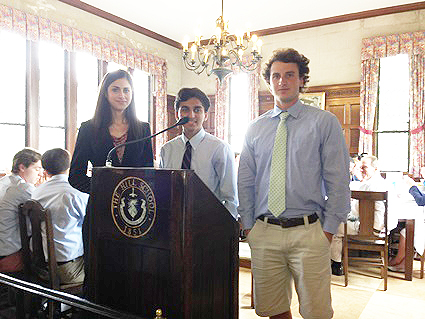
Led by co-presidents Nabil Shaikh '13 (Reading) and Auguste Boova '13 (Pottstown.), The Hill School’s Student Philanthropy Council (SPC) recently presented checks totaling $10,000 to four local nonprofit organizations to help fund those entities’ educational and community programs:

Pottstown Downtown Improvement District Authority ($2,110); The Growing Center ($2,690);
PDIDA will use is contribution for the Clean & Safe program,
which uses enhanced security methods and hired cleaners
as vehicles for downtown revitalization.
Montgomery Child Advocacy Project ($2,500); and the Pottstown Cluster of Religious Organizations ($2,700).

The SPC was established in 2009 through a gift to The Hill School courtesy of Charles A. Frank III, Hill ’59, and his wife, Betty.

Hill student participants solicit and evaluate local nonprofit requests for funding, and then award a total of $10,000 in grants each year. 

Last year, through the Franks' leadership and the generosity of several other donors, The Student Philanthropy Council became an endowed program at the School with the establishment of The Student Philanthropy Council Endowment in honor of Kay and David Dougherty.
The Montgomery Child Advocacy Project (MCAP) will fund the training of 10 lawyers for their initiative: providing legal advocacy for children of extremely unstable backgrounds in the Pottstown area. This non-profit grew out of a noticeable need for lawyers for children for whom parental advocacy is unstable and insubstantial.

The Growing Center plans to use their grant to provide materials for horticultural therapy for mental health patients. Horticultural therapy introduces patients to gardening activities, and is an incredibly potent means to psychological treatment. The Growing Center provides a secure hosting site to local horticultural therapy.


Sunday, May 26, 2013

That's a Real Beach of an Investment for Public Dollars

Remember this?
Why are we pouring tax money into re-building this?
As a species, and generally as a nation, we want what we want when we want it. 

Consequences be damned.

And so as another summer vacation season kicks off tomorrow and Chris Christie works overtime to convince we Philadelphia-area residents that the Jersey shore is open for  summer business, we continue to ignore the elephant in the room.

It would seem that we have learned little from Super-storm Sandy.

Sure, newspapers dutifully reported the folly of building on barrier islands as sea levels rise and budgets diminish.

Recalling them described as "high-speed real estate," this self-same blog joined the chorus of caution.

But despite the warnings, despite the science, despite the vague and empty promises of government officials who promised to "study" the issue, we tumble headlong once again into doing the same thing over and over -- providing for huge populations and public/private investment on unstable real estate -- and expecting a different result.

Let's face it, we like the beach.

And if the beach is popular with the public, using public money to fix it back up again so global warming can knock it back down again, is going to keep getting money from officials elected by that public.

After all, what is an election but a popularity contest?

But because the beleaguered staff here at the Digital Notebook's vast underground bunker revels in being an unheralded voice in the wilderness,
Oh yeah, re-building here makes PERFECT sense.
(and a summer season killjoy to boot) we'll take another swing using the latest developments since Sandy to suggest, however briefly, that "maybe we should try something different...."

In November, scientists writing in The New York Times issued the following warning:
As scientists who study sea level change and storm surge, we fear that Hurricane Sandy gave only a modest preview of the dangers to come, as we continue to power our global economy by burning fuels that pollute the air with heat-trapping gases.
This past summer, a disconcerting new scientific study by the climate scientist Michiel Schaeffer and colleagues — published in the journal Nature Climate Change — suggested that no matter how quickly we cut this pollution, we are unlikely to keep the seas from climbing less than five feet.
More than six million Americans live on land less than five feet above the local high tide.
Floods reaching five feet above the current high tide line will become increasingly common along the nation’s coastlines well before the seas climb by five feet. Over the last century, the nearly eight-inch rise of the world’s seas has already doubled the chance of “once in a century” floods for many seaside communities.

What to do?

I mean, what are the chances it could happen again right?
Actually, they're pretty good.
Well, actually, we did it, back in 1982 with a law liberals and conservatives agreed upon and Ronald Reagan
signed with a flourish.

"The law — the Coastal Barrier Resources Act — was intended to protect much of the American coastline, and it did so in a clever way that drew votes from the most conservative Republicans and the most liberal Democrats," The New York Times reported in April.

"The $75 billion in damages from Hurricane Sandy, coming only seven years after the $80 billion from Hurricane Katrina, told us this much: We need a plan.

"The climate is changing, the ocean is rising, more storms are coming, and millions of Americans are in harm’s way. The costs of making people whole after these storms are soaring," wrote Justin Gillis.

Gillis puts it better than I could hope to:
It should be obvious that the more people we move out of harm’s way in the reasonably near future, the better off we will ultimately be.
But we are doing the opposite, offering huge subsidies for coastal development. We proffer federally backed flood insurance at rates bearing no resemblance to the risks. Even more important, we go in after storms and write big checks so towns can put the roads, sewers and beach sand right back where they were.
We are, in other words, using the federal Treasury to shield people from the true risks that they are taking by building on the coasts. Coastal development has soared as a direct consequence, and this rush toward the sea is the biggest factor in the rising costs of storm bailouts.
Turns out one way to keep people from building on storm-prone
shorelines is to refuse to provide them with
federal flood insurance. Simple.
So what was so clever about that 1982 law, and how can we learn from it?
"The bill simply declared that on sensitive coastlines that were then undeveloped, any future development would have to occur without federal subsidies.

"In other words, no flood insurance and no fat checks after storms.

"The law did not prohibit anybody from building anything. And in fact, some development has occurred on lands in the redlined zone. But the law has mostly held, discouraging development along some 1.3 million acres of American coastline," Gillis wrote.

That sounds very American. Very independent. After all, we wouldn't want to be like those people who rely on "public assistance" would we? Oh the shame of it all. There are no Welfare Queens at the beach right?

Gillis suggests that we begin to "expand" those zones into the riskiest areas, the places that we keep pouring public money to re-build only to see it washed away with the latest truckload of sand?

Fat chance.

As ProPublica reported in March, the Federal Small Business Administration is approving loans for businesses that want to rebuild just as they were in areas that are just as flood-prone as they were before Sandy; in fact probably more so.
A WNYC and ProPublica analysis of federal data shows at least 10,500 home and business owners have been approved for $766 million in SBA disaster loans to rebuild in (the New York City metro) areas that the government now says could flood again in the next big storm.
The data, which shows loans approved through mid-February, was obtained via a Freedom of
Information Act request.
More loans could be going to flood-prone areas. The analysis did not cover Long Island or Connecticut.
The loans require borrowers to get flood insurance, which in turn could encourage some to rebuild properties to be more flood-resistant. However, for many owners there’s no requirement they raise their properties to the heights FEMA recommends.
The result: the federal government is helping people rebuild despite the risk that flooding will again destroy the properties.
The SBA says it’s not their job to assess whether it’s smart to build in flood-prone areas.
Don't you just love that "not-my-job-to-exercise-common-sense" mindset? It is not unique to government workers, but when it is exercised by government workers, it is usually we the people who pay the price.

Speaking of which, we're also paying to rebuild yacht clubs.

The biggest loan approved (in the New York Metro area) as of mid-February was a $1.5 million loan to the Fairfield Beach Club, a private beach and tennis club on the shore of the Long Island Sound in Connecticut.
The Fairfield Beach Club is getting the a $1.5 million
loan from SBA.

Great.

At least, argues Michele Byers in the May 21 edition of Philly.com, if we're going to pay to put these beaches back in place, we the public should have improved access to those beaches.

"It's time to make sure the taxpayers who foot the bill for beach improvements have access to those expensive strips of sand they're saving," she wrote.

Byers further reports:
"Public access must be a required part of all projects, before they can be considered for funding," said Tim Dillingham, executive director of the American Littoral Society, a coastal conservation group.
Dillingham added that federal guidelines for funding contain similar language to ensure that projects are public in nature, and not private.
The beaches, ocean, and tidal waterways belong to everyone. New Jersey should not miss this opportunity to make sure that all residents have meaningful access to the investments made with their tax dollars, and to catalyze the Shore's economic recovery.
So the public should have access to the Fairfield Beach Club right?

Yeah, good luck with that.

And good luck with tying public funding to good decisions about where houses and businesses should be re-built.

"Environmental groups like the National Wildlife Federation say the best flood protection are wetlands and to leave stretches of the coast undeveloped," wrote Robert Lewis and Al Shaw for ProPublica.

“Ideally we’re going to help people move away from the flood zone and not give them assistance to rebuild exactly as is,” said Joshua Saks, the federation’s legislative director. “But we recognize it’s a very personal decision, it’s a local decision.”

Umm, local decision? It's federal money. Your money. My money. Our money. 

Why is it that the government is inevitably the one entity you can count on to take on a risk that no commercial bank or insurance company would entertain for a New York minute?

Hell, they even admit it!

“It’s good government. I mean, basically it’s what the private sector won’t do,” James Rivera, associate administrator in the SBA’s Office of Disaster Assistance, told the reporters.
The Small Business Administration provides as much as $200,000 for damaged homes and $2 million for businesses. In rare cases, homeowners might qualify to have a portion of their mortgage refinanced with an SBA loan.
The loans carry low interest rates – as little as 1.7 percent for home loans and as low as 4 percent for business loans -- and can be repaid over 30 years.
13 houses at $200,000 could mean $2.6 million in loans.
As of mid-February, the SBA approved more than 21,500 disaster loans worth $1.5 billion for Sandy-related damage, according to a copy of the loan database WNYC and ProPublica obtained through a Freedom of Information Act request. The SBA estimates it could ultimately approve as much as $2.5 billion worth of Sandy-related disaster loans.
There is no data yet on how many property owners who received a loan will actually rebuild and, of those, how many will raise their properties to withstand a future flood.
Of the loans made in New York City, 83 percent went to a property in areas FEMA says are at risk of flooding, the data shows. In New Jersey 71 percent went to a proposed flood zone.
So that's a $2.5 billion investment in locations which, the best science now tells us, are likely to be hit with storms as bad or worse than Sandy within the next 15 years.

And that's "good government?"

I think this is one of those times we'd prefer to see government run more like a business, a business not likely to throw money into the ocean.

But wait, it gets better.

Ask yourself this: How would we even know which places we should avoid when investing that public money?

Why accurate flood maps of course; maps that show where rising sea level is going to wash away the property in which we're so foolishly investing.

At least we're doing that right right?

Right?

Mmmmm, again, not so much.

Once more, ProPublica rains on our summer parade:
At the same time the SBA was approving disaster loans, the Federal Emergency Management Agency was releasing new “advisory” flood zone maps.
See if you can guess where FEMA maps show
New Jersey flooding in the future?
Hint: It's greenish in color.
Approved maps ultimately determine flood insurance rates and help builders decide how high to make their properties. The existing maps that govern building along the coast are from 1983.
The new preliminary maps show FEMA thinks far more properties throughout the region are at risk of flooding. FEMA also says many of those properties already in flood zones should be raised even higher to avoid future damage.
FEMA rushed to release the maps to ensure property owners had the data as they start to rebuild, said Michael Byrne, FEMA’s coordinating officer for New York operations.
“It’s the best science we’ve got. We certainly hope people will take it seriously,” Byrne said.
But the maps won’t become final for as long as three years. And it’s up to local governments to decide if they want to require higher elevations before then.
Would those be the same local governments elected by the people who built houses along the beach in the first place?

Right.

But not to worry, these are loans, so at least the government makes money back on that investment like a bank ... right?

Kind of.

ProPublica reports:
The default rate on disaster home loans is about 10 percent, and it’s about 20 percent for some business loans, according to the SBA. The administration estimates that it costs taxpayers 11 cents for every $1 of disaster loans.
“These loans do not come without risk to taxpayers,” said Pete Sepp, executive vice president for the National Taxpayers Union. “We need to have a policy that carefully considers whether rebuilding in flood prone areas makes sense and whether such building ought to be encouraged by government or at least abetted by government through the use of aid and loans.”
Not to worry, the federal government is on the job, feverishly issuing new, more accurate maps so that "carefully considered policy Mr. Sepp mentions can be based on hard facts.

Wait.

Did I say the federal government?

Uh oh.

As ProPublica reported Friday, maybe not so much:
Underfunding by Congress and President Obama will delay
the completion of the new, more accurate flood maps.
The maps, drawn by the Federal Emergency Management Agency, dictate the monthly premiums millions of American households pay for flood insurance. They are also designed to give homeowners and buyers the latest understanding of how likely their communities are to flood.

The government’s response to the rising need for accurate maps? It’s slashed funding for them. (Emphasis mine.)

Congress has cut funding for updating flood maps by more than half since 2010, from $221 million down to $100 million this year. And the president’s latest budget request would slash funding for mapping even further to $84 million — a drop of 62 percent over the last four years.
In a little-noticed written response to questions from a congressional hearing, FEMA estimated the cuts would delay its map program by three to five years. The program “will continue to make progress, but more homeowners will rely on flood hazard maps that are not current,” FEMA wrote.
The cuts have slowed efforts to update flood maps across the country.
Although today’s mapmakers can take advantage of technologies including lidar, or laser radar, and ADCIRC, a computer program that’s used to model hurricane storm surge; and although they can also incorporate more years of flooding data into their models, it may be years before we, the taxpayers who pay for them, can benefit.

Splendid.

Yet somehow we can afford to rebuild the boardwalk in Atlantic City.

And now, to complete the circle... again, ProPublica:
FEMA also funds its maps through the National Flood Insurance Program. It takes a small slice of homeowners’ flood insurance premiums, about $150 million in the 2013 fiscal year. But the flood insurance program is also in trouble, and income from the premiums is already stretched thin. The program has more than $20 billion in debt after paying out massive claims after Katrina and Sandy, and it took in only $3.6 billion in premiums last year.
Hope we're all ready for this....
As part of an overhaul to the insurance program last year, Congress authorized the government to spend $400 million a year for the next five years to update flood maps. But for the 2013 fiscal year, Congress has appropriated just a quarter of that. Sequestration has cut another $5 million, according to the Office of Management and Budget, leaving $95 million for flood mapping this year.
As one Toms River, N.J. told ProPublica reporter Theodoric Meyer, “There’s going to be another hurricane somewhere, there’s going to be another disaster,” he said. “If you’re cutting the flood mapping program, somebody’s going to get screwed.”

Yeah, and it's us taxpayers.

And if you've suffered all the way to the end of this long blog post; and you're thinking you could have read those last three sentences and learned everything you need to know about how we're responding to the very real and expensive threats the rise in sea level is washing in to us -- you'd be right.

And if you thought that response could be summed up in one word -- "stupidity" -- you'd be right too.