Showing posts with label journalism. Show all posts

Sunday, February 3, 2013

365, 12, 7, 24

Well Friday marked another milestone in the life of this Digital Notebook blog of mine.

That was the day that marked a full year of daily posts.

It was on Feb. 1 of 2012 that I began my experiment of seeing if I could post something every day.

The experiment has proven its possible and, often enough, exhausting.

"Why would I do such a thing?" you ask.

Stupidity?

Stubbornness?

Curiosity?

Yes.

To be honest, the real reason was fear.

Like a lot of guys, I don't like facing uncertainty sitting on my hands. I like to try to do something to address it, face it, possibly affect it.

And, as many of you likely know, the company that owns The Mercury is in bankruptcy for the second time in the 15 years I've been here.

Now this particular bankruptcy has more to do with shedding debt and selling ourselves to a newly created "stalking horse" subsidiary, than crash and burn financial distress -- but still....

Newspapers around the nation are closing, reducing days of publication or trying to go the full digital route.

Anyone who has been paying attention knows that journalism is going through a major transformation. The key question is: "Into what?"

Easier to answer is the cause -- as it always has, it's technology that is bringing about this change.

It was the printing press (combined with an burgeoning education system) which transformed reading from a magical skill understood by a few learned monks and aristocrats to the next big thing in mass communication since the town crier.

It was a reliable postal service which made it possible for the founding fathers to keep the public informed enough about what was going on elsewhere in the Republic to establish the geographically largest successful democracy the world has ever seen.

(Newspapers from one city were shipped to another, where they were gleefully cut up and the news stolen for re-publication in the new location.)

Cheap newsprint and even better public education made penny newspapers ubiquitous in major cities and then radio made news and communication instantaneous.

Television provided the instant images and the TV news anchor was born.

But throughout all of it, the people who controlled the technology controlled the information.

Not just anyone could buy a printing press, a radio station, or television network.

Throughout it all, there were professionals who decided what was important enough to tell people and, in an information market, what they wanted to know.

What this latest wave of technology has changed fundamentally, I've come to understand, is that anyone can use it. No longer are the decisions about what and when information will be provided in the hands of a few, trained professionals, often called "the gate keepers" in Journalism 101.

Anyone can start a blog, for example, and many, many, many have.

In the information marketplace, those with the best blog, best tweets, best Instragram, Tumblr or Pintrest pages get the most readers.

This is neither good nor bad, it just is.

Well, to be more precise, it is both good and bad.

On the good side, Pottstown does not have just three reporters anyone; it potentially has thousands albeit part-time.

This means when a storm hits, we can get information from people all over the place; what's flooded, what roads are closed, where the is power out. That makes for better instant information.

It also means that stories we may once have ignored can be presented by readers, or at least that readers can advocate for their publication. In other words, it makes it easier to "give the people what they want."

On the bad side, few of these people have any kind of professional experience.

They are free to post anything they please; rumors, calumny and even outright lies, and they may well have agendas and motivations for what they are doing which are more than just a desire to inform the public.

Worse still, they can do it anonymously. Unlike professionals, they often are not accountable for what they write or broadcast.

Also, because these new digital newsies rarely make money doing it, or enough that they can do it full-time, what they produce is often a sideline and rarely sustainable over the long-haul.

A lack of consistency works primarily to the benefit of those in authority. They can just wait out someone nipping electronically at their heels in the reasonable belief that soon enough, they will just go away.

(Joe Zlomek's Sanatoga Post is the admirable exception to these observations and I continue watch with interest how his model is growing and succeeding.)

Now I've used the word "professional" a couple times here and I should note that like any industry, journalism needed a shake up.

For many journalists, the idea that you are pursuing and presenting the truth as best you can discern became a belief that because they say it or write it, it's automatically the truth.

Add on the awards that journalists like to pat themselves on the back with (hey, if we can't get rich at least we can pin medals on our chests) and you have a recipe for eventual upset. Any market hates complacency and we were long overdue for our wake-up call.

Having a lot of upstarts scoop you, come up with business models that make yours look like a steam engine and surf the fast-changing wave of technological changes with such skill that you look like the 98-pound weakling standing on the shore, will do one of two things.

If its all too much, it may make you give up and start eyeing your pension (if you're lucky enough to still have one.)

I've seen some of the journalists I know simply dig in their heels and refuse to recognize that change is not only coming, it's already here and it's kicking their ass.

It's enough to make me want to pull out what's left of my graying hair.

Or, these shake ups may motivate you to remind people that despite all the bells, whistles, touch screens, pop-ups, apps and tweets, you still bring a bedrock value to the game -- credibility.

I've always thought the key to adapting to change is recognizing what new things bring value to what you do, without losing sight of the values and practices you can't afford to give up.

Now, it's understood that "credibility" can seem a bit flimsy when journalism has been undermined in recent years by the need to compete and make money.

I could never figure out why this stunt did not get
Geraldo fired. Then I remembered, it's Fox News
.
It's lead to everything from TV spots about how great the news NBC season will be or, what I like to think of as the beginning of the fall -- Geraldo Rivera revealing the empty contents of "Al Capone's Vault."

The blending of entertainment and news has made it ever more difficult to draw the line between news, opinion and fluff.

This is, of course, one of the dangers of letting the market decide everything.

It has given us hour after agonizing hour of "reality TV," as if you've ever seen anyone act completely normal while facing a television camera.

Seriously? I mean seriously?
Let's face it folks, "Honey Boo Boo" would not be on TV if no one watched it.

All of which is enough to put a little fear of irrelevance into the heart of anyone who believes that it actually serves democracy to have an independent entity that questions authority, exposes stupidity, corruption and waste and is able to present it with enough credibility that the people believe it, and act to correct it.

A little fear can be a good motivator.

Which brings us back to this Digital Notebook blog of mine.

Given that a newspaper only has as much space as the advertising pays for, I thought I might try this digital experiment of my own.

This is not the kind of "bell and whistle"
I meant folks.
It started by creating a place that, just like the newspaper, is new every day, where all the news that doesn't make it into the paper can be posted for people to see, or not.

It has also provided, as regular readers know, a place for me to spout off column-style from time to time.

So what insights has this experiment revealed.

Well, to a certain extent, it has primarily reinforced things I already knew.

That in local news, people like news about themselves.

Parents like to see their kids triumphs proclaimed, teachers like to see their work appreciated and people like to see those in authority held to account and, more than a little occasionally, ridiculed.

This is, of course, nothing new to someone who has been in local news for 25 years now.

"People like news, always have," was the sage observation boss lady Nancy March shared with me, with a smile, when I told her I was contemplating this post.

As to the daily pace, that was a little harrowing. Good thing I have been working at a daily newspaper for 15 of those years.

Nancy has another saying you get used to hearing during a typical newsroom morning, as we look over the paper, admire our handiwork and pat ourselves on the back for our cleverness, thoroughness or enterprise.

"Yeah, that was a good story," she'll say brusquely, followed by the inevitable: "What have you got daily?"

And so it was with this blog, planning how to get through weekends and, especially vacations.

Also, one advantage of this technology is that rather than rely on received wisdom, you can actually count which posts get the most interest.

The tireless John Armato
And so I saw the self-evident evidence that when John Armato sent me a press release with photos (I could never have made 365 consecutive posts without his steady stream of good news about Pottstown Schools) and I dutifully posted it.

He would then dutifully send out a link to all district employees, which translated into lots of hits.

Another hit generator is a daily e-mail that comes from Lawrence Feinberg, from the Keystone State Education Coalition. It contains education news from all around the Commonwealth and, when I had a post about education issues, I would send him a link.

Lawrence Feinberg
If he thought it worth sharing, he would and, again, my "hits" would go up.

All of this, of course, is the basic lesson of distribution. You can have the nicest or the cleverest blog in the world, but if no one sees it, what's the point?

It's the newspaper equivalent of giving a party to which nobody comes.

Finally, those posts which seemed to draw the most attention whose source was not obviously from someone with a wide distribution list sharing the link, were those not much different in subject from what I regularly write about in the newspaper.

This blog gizmo shows the most popular posts right on the page you're reading this (presuming you've gotten this far) and you'll see the three most popular posts come from distribution lists.

But the four and fifth place finishers are about Pottstown Borough considering new core values and a new mission statement; and a photo and ruminations on downtown facades.

These are not exactly the kind of subjects that would have a tabloid headline writer drooling. But they are, apparently, the kind of things people want to know about their community and what their leaders are doing.

All of which is to say that I spent a year in this dogged experiment and found out a whole of things I already knew:

1) People like local news about their community, and they like when it comes from a trustworthy someone who doesn't have something to gain by its distribution.

2) A good distribution network is as necessary for building audience for an electronic news vehicle you read on a screen as is is for a one you hold in your hand.

3)  And maybe we don't have that much to fear after all. We just need to be smart, and pay attention to how each new different vehicle works, what advantages it presents, and which paths it may take us down.

4) And finally, we need to figure out how to continue to provide this often-unappreciated function so vital to democracy in such a way that someone can make a living doing it.

And so, 365 posts later, on-line 12 months a year, seven days a week, 24 hours a day, and having garnered several hundred hits shy of 75,000 hits, we bring the experiment to a close.

This does not mean the blog will end folks, merely that I am not so sure that I will continue my daily posting.

I have made no decision about it one way or the other, just wanted to state that having run the course of my experiment, I am releasing myself from the pledge to do so.

Who knows? Maybe that will turn into an experiment as well.

It's not like any of this is planned or anything.


Saturday, December 29, 2012

Battle of the Amendments

This interactive map, complied and published by the
Journal-News in White Plains, NY, shows the
names and addresses of gun permit owners and
has ignited a firestorm of debate.
Prepare to be amazed.

A newspaper did something with which I disagree.

(OK, that's not so amazing, but I was trying to catch your attention. Did it work?)

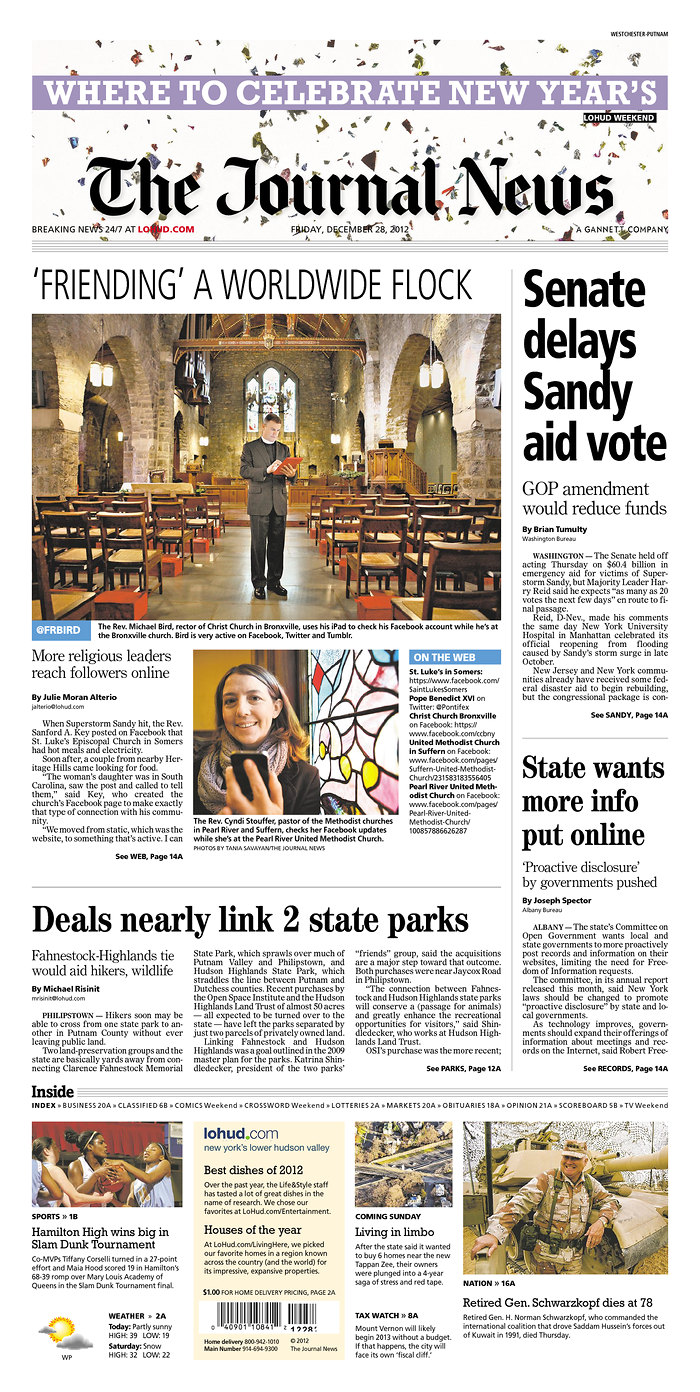
Recently the Gannett newspaper in my old stomping grounds of Westchester County, N.Y. did something in reaction to the shootings in Newtown that garnered national attention.

The Journal News, which was once a dozen different independent newspapers now blended into one homogeneous whole under the Gannett rubric, published an interactive map with the names and addresses of handgun permit owners in Westchester and neighboring Rockland and Putnam counties.

The information was publicly available and they were perfectly within their legal rights to do this.

But as I've said to many people over the years, "legal" and "right" are not synonyms.
The Dec. 28th front page of the Journal-News

Primarily, although I admire the reporting skills necessary to accomplish this feat, I think this was just stupid.

The second half of having a right is to exercise it responsibly.

The right to Freedom of Speech does not give you carte blanche to shout "fire" in a crowded movie house, as the old saw goes.

The right to Bear Arms does not give you carte blanche to shoot anyone or anything you feel like.

And the right to a Freedom of the Press does not give you carte blanche to encourage crime.

One of the old saws exercised by those who support Second Amendment rights is that criminals use guns in ways that law-abiding gun owners do not and further gun control laws only further restricts the rights of those who have done nothing wrong.

While I do not consider this to be the black and white argument the NRA does, it is true that criminals steal guns and use them to commit crimes. Publishing an on-line map to where all the guns that can be stolen are located does not seem like a responsible use of the Freedom of the Press.

Now I realize the publication of this map did not happen without serious thought.

“Frequently, the work of journalists is not popular," Journal News Publisher Janet Hasson wrote in a statement published by the Washington Post.

"One of our roles is to report publicly available information on timely issues, even when unpopular. We knew publication of the database (as well as the accompanying article providing context) would be controversial, but we felt sharing information about gun permits in our area was important in the aftermath of the Newtown shootings,” Hasson wrote.

Reaction on the publication was immediate and virulent.
It was not long before Hasson's name and address, along with reporters and editors, including the person responsible for the puzzle and the comics, were published on conservative web sites, according to the Post article.

Bloggers even published descriptions of the yards, the contents of the homes, and the apparently likelihood of the homes being empty.

This is of course no more proper, but does seem to demonstrate the aspect of the map's publication which so angered gun owners.

Understandably so.
An NRA campaign advertisement


I am not disputing the newspaper's right to do what it did, just the judgement of those who decided to do it.

The debate about guns in this country is super-heated. And for years it has been stalled, with the NRA holding the upper hand and generating support with tales of the government's plans to take people's guns.

Against the odds, the shootings in Newtown appear to have broken that log-jam and now the pent up righteousness on both sides of the issue seem to be spilling over into the general conversation.

It is a long-overdue discussion, but, as this example demonstrates, not one that is likely to be held civilly.

Consider the example of David Gregory.

As The New York Times reported Wednesday: "The Metropolitan Police Department said on Wednesday that it had opened an investigation into whether NBC and David Gregory, the host of “Meet the Press,” broke the law when Mr. Gregory displayed a high-capacity gun magazine during an interview on Sunday with the vice president of the National Rifle Association."
David Gregory holding an illegal ammunition
magazine on "Meet the Press."
"NBC had asked the police for permission to use a high-capacity magazine and 'was informed that possession of a high-capacity magazine is not permissible, and their request was denied,' said Officer Araz Alali, a police spokesman."
According to a federal law enforcement official, an NBC employee contacted the Bureau of Alcohol, Tobacco, Firearms and Explosives on Friday to ask whether it would be legal for Mr. Gregory to show the magazine on television without the ammunition.
The bureau, which does not enforce Washington’s gun laws, said it would be legal. That information, however, was incorrect, as it is illegal to have any empty magazine in Washington, the official said.
NRA Vice-President Wayne LaPierre on "Meet the Press."
Mr. Gregory displayed the magazine, which rapidly feeds ammunition into the chamber of a gun, about 10 minutes into his interview with Wayne LaPierre, the N.R.A. vice president. The host picked it up from the table in front of him and held it in the air as he questioned Mr. LaPierre.
“Let’s widen the argument out a little bit,” Mr. Gregory said. “So here is a magazine for ammunition that carries 30 bullets. Now isn’t it possible that if we got rid of these, if we replaced them and said, ‘Well, you could only have a magazine that carries 5 bullets or 10 bullets,’ isn’t it just possible that we can reduce the carnage in a situation like Newtown?”
Mr. LaPierre said he did not believe it would have made a difference. “There are so many different ways to evade that, even if you had that,” he said.
This episode illustrates the pitfalls of this discussion. Obviously, David Gregory had the magazine for purposes of illustration, but the nation's patchwork of gun laws has many variables and the Washington, D.C. at play here apparently does not take intent into account.

Which is an argument the gun lobby could make, that banning a type of gun or ammunition does not take into account someone's intent to use it harmlessly.

It's a bizarre example to be sure, but it is on-point.

This patchwork of laws within which this issue is debated is largely due to the fact that the NRA has successfully prevented any kind of comprehensive national legislation on this issue, leaving it to be debated and legislated in statehouses and city halls; and ultimately, the Supreme Court.


For example, in this Christmas Day article in the Times about the Alcohol, Tobacco and Firearms, or ATF, it was reported the the federal agency’s "ability to thwart gun violence is hamstrung by legislative restrictions and by loopholes in federal gun laws, many law enforcement officials and advocates of tighter gun regulations say."
Here's more:
For example, under current laws the bureau is prohibited from creating a federal registry of gun transactions. So while detectives on television tap a serial number into a computer and instantly identify the buyer of a firearm, the reality could not be more different.
When law enforcement officers recover a gun and serial number, workers at the bureau’s National Tracing Center begin making their way through a series of phone calls, asking first the manufacturer, then the wholesaler and finally the dealer to search their files to identify the buyer of the firearm.
About a third of the time, the process involves digging through records sent in by companies that have closed, in many cases searching by hand through cardboard boxes filled with computer printouts, hand-scrawled index cards or even water-stained sheets of paper.
Is this the most efficient way to search for gun records?
In an age when data is often available with a few keystrokes, the A.T.F. is forced to follow this manual routine because the idea of establishing a central database of gun transactions has been rejected by lawmakers in Congress, who have sided with the National Rifle Association, which argues that such a database poses a threat to the Second Amendment.
In other countries, gun rights groups argue, governments have used gun registries to confiscate the firearms of law-abiding citizens.
Advocates for increased gun regulation, however, contend that in a country plagued by gun violence, a central registry could help keep firearms out of the hands of criminals and allow law enforcement officials to act more effectively to prevent gun crime.
The heart of this debate lies, of course, in the wording of the Second Amendment.
"A well regulated Militia, being necessary to the security of a free State, the right of the people to keep and bear Arms, shall not be infringed."
My readings of history, limited as they are, have convinced me that the gun rights crowd has this right.

The founders actually meant for people to keep guns in their homes.

There are several reasons for this.

Settling a forest in colonial times often required a gun to put 

protein on the table.
First, it was often prohibited in monarchies as a way to prevent revolution, so allowing people to keep the guns on which many of them depended for food served two purposes -- building support for the Revolution and taking a position opposite one taken by the monarchies they were asking the citizens to fight..

Second, and this one is interesting, the founders had an abject fear of standing armies.

They believed, probably correctly, that standing armies were the tool of empires and required national debt and taxes to pay that debt to fund mercantile wars of conquest.

They had had a taste of that cost when they were required to house the British troops stationed here.

Most of the Founding Fathers feared and loathed

standing armies like the British used.
Which is why they added yet another amendment to the Constitution (the third) dealing with standing armies: "No Soldier shall, in time of peace be quartered in any house, without the consent of the Owner, nor in time of war, but in a manner to be prescribed by law."

It is one reason Alexander Hamilton's national financial system was viewed with such suspicion by both John Adams and Thomas Jefferson -- who by this point didn't agree on much -- because his system required a national debt and would make it easier to establish and pay for a standing army.

Indeed Hamilton was among several founders who believed the U.S. should become what it had fought, a great power that vied with its European counterparts for control of the globe.

Hamilton briefly got his wish by using his old commanding officer, George Washington, as cover but Adams, who was president at the time, ultimately resolved the crisis with France without going to war and sent Hamilton packing.

Most founders preferred a "well-regulated militia," that
not only went home after a war, but who supplied their 
own weapons.
But to get back to the point, the alternative to a standing army was a "well-regulated militia" that could be called up when needed and, as an added bonus, provide its own guns -- something else for which the cash-strapped government did not have to pay.

Further, America was one of the few countries explored and created after the gun had become an item of common use.

Modern England and many other European states were established long before the gun was central to the wars held to establish them.

Few would debate we have abandoned the
founders' 
fears of a standing army. Having done so,
should
the right to bear arms also be abandoned?
Ironically, what began as a right to make standing armies unnecessary has, since we created the permanent army (and military/industrial complex) in the wake of World War II, become the gun rights advocate's argument for keeping guns.

In other words, now that we have a standing military machine, they feel citizens should be allowed to defend themselves from their own government, not the standing armies of foreign governments.

All these accidents of history have resulted in a gun culture that is difficult or impossible to dislodge from the greater American consciousness.

What Newtown has done -- unlike the endless stream of killings in urban areas where numbers are higher, just less concentrated -- is brought us face to face with the consequences of that culture, along with all the other factors which play a part.
How much do video games 

contribute...
... to our gun culture?

Yes, other factors play a part.

But look at other countries which have all the same factors -- video games, Hollywood movies that glorify violence -- and then look at their statistics for death by guns.

Per capita, they are demonstrably lower, so the gun culture here, and the laws that both accommodate it and restrict it, obviously should be part of the discussion.

The question before us is what to do?

What will work?

And how can we reach an accommodation without devolving to the point that both sides feel like the other is encouraging people to rob their homes?

Monday, September 3, 2012

Love's Labors Lost?

Are we witnessing
print's final days?
It's Labor Day and I'm writing today about a group of people the media usually does not lump in with labor.

The media.

Or at least the newspaper portion of it, the foundation on which the rest of most newsgathering is built.

In case you don't know, no different from the steel mills and other plants that once dotted the landscape, local and national, the newspaper industry is another employer staggering through tough times.

The United States has shed one-fifth of its journalists since 2001, a figure that could rival any other moribund American enterprise.

Last Tuesday, The Harrisburg Patriot-News, the Pennsylvania newspaper  most others rely on for their news about doings in our Commonwealth's capitol, announced it will no longer be a daily newspaper.

Instead, the paper part of their operation, what most refer to as "print," will be published only three days a week.

Here's how the paper explained it to their readers:

Under the new company, The Patriot-News will change its print schedule to three days a week beginning in January 2013. At the same time, the organization will intensify its online and digital news-gathering efforts 24 hours a day, seven days a week.

The newspaper will continue to publish on Sundays. The other two days of publication will be determined after gathering input from readers and advertisers.

PA Media Group will offer larger newspapers on the three days it publishes — each on the scale of the current Sunday editions — and include many of the sections and features readers have come to expect from The Patriot-News. News. Sports. Entertainment. Go! PN Community. Even seven days of the comics will be run in full. 

Well at least the comics are still sacrosanct.

Only in the news business is your final duty
to cover your own lay-off.
I have mixed feelings about this.

I was not surprised.

It's happening to newspapers all over the country.

My surprise diminished even more when a friend with a better eye for detail than me pointed out the Patriot-News is owned by the Newhouse family, whose Advance company reduced the publication of the New Orleans Times-Picayune in June.

Of course, in New Orleans, with those reductions in publication came reductions in staff.

Whether the same will be true in Harrisburg, we can only guess but given that personnel is the second biggest expense in running a newspaper, I can't imagine the Patriot-News would have made this change without an eye toward those savings.

However, their promise to "intensify its online and digital news-gathering efforts," probably does not mean hiring more people. Rather, it more likely means running ragged the few people still luckily enough to work there when the dust settles.

The fact that the Patriot-News won a Pulitzer Prize this year for its coverage of the Joe Paterno scandal only emphasizes the fact that nothing can stop the market forces toppling once  mighty city dailies.

(The changing face of this industry is chronicled at the depressingly-named Newspaper Death Watch web site.)


I have some hope, laced, perhaps, with desperation, that the same thing will not happen to The Mercury, at least not any time soon.

The big city dailies grew as "aggregators." They collected news on a variety of subjects, from a variety of places, and put it all in one all-in-one package for easy consumption.

But one other thing the Internet has fragmented in America is the way we get our information. It is now possible to get our news from a pantheon of different sources, each specializing in a niche, or catering itself to our tastes, our timetable or, often enough, our politics.

Half-Off shampoo!!!
More and more, we find, people don't want a big package of six things they don't want, just to get two things they do want.

If they want coupons, they just go to coupons.com. And if they want sports news, they just go to sportsnews.com. The Internet has essentially turned the media landscape into an endless series of specialty magazines, once called "niche publications."

All of which is fine for the folks at macrame.com, but it leaves conventional journalism kind of twisting in the breeze.

You see, coverage of the news of the day is not always a great product to sell products: "Don't miss tomorrow's gripping report of the new zoning code!"

Is that stuff important? It is to the people whose property is about to get re-zoned. Does that stuff sell newspapers? Please.

But the journalism model now crumbling before our eyes requires that we sell newspapers. Its what allows us to stay independent of government influence so we can keep an eye on that government, at all levels.

The New Hampshire Gazette was one of the 38 newspapers being
published in the colonies when "the shot heard round the world"
occurred at Lexington and Concord and was one of the first newspapers
of the time to use a "headline." Thanks to the excellent Facebook
page, Reporting the Revolutionary War for this image and facts.
That is, after all, the responsibility we carry, the one that earns us the right to trumpet the First Amendment when we charge in, 60 Minutes Ambush Style, lights blazing, righteous indignation flying in every direction, and demand in the name of the people that a public official be held accountable to those who elected him or her.

Let's be honest.

It's not a responsibility we could claim to have upheld to the highest standard over the years. Sure, we did take down a corrupt president and numerous more local officials over the years, but more and more, that is the exception, not the rule.

And I tend to doubt the founders wanted to be sure that protection of our right to report car crashes, perp walks and news about Snookie's baby was enshrined in the Constitution.

If you didn't want to read this stuff, this
publication would not be in business.
But deny it if you will, its what sells papers and its what people want to read and that is what pays for coverage of the zoning meeting, or the government permit that may one day mean your water is polluted or your taxes go up.

Sadly, the balance between what we want to know and what we should want to know continues to tip in the wrong direction.

Further, I think it's fair to say, the founders did not reserve the right of the free press for just"professional journalists" either, so we should quit our bitchin' and get on with it. Believe me, we're trying.

I just hope people realize what they may lose when newspapers go away.

First of all, don't look to television. They're about 10 years behind us on the "your-model-is-no-longer-viable" curve and besides, there's very little a Philadelphia television station reports on in Pottstown that they haven't read about first in The Mercury.

Second of all, you will lose a professional standard under which we try to verify facts before reporting them.

I know, I know, the rush to be first and the Facebook frenzy and Twitter tremens, as filled with exclamation points as a 13-year-old girl's diary, that erupts anytime someone famous gets a hangnail leaves that standard in tatters as often as not.

This just in! Jersey Shore is Cancelled!!!!
And yes, people may think we're biased, or think we're lazy or unprincipled, but wait until they get a load of the information they will get from people who don't even have a standard to which they are supposed to rise.

Many of those folks aren't even getting paid. How long do you think they will sustain their "coverage?"

How many new digital alternatives to The Mercury have come and gone? I don't say that to crow, only to make the point out that reporting and publishing the news takes time and time is money and if you're not making money, eventually your interest wanes and you have to pay the mortgage.

Nobody gets into the newspaper business to get rich, unless you're on the owner side of the equation, and even they are cutting down on their private jets these days.

For many of us in the newsroom, I say with as little melodrama as I can, it is truly a calling. Like a defense attorney, we're not often loved, but we do have a crucial function to perform.

But even reporters have to eat.

The only new model I have seen come along that has proven sustainable is Joe Zlomek's Sanatoga Post. He tells me he's making money on the site and I have every reason to believe him. And that's why its been around as long as it has; that and the fact that Joe works under the same standard of reporting that most professionals do.

That's why people trust the site; that's why people come back to it; and that's why he can sell ads on it.

So where does that leave at The Mercury?

And today's Talking Point is....
Well, hopefully, in the right niche.


One of the things that makes The Mercury valuable, I tell myself at night while staring at the ceiling, is that it fills a niche too -- the local niche.

Much as they might try to convince you otherwise when they call in the middle of dinner, the Inquirer -- which these days staggers from one overly optimistic owner/savior to another, shedding staff all the while -- is not going to cover Pottstown, or Owen J. Roberts, or half a dozen other places, like The Mercury does.

And neither will that crocheting web site written out of a Wyoming basement; or the nattering nabobs reading from the Super PAC script on Fox News/MSNBC.

But things here certainly will change. If you've been paying attention, you will have noticed they've change quite a bit already.

For one thing, you are not reading this post, what would be called a "column" in the old days, on a piece of paper but on a screen.

And you can follow me on Twitter (@PottstownNews) or see questions I post on The Mercury's Facebook page(s) from which stories are often written.

Or maybe, you've had the misfortune of seeing my smiling face introducing a video, and discovered that even spiffy new technology can't make a DRBC hearing interesting.

Whether or not these digital efforts will pay off remains an open question.

In case you don't know, the name of our parent company is now Digital First Media, which at times can seem more like a goal than a description.

But we're trying.

Last year we were identified by Editor & Publisher magazine, itself struggling for survival, as one of 10 papers in the country that "does it right" when it comes to adapting to our digital world.

Research shows many of our videos get more views than many other papers in the entire company, which now includes newspapers from California to Connecticut and our Facebook page now approaches 6,000 "friends."

On Friday, the sports department launched an ambitious mostly digital project, "Mercury Sports Live," to cover high school football and we post pictures of area police departments' "most wanted" on our "Pinterist" page.

One Catch-22 we face is that many of our readers are not spring chickens any more. The benefit we get from that fact is that our print circulation remains steady.

Our long-time readers like to leave their news and information minute with ink on their fingers.

But that also means that while we run on the digital treadmill, finding and trying lots of things other papers eschew, our readers may not be following along.

Reaching that next generation, that keeps us sustainable, is crucial and, remains, elusive.

But if we're going to have something resembling professional, competent newsgathering -- and something which keeps me in the labor force -- we're going to have to keep at it and figure out something that works.

Maybe we'll have to start beaming the information straight into your head via Wi-Fi while you get your morning coffee.

But no matter what deliver method we end up using, I suspect it still may be a long time before I can convince a 20-something that he or she should care about next week's zoning meeting.

...Maybe if I put it on Twitter....