Showing posts with label Comcast. Show all posts

Tuesday, March 10, 2020

Council Approves 10-Year Comcast Franchise Deal

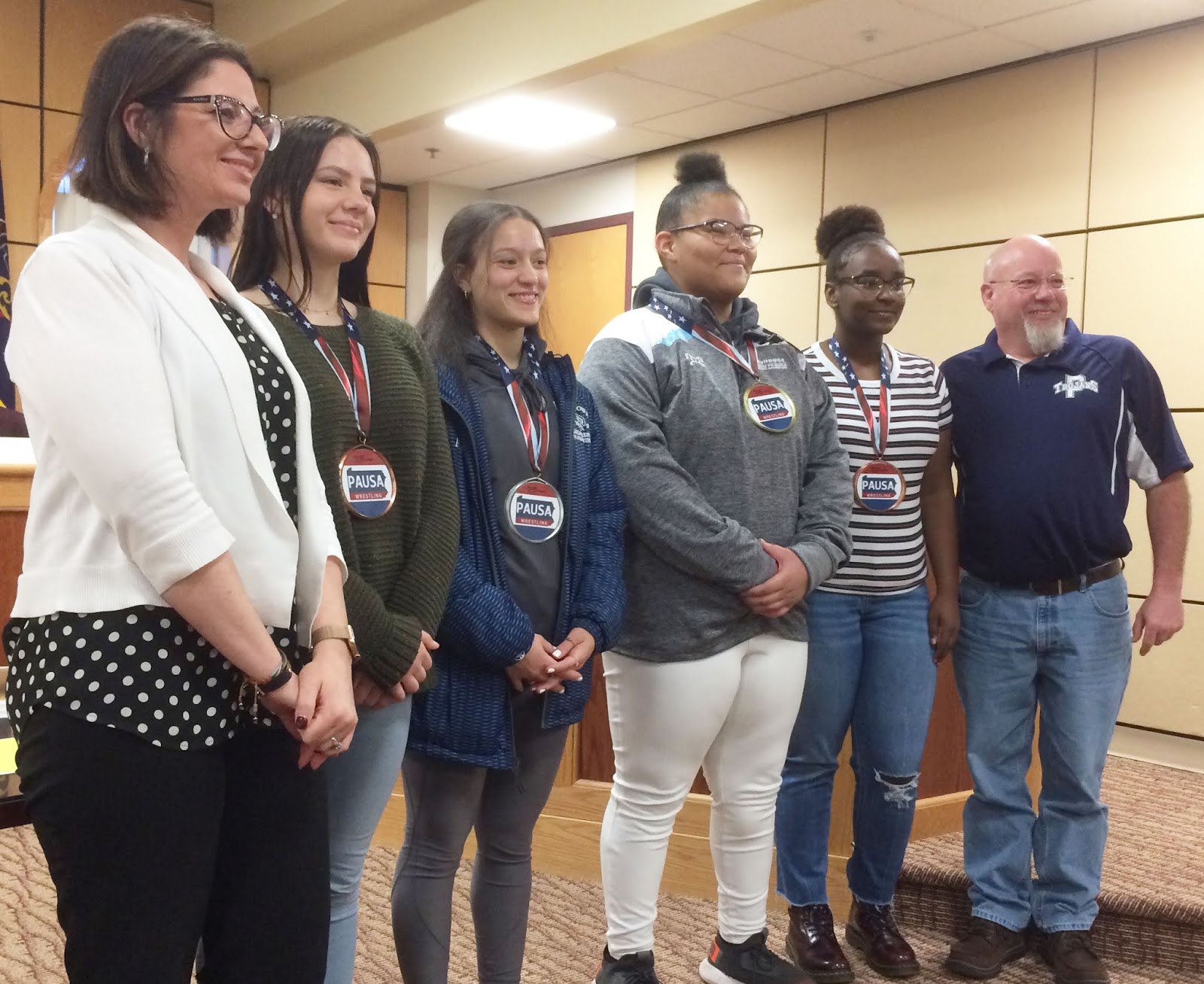
Photo by Evan Brandt

CHAMPIONS ALL: Pottstown Mayor Stephanie Henrick and Councilman Michael Paules took a few minutes Monday night to congratulate four Pottstown High School female wrestlers, all of whom won medals at a regional tournament in Gettysburg over the weekend. Their names are sophomore Mia Bumbarger, junior Julianna Figueroa, freshman Xiyah Robinson and freshman Daishawnia Dean


If you were thinking that a potential 10-year franchise re-up with Comcast would attract a crowd of angry villagers upset about rising fees, then you don't know Pottstown.

Sure, there were a few Facebook bros who talked about what council should do, and how Comcast should face competition, but when it was time for people with something to say to show up and say it when it actually mattered .... no shows.

So without any input from the public, council unanimously adopted the new franchise agreement,
ending the previous 15-year agreement and replacing it with another 10 years.

According to Borough Solicitor Charles D. Garner Jr., who negotiated the contract over the course of the year with Borough Manager Justin Keller, it includes a one-time technology grant of $65,000.

It also maintains two channels for PCTV, channels 22 and 28.

Keller said last week the deal with provide a 5 percent franchise fee to the borough, which works out to about $350,000 to $400,000 a year over the term of the contract.
That's about all there is to it folks.

Council also approved plans for a renovated McDonald's on Shoemake Road, a renovated car wash across the street and a whole bunch of beer gardens in the coming months.

You can read about them here, in the Tweets from the meeting.


Thursday, March 5, 2020

10-Year Comcast Contract Vote Looms Monday

Photos by Evan Brandt
Comcast representative Brian Jeter talks to borough council about how awesome his company is.


If you have something to say about your cable service with Comcast, you had better clear your schedule for Monday night.

That's when a public hearing will be held and it will be your last chance to have your say before council votes on a proposed 10-year-contract with the cable giant.

Before council to smooth things over Monday night was company man Brian Jeter, who talked about
how Comcast is, mentioning the new Xfinity store the company opened in the Upland Square Shopping Center and noting that upgrades are on tap for the building on Shoemaker Road, that houses 80 to 100 employees.

Borough Manager Justin Keller said he is frequently asked why other service providers are not in the borough and he said the contract under consideration does not prevent that. He said other providers like FiOS "aren't interested in coming here."

Keller said the deal with provide a 5 percent franchise fee to the borough, which works out to about $350,000 to $400,000 a year over the term of the contract.

Councilwoman Lisa Vanni provided the only pointed questioning of Jeter, which he deftly demurred.

She complained there are not a lot of options for picking channels or different levels of pricing, but Jeter said there are more options available than there were just one year ago.

Here is video of a relatively brief borough manager's report:


Council also heard from Tricia Reedy Jones, who was in town to talk about the importance of participating in the Census, which will begin arriving in mailboxes starting March 12.

She said Pottstown was totally lame 10 years ago and had two Census tracts that were undercounted by more than 25 percent.

What makes that even more lame is that in both of those Census tracts, children living in poverty surpasses 45 percent, meaning the children most likely to benefit from federal anti-poverty programs were undercounted, thus ensuring those programs are underfunded.

Reedy Jones said there are only nine questions on the Census and it only takes 10 minutes to fill out. Is it really too much to ask people? Come on, get in the game.

And with that, click here to see the Tweets from the meeting.

Thursday, December 5, 2019

Dragon Boat Will Ferry Santa to Pottstown Saturday

Santa will arrive in downtown Pottstown Saturday via dragon boat, crossing the Schuylkill River to land in Riverfront Park, before riding a fire truck downtown for more holiday fun.


There was news a-plenty at last night's Borough Council meeting, which we will get to in tomorrow's post, but first I want to let everyone know how busy Santa Clause will be in Pottstown, particularly on Saturday.

Despite the fact that no one provided any of this information to the newspaper, or me, the economic development report delivered at Wednesday night's council meeting by Peggy Lee-Clark, executive director of PAID, provides the basics.

Christmas magic begins Friday night at The Alley on High Street, which is now decorated as a
"Christmas Village" and from 5 to 11 p.m. Friday, vendors including NV Donuts, will be there along with a Christmas Tree.

"But the real excitement starts on Saturday," Lee-Clark said.

From 10 a.m. to 12 p.m., Santa will be at The Pottstown Integrated Wellness Complex at 724 N. Adams Street, known to most as the YMCA, to visit with children and adults alike.

From 12 to 2 p.m., Beverly's Pastry Shop at 322 High St. will host Christmas cookie decorating.

The big man in the red suit will arrive in downtown Pottstown via, get this, a dragon boat, which will ferry him and his throne across the Schuylkill River to Riverfront Park at 2 p.m.

From there, he will ride a fire truck to The Alley on High Street to hob knob with Pottstown peeps.

From 3 to 6 p.m. is the official "Holiday Stroll" on High Street where shoppers can fill out a "bingo card" with a theme from "A Christmas Story," which, by zero coincidence, is the show that opens at Steel River Playhouse, which opens Friday and runs through Dec. 22.

Bingo cards can be obtained from the Schuylkill River Heritage Area in Riverfront Park, where Santa will stop by after his sojourn across the river, and at The High Street Terminal market, 300 High St.

But make sure you are back at Smith Family Plaza in front of borough hall by 7 because that's when the tree lighting begins.

It is also when the winners of the contest for businesses decorating the planters outside their buildings will be announced by the judge, Mayor Stephanie Henrick.

(Santa will return to Pottstown on Dec. 21, when he will ride a fire truck through town, according to Pottstown Fire Chief Frank Hand.)

And don't forget on Sunday is the Historic Holiday House tour, proceeds from which raise money to pay for July 4, 2020 fireworks at the GoFourth Festival in Memorial Park. Read more about that here.

Here is video of Lee-Clark's report:


And for those of you who can't wait for the hard news out of last night's meeting, here are the Tweets from the meeting.

Monday, December 18, 2017

Limiting Diversity, Ownership Stifles 1st Amendment


As I have at times had to remind a few of The Mercury's Facebook commenters when they cite the "First Amendment" as reason to leave an offensive post on our page -- "Freedom of speech belongs to you. Freedom of the press belongs to those who own the press. Want to say something in a newspaper? Start one yourself."

There is reason to be worried about both freedom of the press and freedom of speech and expression, however, as the headlines stack up with evidence that both are threatened with curtailment.

The first and most obvious to anyone paying attention is the recent decision by the Federal Communications Commission to remove "net neutrality," the rule that ensures all web sites, Twitter, Facebook, Instagram and a zillion other social media accounts be treated equally.

It seems hard to imagine a more American idea than one that ensures all voices are given equal opportunity to say what's on their minds -- and have an equal opportunity to be heard -- no matter how offensive.

But that's never been entirely true.

As noted above, those of us who work in the media have a much better chance of being heard and have since the start of the nation.

With that advantage, our responsibility in the media, and particularly the press -- upheld better by some than others in an exercise inevitably fraught with bias -- is to try to give a broad variety of views equal opportunity to be aired.

The counter-balance to this built-in limitation in the press since the nation's founding has been free speech; that anyone can stand in the middle of the town square and state their piece with people given the choice to ignore it or to listen, or even to argue -- which is of course closely related to the right to assemble for this purpose.

In the last 15 years, that function has been carried forward onto the Internet with spectacular and sometimes incendiary results.

Want information on Basque separatists? They have a web site.

Curious about Islam? No shortage there.

Climate change? Ocean dumping? Hillary's emails?

Yup, yup and yup.

At a time when the President takes to Twitter to "get around the filter" of the media and speak directly to the people, his administration will preside over the greatest potential restriction of that opportunity since the Internet was invented.

While something tells me Donald Trump's Twitter feed is unlikely to be restricted, how long before Twitter decides to create "Twitter Prime," which gives faster speeds and greater visibility to those willing to pay for it?

Facebook already allows you to "sponsor" posts, to pay to have them put in front of more people, and the absence of net neutrality may make such schemes an everyday occurrence.

And beyond the operators of the platforms, consider the ISPs, or Internet Service Providers. Once a broad variety of tech start-ups, it has since narrowed down to be essentially the same utilities which built the infrastructure, Comcast, AT & T and the like.

All promises to the contrary, those providers will now perform the function they are designed to perform -- make money.

So unlike the gas company, or the water company or PECO, these corporate giants (which are about to get a huge tax cut by the way) will in many communities -- like here in Pottstown -- enjoy a monopoly on a utility that allows those willing to pay more, to get better service.

Imagine the outcry (if there was anyone left to report it) if the water company provided cleaner water to those who paid higher rates.

Yes, you pay more to your cable company to get more channels, but is that the model we want for the Internet? Does anyone really like the way cable TV operates?

"The FCC is doing away with rules barring internet providers from blocking or slowing down access to online content. The FCC would also eliminate a rule barring providers from prioritizing their own content," CNN reported.

If only those who can pay for a podium and loudspeaker can have access to the town square, the number of views or information the public will be exposed to will be limited to those who can afford the price of presenting it.

Net neutrality's demise will mean -- as with so many other things in America --
that those with more money will have an advantage -- to make even more money.

As Michael Cheah, general counsel at video site Vimeo,  told CNNMoney: the point of the net neutrality rules is "allowing consumers to pick the winners and losers and not [having] the cable companies make those decisions for them."

There was a time when a quote like that would have been spoken by a Republican, back when the GOP championed the "free market" as a solution to many problems. Their suggestions was usually calling for the removal of government regulations to unleash the power of the market.

This is one of those rare instances when removing a regulation stands to restrict the market to a few monied players -- something else which Republicans increasingly seem to favor ever since Citizens United unleashed the lobbyists to funnel obscene amounts of money into campaign coffers.

Which brings us to the second, somewhat less reported threat to the First Amendment -- media consolidation.

It was rightly seen as big news last week when it was announced that the omnivorous Walt Disney Company is consuming the larger part of 21st Century Fox for $52.4 billion.

"Disney has already announced an ambitious plan to introduce two streaming services by 2019. With this deal and the wealth of movies, TV shows and sports programming it provides, the company will now have the muscle to challenge Netflix, Apple, Amazon, Google and Facebook in the fast-growing realm of online video," the New York Times reported.

Consider that in addition to its own treacly empire of theme parks, princesses and dancing candlesticks, Disney owns both Marvel and the Star Wars movie empires (pun intended), as well as the ABC network and ESPN. 
Now it will introduce its own streaming services and everyone who thinks Disney will have enough money to pay to ensure its content gets priority online raise their hand.

This comes hand-in-hand with last month's decision, again by our freedom-loving friends at the FCC, to remove restrictions on ownership of broadcast television and other media companies, "potentially leading to more newspapers, radio stations and television broadcasters being owned by a handful of companies," as the Washington Post reported.

Initiated in the 1970s "to ensure that a diversity of voices and opinions could be heard on the air or in print," FCC Chairman Ajit Pai said "small outlets are struggling to survive in a vastly different media world" and the rule is no longer needed, the Post wrote.

According to Pai, the rise of blogs, websites and podcasts mean "traditional media outlets now face more competition than ever — and rules that once enforced a diversity of viewpoints are no longer needed," wrote the Post which, in case you didn't know, itself now has the same owner as Amazon, Jeff Bezos.

“As a result of this decision, wherever you live, the FCC is giving the green light for a single company to own the newspaper and multiple television and radio stations in your community. I am hard pressed to see any commitment to diversity, localism, or competition in that result,” said FCC Commissioner Jessica Rosenworcel, a Democrat who voted against lifting the rule.

("A major beneficiary of the deregulatory moves, analysts say, is Sinclair, a conservative broadcasting company that is seeking to buy up Tribune Media for $3.9 billion," according to the Post. I'm sure that is complete coincidence.)

So, to sum up, blogs, websites and podcasts are competing with traditional media (true), so the FCC is letting single (well-monied) entities buy up all the traditional media in a given market so they survive, but at the cost of limited diversity of views and content.

And at the same time, it is allowing media consolidation, the FCC is throwing net neutrality out the window so that "competition" against traditional media will now be limited among those with enough money to pay to be in the ring to compete and to get an unfair advantage over the guy blogging from his mother's basement. 

In other words, big media can now consolidate and prioritize what it wants you to see on the Internet.

Frankly, let's call it what it is -- it's un-American and it is a direct threat to the First Amendment.

Teddy Roosevelt, a Republican who recognized the danger of the consolidation
of economic power and the value of "a square deal," would have railed against this as fervently as he did over the railroad, coal and timber trusts of his era.

"Yet more and more it is evident that the state, and if necessary the nation, has got to possess the right of supervision and control as regards the great corporations which are its creatures; particularly as regards the great business combinations which derive a portion of their importance from the existence of some monopolistic tendency," Roosevelt wrote and it is as true now as it was then.

With fewer companies making content, and Internet providers willing to take payments to ensure well-heeled content is seen first, while content from those with shallower pockets remains unseen, it creates yet another uneven field on which smaller competitors are at a disadvantage.

Consider the change that means.

How many times has a video shot by someone you've never heard of before gone viral on the Internet? And I don't mean cat videos.

Consider how that has given birth to everything from the exposure of police violence against African-Americans, to James O'Keefe's "Project Veritas" and the video that took down ACORN. 

Well, if you can attract investment (maybe even tax-free political donations?) from big money, your content might get seen on the Internet. If not ... well, looks like you're out of the competition. Truthfully, without money, you could never even be in it.

That is not supposed to be how a democracy works, or how America works.
None of which even considers the enhanced (and terrifying) opportunities fewer hands with more and more control over content and discourse provides for censorship, an invisible injury to freedom of thought because you don't miss what you never knew existed.

After all, if a corporate giant can prioritize what you see, what prevents them from ensuring you don't see it at all?

I mean, consider that I just called for more regulation of Comcast. Under the new system, you might never even have ....... 
Sunday, May 13, 2012

The Matrix Pre-Visited (Or Technological Me)


"Wasn't technology supposed to make our lives easier?"
my mother asked me as I ranted.
Like any self-respecting nerd, I read a lot of science fiction when I was a young man (and still do when I can).

In retrospect, I suppose I liked it because it provided a framework within which you could ask “what if?”

Because it required the suspension of disbelief, it allowed for all kinds of explorations, and not just technological ones.

It also encouraged the reader to think about the future, about the future consequences of present day actions, trends and decisions.

I’ve been thinking a lot about the future this week, particularly as it was smacking me over the head all weekend.


What brought this all about was a final break with the past, and by that I mean our old DSL connection to the Internet. Yes, we were the turtle-like “Slowskis” portrayed in Comcast Xfinity commercials, trying to convince ourselves, and anyone gullible enough to listen, that we didn’t mind slow loading of our web pages.

But it got so bad that I did not even dare to try to open some sites (The Mercury in particular) unless I had a cake to bake or an opera to write while I waited.

Further, Karen, the in-house bargain-hunter, finally figured out that getting Xfinity for cable, phone AND Internet would actually save us money.

Needless to say, my 13-year-old was overjoyed that the Xbox-360 he purchased with his own money could finally be connected to the Internet so he could join his friends’ zombie-slaying adventures.

But while the phone works fine, and the lap top gets a burly signal from the wireless router, the Xbox, which sees and attaches to our cozy little home network, refuses to get on the Internet.

So when I tell you we spent HOURS trying to solve this problem, please believe me when I tell you it was more than 10, resulting in what my son would call “an epic fail” – this despite an heroic effort (and by “heroic” I mean an unbelievably patient and logical effort) by our friend Matthew who lent his considerable expertise to the enterprise.

What was that button you pushed?!
(In case you haven't guessed, this is the part where you are to imagine repeated "smacking" of my head by technology as we explored DNS address differences, WPA, MASKS and, I'm pretty sure, old USSR launch codes.)

From a consumer point of view, this is obviously a problem because we are supposed to be able to use the system this way and we are paying for the ability to do so.

But since my skills as a technologist rarely rise above plugging in the wires to the right place; and since our consumer culture's lure is tepid to the guy who has to pay for it, in comparison to a 13-year-old who doesn't, our zeal for the necessity for this hook-up sent my mind in a different direction – one which asked why we considered it so goddamned important.

As luck, serendipity or the harmonic convergence would have it, discussions and examples of the technological advances which have marked my lifetime to date abounded last weekend.

On WHYY, Radiolab was talking about “Cleverbot,”(click here to hear the podcast), a program designed to learn to talk to us by, well talking to us.

(My son tells me he talks to Cleverbot "all the time" at school because it is not blocked by the school district's filters.)

But the examination spawned a conversation on the program about whether this kind of interchange represents "thinking," a thought which one is tempted to discard as absurd until you hear the part about the computer "therapist."

Then there was the next segment about "Furbies."
A seemingly aloof Furbie being interviewed by Tim Howard.

Do you remember them? Essentially they were furry heads with emotive ears that make cooing sounds and ultimately learn to talk (from us?!?).

The programmer, a former mime and actor, used what he had learned about non-verbal communication to have the furry little bastards evoke an emotional response from us, despite the fact that we know logically they are machines and not alive ... at least as we currently define "alive."

One contributor found that when she held her Furbie upside down, it told her it was scared, which, again, evoked an emotional response and she found she could not stand to keep it there as it became increasingly upset.

Ken was not part of the Radiolab experiment
The Radiolab folks conducted a diabolical experiment in which 9-year-old girls were asked to hold a live gerbil upside down (they lasted about 10 seconds); a Barbie (they lasted until their arms gave out) and a Furbie (they lasted not much longer than the gerbil).

The resulting conclusion -- that those old enough to articulate their reactions but not so old as to use society's conventions to rationalize them away are swayed to an emotional reaction by mere mechanical manipulation -- is fairly conclusive as these things go ... and a little scary.

It's not exactly "The Matrix," but in many ways, it's not that far off either.

Meet Bina 48, the existential robot
Then they aired the portion of the program about journalist Jon Ronson who was assigned to interview a robot named Bina 48 who was capable, to some extent, of fairly complex interaction, including a story about her family and her black sheep of a brother.

Her responses were awkward, but her creator insisted he was already making a new and improved model.

As a reader of science fiction I, of course, read Isaac Asimov's "I Robot," which always seemed less of a story with a plot to me as a warning that if we're going to invent things like this, we should give some thought to making sure some basic protections are in place.

For the uninitiated, the key feature of Asimov's story, given a new twist in the Will Smith blockbuster, is the Three Laws of Robotics:

  1. A robot may not injure a human being or, through inaction, allow a human being to come to harm.
  2. A robot must obey the orders given to it by human beings, except where such orders would conflict with the First Law.
  3. A robot must protect its own existence as long as such protection does not conflict with the First or Second Laws.

So while I'm pretty sure that Xbox or Xfinity or Comcast were not in danger of violating any of the three laws, I was pretty sure by the end of last weekend that I might injure one or all of them.

But all joking aside, this is hardly the point.

My job has made me participate in the technological revolution in ways I probably would never have embraced left to my own devices (pun intended).

And while I have experienced many advantages, more efficient and effective reporting; a wider audience for my work; re-connections with friends from high school; and I would not trade the nearly daily contact with my father for all the Luddites in Manchester -- I'm still not comfortable with it all. 
Perhaps I never will be.

A friend, getting a guided tour of social media sites almost as new to me as to him, was astounded at what information people will share.

"The Architect," right, who built "The Matrix" that holds humanity
captive in a world that exists in their mind, explains to "Neo," left,
that the idea that he is a "savior" is just another way to control those
who can't accept the world he has created for them in The Matrix.
And I thought about another friend I have been watching who is posting photos of his entire life on Facebook's "Timeline" and thought to myself: "Why would anyone do that, show the world (or at least a larger portion than was previously possible) so much about your private life?"

It's a rhetorical question of course.

People have always been willing to share, provided they feel they're in control of the sharing.

And perhaps that's the real illusion social media gives us with the flashy screens and vague promises about "never sharing your private information."

But I wonder if that "control" is another illusion.

Remember, the prophecy of "The One" in "The Matrix" all turned out to be just another method of control.

Perhaps we're living there already.