Showing posts with label Berks County. Show all posts

Friday, June 8, 2018

Landfill Expansion Hearing Draws Berks Co. Crowd

Photos by Evan Brandt
A near-capacity crowd showed up at Earl Elementary School Thursday for the public hearing on the proposed expansion of the Rolling Hills Landfill.


Of the 18 people who spoke at Thursday night's public hearing on the proposed vertical expansion of the Rolling Hills Landfill in Earl Township, only five spoke either in favor of the proposal, or defended the landfill's operations.

Most who spoke talked about the negative impact years of heavy truck traffic have had on downtown Boyertown's historic buildings, and its current efforts to revitalize the downtown by emphasizing its historic aspects and its walkability.

Berks County Commissioner Mark Scott came out swinging, arguing that
Mark Scott
because the commissioners had not consented to the to the expansion, the Pennsylvania Department of Environmental Protection's consideration of the expansion is "illegal."

He told DEP officials, "I suggest you reject the plan until such time as consent is obtained from the Berks County Commissioners," adding with a look at the audience, "don't hold your breath."

He said the "hams/benefits" analysis by Delaware County Solid Waste Authority, which owns and operates the landfill is a "status quo" analysis which assumes nothing has changed since its last expansion "but that's false. The Boyertown community is far more vibrant than the last time harms and benefits were evaluated."

He notes that the analysis by the authority only looks at Earl Township. "Nothing is said about Boyertown and its long trevails with excess traffic. Nothing," said Scott. "It also fails to mention traffic impacts on Gilbertsville, Colebrookdale or Boyertown along Route 73."

He noted that the Rolling Hills Landfill does not pay property taxes, wile the privately owned Conestoga Landfill, which is about the same size, "pays about $250,000 to the Twin Valley School District, the county and the township."

He said the $60 million Earl has collected in tipping fees -- which makes township property taxes unnecessary -- "is supposed to be a public benefit. I ask you, how does stuffing more cash into Earl Township's bloated mattress benefit the impacted area?"

Adrienne Blank
Adrienne Blank, executive director of Building a Better Boyertown, said the
group received a $1 million grant in December to drive revitalization efforts based on historic tourism and a walkable downtown, and what former BBB President Jake Lea referred to as "the endless caravan of trucks" down East Philadelphia Avenue threatens that effort.

John Sartor, an engineer with Gilmore Associates, said a study by his firm also found that the vibrations from trucks can damage "fragile historic structures."

That study, and one by ClimeCo, was paid for by Building a Better Boyertown. Zachary Palm, from ClimeCo, said his firm's environmental study showed air quality in downtown Boyertown is harmed by the particulate matter the ash that escapes from the trucks on their way to the landfill.

Crystal Seitz, executive director of Pennsylvania's Americana Region, said feeling safe while walking through downtown Boyertown, being able to have outdoor dining, are crucial to Boyertown's revitalization effort.

Patricia Loder
She said $857 million is spent every year by tourists in Berks County and most of that happens in downtowns, the soot, noise and danger from the trucks impedes that revitalization, she said.

Boyertown Borough Manager Patricia Loder said a recent analysis found that 30 percent of the truck traffic through Boyertown is connected to the landfill.

She said if the trucks cannot be re-routed, and an option of shipping the ash by rail won't work, the borough would request a "traffic mitigation fee" based on the tons of ash hauled through the borough.

That money could pay for new traffic signals and a new parking garage to make up for parking lost should parking on East Philadelphia Avenue be reduced to one side to accommodate the trucks.

Most said the preferred solution was to re-route the trucks from downtown Boyertown.

Joe Paschall
Even several of those who supported the project, said they were not opposed to the suggestion made by many that the option of transporting the incinerator ash from Delaware County to the landfill via rail be more fully explored.

Joe Paschall, who said the landfill provides many benefits, including jobs and $60 million in tipping fees to Earl Township -- and who said "you can't blame the landfill for all the truck traffic through Boyertown" -- said he likes the idea of transporting the remains of the waste burned in Delaware County's Chester incinerator by rail.

And Nathaniel Guest, the executive director of the Colebrookdale Railroad Preservation Trust, said a recent study showed the rail option is viable, although it would take investment in a new transfer station, for trucks to take the ash for the final few miles to the landfill, as well as a shoring up of some of its bridges to carry the weight.
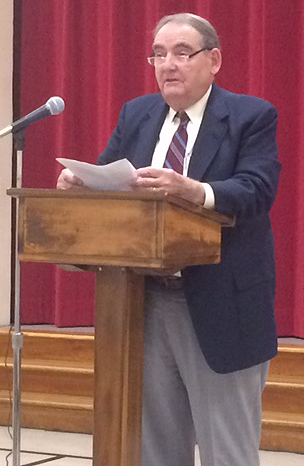
Joseph Vasturia

Joseph Vasturia, CEO of the Delware County Solid Waste Authority, said he has
been with the organization since the 1980s and that the route the trucks take to the landfill is dictated by the DEP permit.

In the last year, the landfill has contributed more than $4.5 million to the county, the state and Earl Township.

Under the expansion request, the average daily tonnage will remain at 3,200 tons and the height of the landfill will not exceed 884 feet.

But it's already too high, said Oley Township Supervisor James Coker. All of Oley township is designated an historic place, and it has had to endure the landfill's assault on its aesthetics "with no benefit whatsoever" to his township.

The hearing broke up after 90 minutes and the comments made, as well as those submitted to DEP by Friday, June 15, will be part of the record and be considered in DEP's decision.

Here are the Tweets from the hearing.

Wednesday, November 9, 2016

Is Acrimony the Cure to Voter Apathy?

Photos by Evan Brandt

An overwhelming voter turnout at two New Hanover polling places Tuesday can be partly attributed to the growth of housing in the township.


The lines at New Hanover Lutheran Church were unbelievable, and due in part to a lot of population growth in the township in recent years.

But how do you explain Upper Pottsgrove, where a massive turn-out of more than 80 percent
The line of Upper Pottsgrove voters at Pottsgrove Middle School

Snaked down to the end of the hall all the way to the front door.
occurred at the township's single polling place?

There has been no concurrent increase in this township's population. Lines were also more than an hour at Berean Bible Church in Lower Pottsgrove, due in part to reported problems with a voting machine.

But again, although large developments are pending there, there has been no surge in population in Lower Pottsgrove, or in Union, or in Amity.

So we're left to ask why was turn-out so huge?

Some might say voter anger and they would not be wrong I think.

Although they differed in almost every other way, those who voted for Bernie Sanders on the Democratic side, and those who voted for Donald Trump on the other, shared one common attribute -- they were angry at the status quo.
Maybe its time to heed the advice of Scott Major, pastor of

First Church of the Brethren in Pottstown, also a polling place.

In the Republican primary, the candidate of anger won the nomination, but not in the Democratic primary.

And so the candidate who wanted to up end the status quo faced off against the champion of the status quo, Hillary Clinton.

It meant for lots of sparks, lots of accusations of dirty tricks, lots of friction among neighbors and family.

Are we to conclude that this was what was needed to drive people to the polls?

Most of the voters I spoke with in my round of 10 polling stations on election day, did not seem particularly angry, although the ones who were definitely supported Trump.

Anger as antidote to voter apathy seems a dangerous path for a nation to follow, because to maintain it, the people have to be kept angry.

Saturday, August 4, 2012

First in Berks

These fields in Robeson were destined for high-density housing until they were preserved by the Natural Lands Trust as part of the newly former Green Hills Preserve.
 Nearly 170 acres of verdant land in Robeson Township, Berks County, has been saved from the high-density development first proposed there, by the very people who hoped to profit from its development.

Further, the property, now known as Green Hills Preserve, provides crucial habitat for wildlife including the bog turtles a species considered to be critically endangered, the highest risk category assigned for wild species.
The bog turtle is a very small, very endangered species.

The discovery of the turtles reduced the acreage available for development, Robeson Township Manager Thomas Keim told The Reading Eagle.

In an announcement made last week on its web site, the Natural Lands Trust made known that it had acquired its first preserve in Berks County.

The property features gently rolling agricultural fields, woodlands, and wetlands. Allegheny Creek, a PA Department of Environmental Protection-designated “Cold Water Fishery” stream, bisects the newly established preserve.

Now called the "Green Hills Preserve," the 168-acre parcel, between Morgantown and Gunhart roads, had been approved for "high-density development" of 670 homes called Villages of Green Hills.

But in 2009, as you may recall, the housing market was not so hot and the developer went bankrupt.

That's when Ed Ritti, Vice President and Associate Broker of Prudential Fox & Roach’s Land Development Division, had an idea for a different kind of buyer.

“Thanks to Ed Ritti’s out-of-the-box thinking and the support of many funders and partners, this beautiful property will be protected forever,” said Molly Morrison, president of Natural Lands Trust. “We are thrilled to now have a presence in Berks County and to add Green Hills to our network of 41 nature preserves.”

After more than two years working to piece together critical funding, Natural Lands Trust was able to purchase the property from the lender

Funders and partners for this project include Berks County Conservancy, National Fish and Wildlife Foundation, Open Space Institute, the Pennsylvania Department of Conservation and Natural Resources, Pottstown-based Schuylkill River National and State Heritage Area, Southern Berks Land Company, Susquehanna Bank, US Fish and Wildlife Service, Virginia Cretella Mars Foundation, and the Wyomissing Foundation.

Green Hills Preserve is situated within the Schuylkill Highlands, a region at the nexus of two landscapes that have been prioritized for protection: the Highlands (as defined by the US Congress) and the Schuylkill River watershed (a focus of much planning work by the Pennsylvania Department of Conservation and Natural Resources, the Pennsylvania Department of Environmental Protection, and the Philadelphia Water Department).

The area’s importance derives from the need for water quality protection, habitat conservation, and recreational development in a region set for considerable growth over the next 20 years.

Like many of Natural Lands Trust’s other nature preserves throughout the region, Green Hills Preserve eventually will be open—free-of-charge—to visitors for passive recreation once a hiking trail system has been established and a parking area is built. Funds to construct those amenities—as well as ongoing habitat restoration and stewardship work—still need to be raised.

Since its founding in 1953, Natural Lands Trust has protected more than 100,000 acres of land, including 41 nature preserves that it owns and manages in 13 counties. It recently joined forces with Montgomery County Lands Trust and about five of its preserves are located within Montgomery County.

Nearly all of them are in the greater Delaware Valley.

So it seems that although the collapse of the housing market has had an undeniably negative effect on the country and the economy, some silver linings can be found.